Villa owner statement and management fee: a vacation rental guide
What a monthly owner statement must show, how management fee models compare, payout timing by channel, and how to stop disputes, with one worked villa month.
 Tai Pham
If you manage villas or apartments for owners, the monthly owner statement is the document that keeps the relationship working. A good vacation rental owner statement answers the owner's questions before they ask: what the property earned, what the channels kept, what was spent and why, what your management fee was, and when the money arrives.
A weak statement does the opposite. The owner sees a payout that doesn't match the nightly rates they remember from Airbnb, a cleaning line with no detail, and a fee calculated on a number they never agreed to. Then the calls start.
This guide covers what an owner statement must show, the common ways to structure a management fee, how to handle expenses and payout timing, and how to prevent disputes. It uses one hypothetical villa all the way through. There are no "typical" fee percentages here, because there is no published standard. What is fair depends on what you do for the owner, and that belongs in your agreement.
What a vacation rental owner statement must show
An owner statement is one page per property per period, usually a month. Whatever template you use, these lines should always be there, in this order:
| Line | What goes in it | Where the number comes from |
| Period and property | Month, property name, which stays are counted | Your agreement (by checkout or by night) |
| Gross booking revenue | What guests paid for the stays, split by channel | Platform reports, direct booking records |
| Channel fees | What each platform kept: host fees, commission, payment charges | Platform earnings exports and invoices |
| Expenses | Cleaning, laundry, repairs, utilities, supplies, each with a receipt | Your expense log |
| Owner net before fee | Gross minus channel fees minus expenses | Calculated |
| Management fee | Your fee, with the formula written out | Your agreement |
| Amount payable to owner | What you will transfer, and when | Calculated |
| Notes | Owner stays, blocked nights, refunds, anything unusual | You |
Two rules make this work. First, every number must be traceable to a source document. Second, the method must not change from month to month. If you count stays by checkout date in March, you count them by checkout date in April.
Which month does a stay belong to?
A stay from 29 March to 3 April crosses two months. You have two honest options: put the whole stay in the month it checks out, or split it night by night. Checkout is simpler, and it matches how platforms bill. Booking.com's own commission guide says commission invoices cover reservations where the guest checked out in the previous month. Its example: a guest who arrives on 31 January and checks out on 1 February appears on the March invoice.
Whichever you choose, write it in the agreement and print it on the statement. Most "missing booking" complaints are really a stay that landed in the next month.
Channel fees: show them, don't hide them
Owners often compare the statement with the price they see on the listing. The gap is channel fees, so show them per channel.
- Airbnb. Airbnb's Download your earnings export includes host service fees, cleaning fees, gross earnings and any taxes withheld per earning. Use it as the source for your Airbnb lines.
- Booking.com. Commission is a set percentage of the total booking amount, including cleaning fees and charged cancellations, applied once the guest checks out. The exact percentage depends on country, property type and your agreement, and it can be higher if you join programmes such as Preferred Partner. The monthly reservation statement lists every reservation on the invoice, so use it to check each stay.
- Direct bookings. No channel fee, but card or bank charges may apply. Show them on their own line.
If the owner wants to understand why one channel costs more, our Airbnb vs Booking.com fees guide and the free OTA fee calculator explain it better than a long email.
Management fee structures
There is no single correct model. Each one shifts risk between you and the owner in a different way. Describe the model in plain words in the agreement, with one worked example.
| Model | How it is calculated | Who carries the risk | Watch out for |
| Percentage of gross | A percentage of gross booking revenue | Owner carries all costs | Define "gross": with or without cleaning fees and taxes |
| Percentage of net | A percentage of revenue after channel fees, or after channel fees and expenses | Shared: high costs lower your fee too | Define exactly which costs are deducted first |
| Fixed monthly fee | A set amount per month | You carry the vacancy risk | Review it when the property's earnings change |
| Fixed plus percentage | A small fixed fee plus a percentage | Shared | Two formulas, so show both on the statement |
Percentage of gross is the easiest to calculate and check. Percentage of net aligns your incentive with the owner's, because you earn more when you control costs, but it needs the clearest definition of "net". A fixed fee suits owners who want predictability, and it protects them in a bad month at your expense.
Separate questions to settle in writing: does the fee apply to cleaning fees charged to guests? To upsells such as late checkout? To owner stays (normally not, because there is no revenue)? And is cleaning a pass-through cost or included in your fee?
A worked example
Say you manage one three-bedroom villa in Canggu. Every number below is hypothetical, and the fee percentages are picked only to show the arithmetic. They are not market rates.
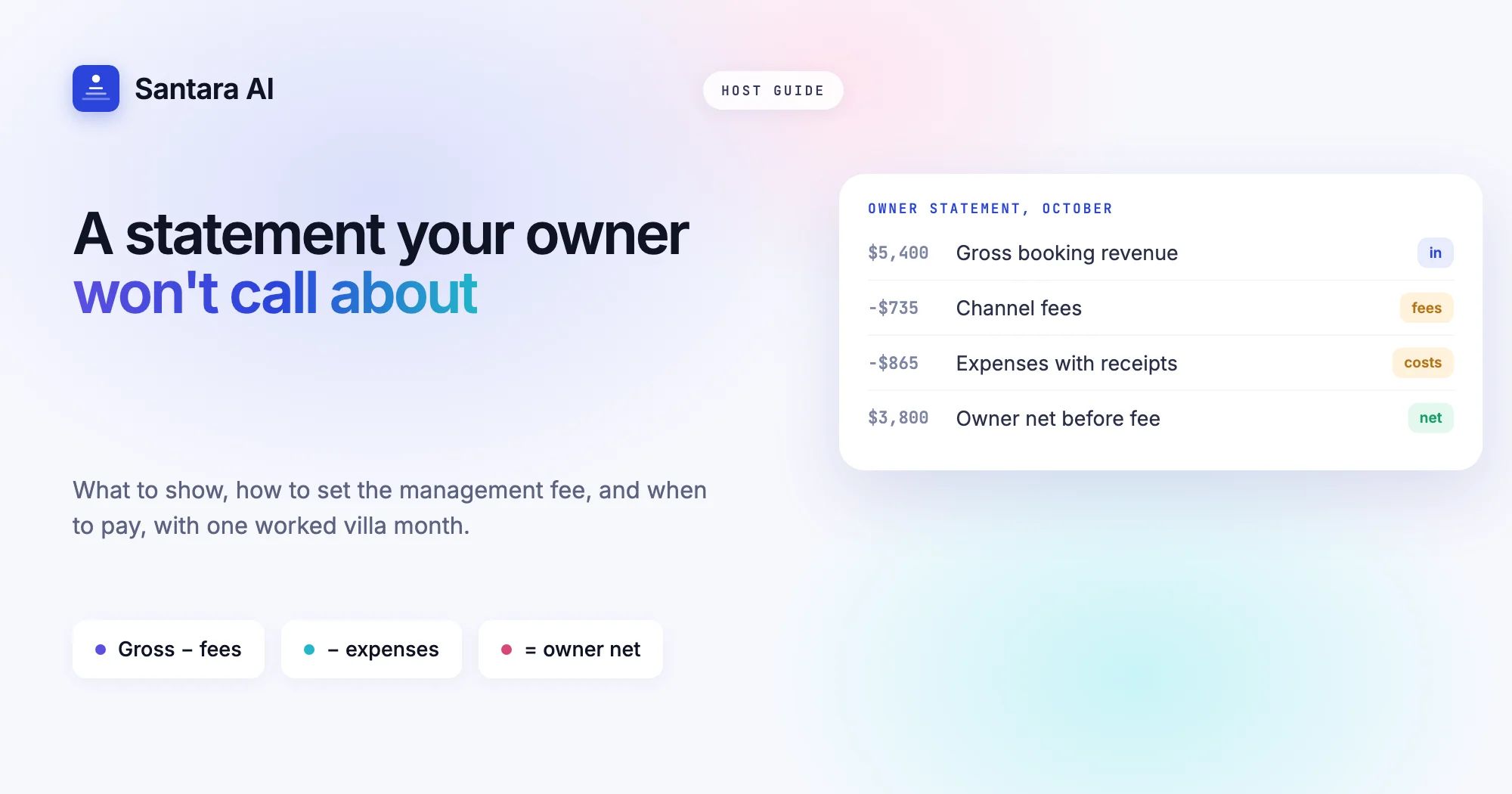
In October, nine stays checked out. Guests paid $5,400 in total: $3,000 through Airbnb, $1,800 through Booking.com and $600 direct. The earnings export and reservation statement show channel fees of $465 on Airbnb and $270 on Booking.com, so $735 in total. Expenses with receipts came to $865: cleaning $360, laundry $90, pool and garden $120, a shower mixer repair $85 and electricity and water $210.
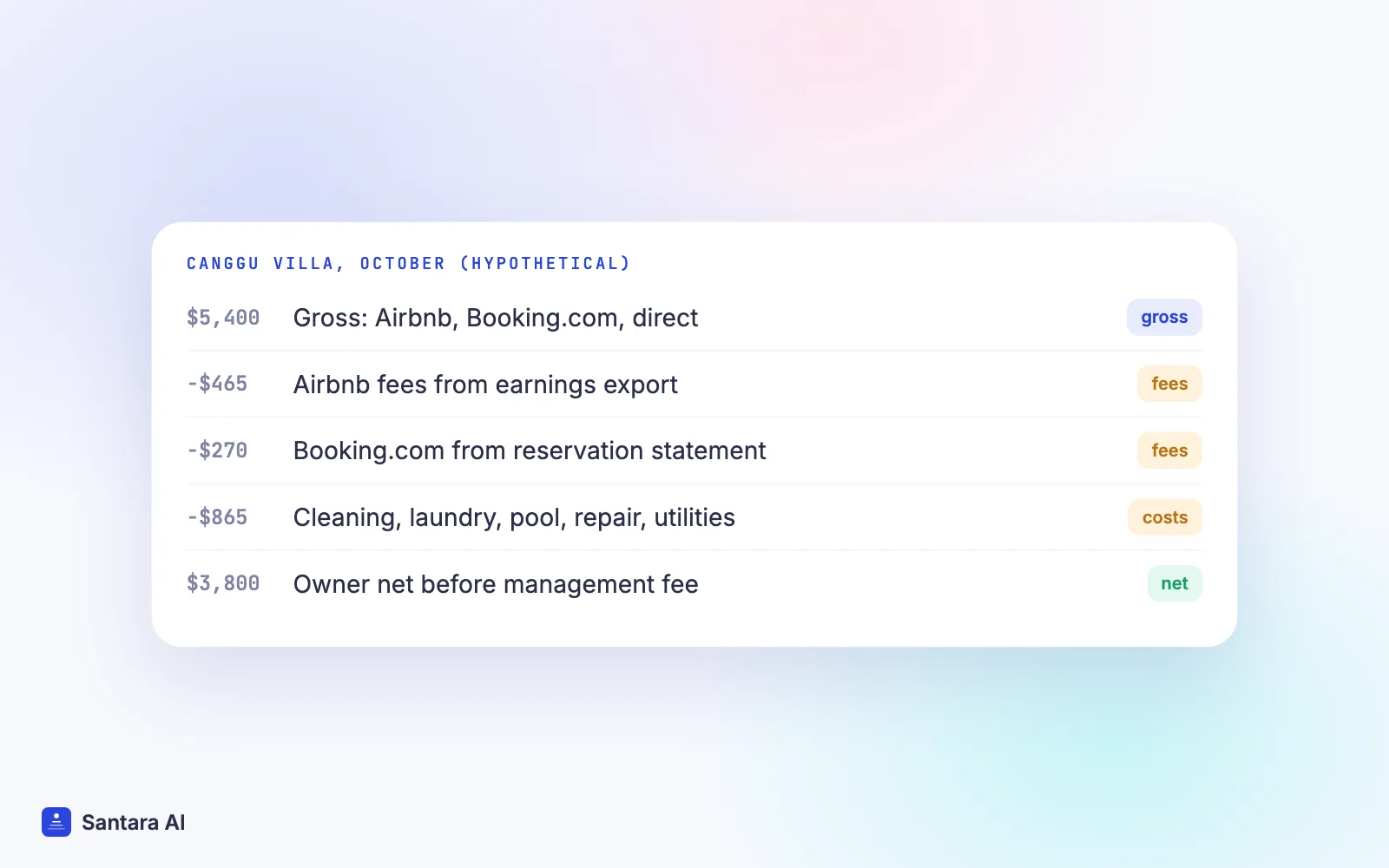
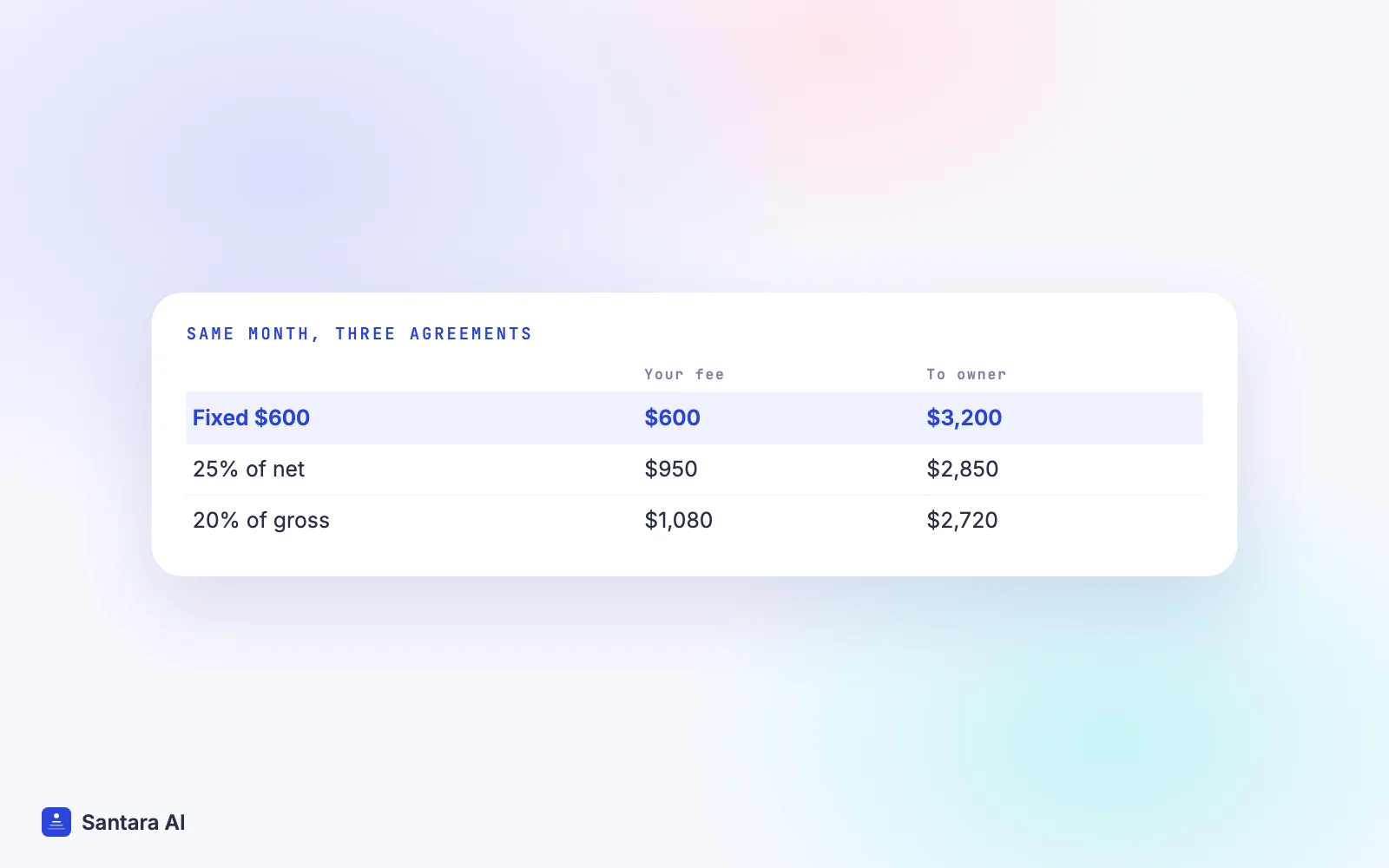
Owner net before your fee is $5,400 − $735 − $865 = $3,800. Now the fee, under three different agreements:
| Agreement | Fee calculation | Your fee | Paid to owner |
| 20% of gross | 20% × $5,400 | $1,080 | $2,720 |
| 25% of net after fees and expenses | 25% × $3,800 | $950 | $2,850 |
| Fixed $600 per month | Flat | $600 | $3,200 |
The same month gives three different payouts. That is why the fee line must show its formula, not just a figure. "Management fee: $950" invites a question. "Management fee: 25% × $3,800 owner net = $950" answers it.
Payout timing
Your payout to the owner can only follow the money you actually receive, and each channel pays on its own schedule.
Airbnb's payout timing page says that for most home stays of 27 nights or less, it initiates the payout by the end of the business day after the guest's scheduled check-in date. Your bank or payout method then adds its own processing time. For stays of 28 nights or more, the first month is paid after check-in and the rest monthly. In some cases, such as a new host's first reservations, Airbnb releases the payout after checkout instead.
So a statement by checkout month and the cash in your account will not line up perfectly. Agree a fixed owner payout date that leaves time to reconcile, for example a set day early in the following month, and say what happens to a stay whose money hasn't arrived yet.
Step 1
Close the month
After the last checkout of the month, lock the list of stays you will count.
Step 2
Export from every channel
Download the Airbnb earnings export and the Booking.com reservation statement, plus your direct booking records.
Step 3
Match stays to money
Check each stay's gross and fee against the export. Booking.com asks you to mark no-shows and changes within 48 hours of checkout so the invoice is right, so do that during the month, not at the end.
Step 4
Attach receipts and notes
Every expense line gets a receipt or photo. Note owner stays, blocked nights and refunds.
Step 5
Send the statement, then pay
Send the statement a few days before the payout date so the owner can ask questions first.
How to prevent disputes
Most disputes come from four places, and each has a simple fix.
- Expenses the owner didn't expect. Agree a spending limit in writing. Repairs under it you just do and report; repairs above it need the owner's approval first, by message, so there is a record.
- Revenue that looks low. Show nights sold and blocked nights. An owner stay or a week closed for maintenance explains a quiet month. Our occupancy, ADR and RevPAR guide shows why owner stays should not count as bookings.
- Mixed currencies. If Airbnb pays in USD and your costs are in rupiah, don't convert them silently with a rate you picked. Show each currency separately, or state the rate and its source.
- Refunds and cancellations. A cancelled stay with a charge brings in money without a guest. A refund paid after the statement must appear as a correction in the next one, never as a quiet edit.
How Santara AI handles owner statements
Santara AI has a Reports screen that produces one monthly statement per property. It shows gross booking revenue, minus channel fees, minus expenses, which gives the owner net. You add expenses against the property and month, and you can download the statement as a CSV.
A stay counts in the month it checks out, which matches the Booking.com invoicing logic above. Currencies are never converted: if a property earns in two currencies, each is stated separately. Because bookings from every connected channel land on the same calendar, the statement starts from one list of stays instead of three exports.
What the Reports screen does not do
Santara AI does not calculate your management fee. The statement stops at owner net, and you apply your agreed fee yourself, using the formula in your management agreement. It also does not file taxes or pay owners for you.
FAQ
What should an owner statement include for a vacation rental?
The period and property, gross booking revenue by channel, channel fees, each expense with a receipt, owner net, your management fee with its formula, the amount payable and the payout date. Add notes for owner stays, blocked nights and refunds.
Is a management fee charged on gross or net revenue?
Either, depending on your agreement. Percentage of gross is simpler to check. Percentage of net shares cost risk with you. Fixed fees put the vacancy risk on you. Whatever you pick, define the base exactly and show the formula on every statement.
When should I pay the owner each month?
On a fixed date agreed in writing, after you have reconciled the month against each channel's report. Channels pay on different schedules, so leave enough time for the money to arrive.
Should cleaning fees charged to guests count as revenue?
Show them in gross revenue, because guests paid them and Booking.com includes them when it calculates commission. Then show the actual cleaning cost as an expense. Whether your fee applies to them is a question for your agreement.
Keep reading
Your first 3 months are free.
Join For Free