Low season vacation rental playbook for Southeast Asia hosts
Which months are really wet in each part of Vietnam, what's known about Bali, and four levers for quiet months: monthly stays, local guests, minimum stays, maintenance.
 Tai Pham
Every host in Southeast Asia knows the feeling. The calendar that was full three months ago now has gaps on weekdays, then on weekends too. Low season for a vacation rental is not a disaster, but it does need a different plan from peak season, and most hosts simply leave their peak settings running and hope.
This low season vacation rental playbook covers what to change and when: which months are actually wet in each part of Vietnam (from the national tourism authority, not guesswork), what we can and can't say about Bali, and the levers that work when demand drops: longer stays and monthly rates, local guests, relaxed minimum stays and a planned maintenance window.
You won't find occupancy targets or "low season drops by X%" figures here. We haven't found a source that publishes them reliably for small properties, and your own calendar from last year is a better guide than any average.
When is low season for a vacation rental? Check your region
Vietnam is long and its seasons don't move together. The Vietnam National Authority of Tourism's weather and climate guide splits the country by region, and the rainy months differ a lot:
| Area | Rainy or stormy months (official guide) | Drier months |
| Hà Nội | June to August: hot, humid, rainy | September to November |
| Huế | September to February, flooding possible September to November | March to August |
| Hội An | September to January: rainy, cool | February to August |
| Nha Trang | September to December | January to August |
| Đà Lạt | Rain from April/May to October | November to March |
| Hồ Chí Minh City and Mekong | May to November: sporadic rain | December to April |
| Phú Quốc | July to September: stormy | October to June |
Đà Lạt is listed as rainy from April on the climate page and "rain from May to October" on the Đà Lạt destination page. Treat the edges of any season as soft.
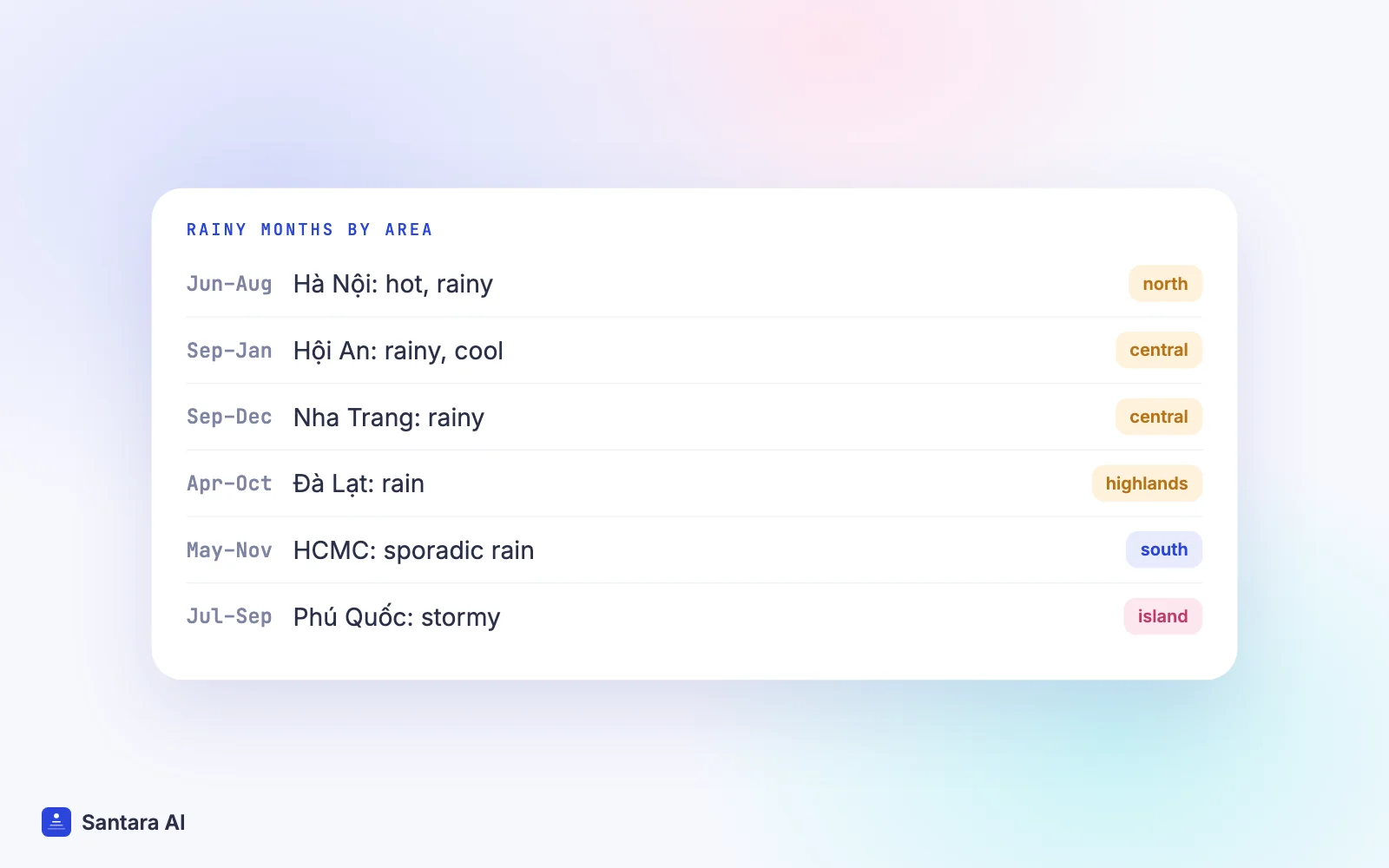
Two practical points follow. First, a host in Hội An and a host in Phú Quốc have quiet months at different times of year, so generic "low season" advice often misses. Second, rain does not always mean empty. The south's wet season brings afternoon showers, not week-long storms, so a Saigon apartment may see little change while a Hội An river villa in a flood month may see real cancellations.
Bali. We could not find an official month-by-month source showing which months are quiet for Bali rentals, so we won't name any. What is official is the weather: BMKG expects the 2026/2027 rainy season to start late across much of Indonesia, with parts of Bali starting in November and most of Bali in December 2026, according to InfoPublik's report on the BMKG forecast. For arrivals, BPS Bali publishes monthly foreign-visitor releases at bali.bps.go.id. Your own booking pace from last year tells you more about your street than either.
Find your own quiet months first
Before you change a single price, pull last year's calendar and look at three things per month:
- Nights sold vs nights available. This is your occupancy. If you track it already, our occupancy, ADR and RevPAR guide explains how to count blocked nights properly.
- Booking lead time. In quiet months, bookings often arrive later. If last year's August stays were booked 10 days out, your empty August today may not be a problem yet.
- Which nights stayed empty. Single weekday gaps between bookings need a different fix from whole empty weeks.
Write the result down as "my quiet months are X to Y, and the gaps are mostly Z". That one sentence decides which of the levers below matter, and it is the starting point of every low season vacation rental plan.
Lever 1: longer stays and monthly rates
Longer stays are the most useful low-season tool because one booking fills many nights and cuts your cleaning count. The platforms support them directly:
- Airbnb lets you set a weekly discount for stays of 7 or more nights and a monthly discount for 28 or more nights. Its discounts help article says discounts of 10% or more appear in search results, and that Airbnb may add its own Monthly Stay Savings on 28+ night stays, paid by Airbnb, not from your payout.
- Airbnb's long-term cancellation rules are different. For 28+ nights you choose Firm or Strict, and under Firm a guest who cancels late still pays for nights spent plus 30 more, per Airbnb's cancellation policy article. Read it before you price a month, because it changes your risk.
- Booking.com caps stays at 30 nights by default. Its long-stay policy page explains how to accept stays over 30 nights under Property → Policies, and points to weekly or monthly rate plans for discounts.
How to set a monthly price without guessing: start from what the month would earn if you sold it night by night at realistic low-season occupancy, then subtract the costs you avoid. Say you run a two-bedroom villa in Canggu. Suppose, purely as an example, that in a quiet month you would sell about half the nights at your low-season rate, with four or five turnovers. A single 30-night guest means one turnover, one laundry run and no gap nights. Your monthly price can sit below "30 × nightly rate" and still beat the nightly plan. Do the sum with your own numbers, not ours.
Long stays come with admin. In Vietnam and Indonesia you still have to register guests with the authorities however long they stay; see our guest registration guide. Agree utilities in writing too: electricity for air-conditioning over a month is a real cost, and many hosts cap it or meter it.
Lever 2: local and regional guests
Low season for international travellers is not always low season for domestic ones. Public holidays, school breaks and long weekends bring local guests even in rainy months. A few practical changes help:
- Update your listing for them. Mention parking, room for a family, and what the area offers in the rain: cafés, cooking classes, spas.
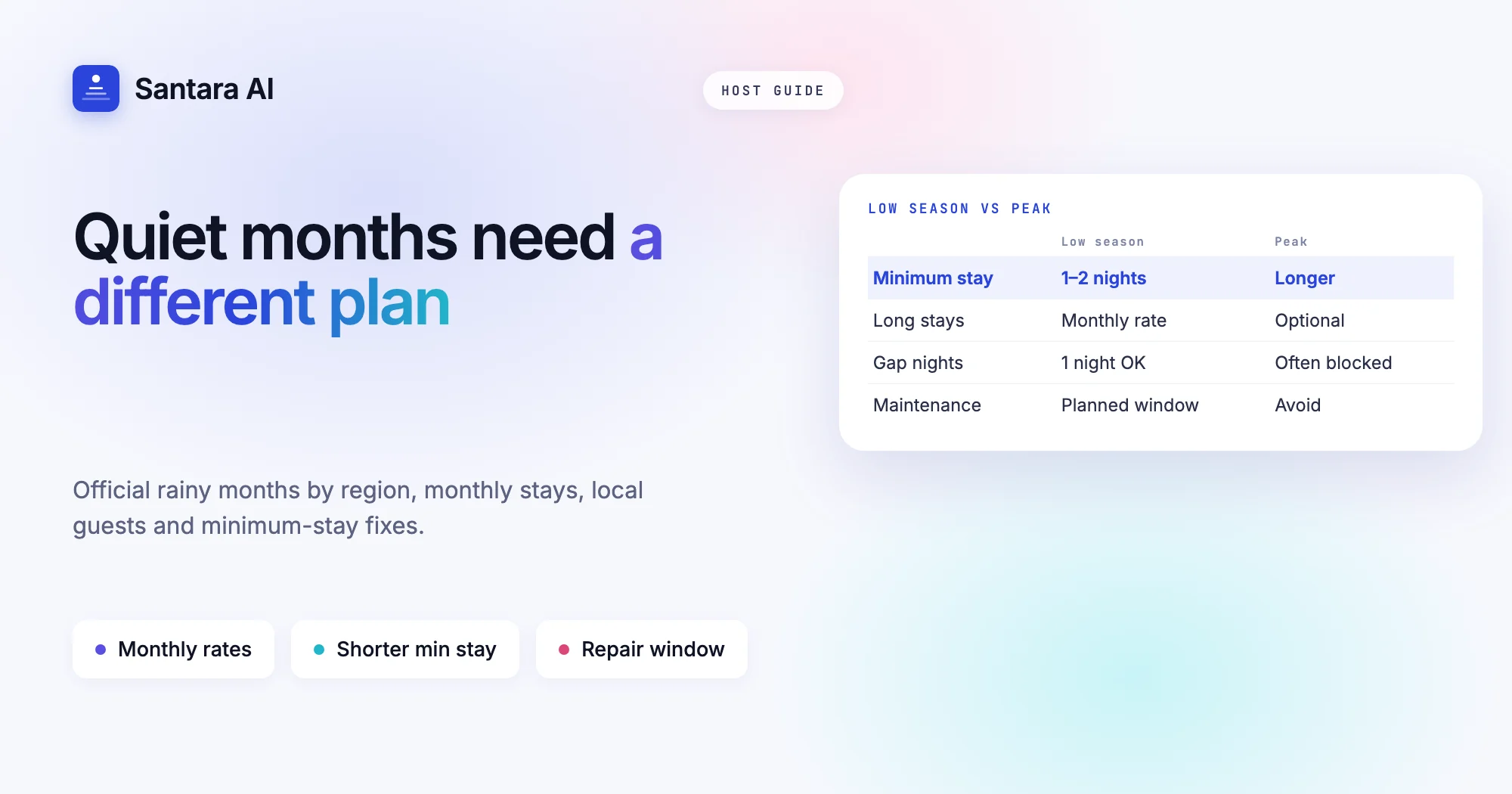
- Make weekend stays easy. A Friday-to-Sunday guest from a nearby city should not hit a three-night minimum.
- Answer in their language. If most of your low-season guests are domestic, write your house manual and quick replies in the local language too.
Check official holiday calendars each year; our Tết and Lebaran pricing guide lists the 2027 dates for Vietnam and Indonesia.
Lever 3: relax minimum stays and restrictions
Peak-season minimum stays are there to protect your best nights. In low season they mostly hide you. Booking.com says it plainly in its restrictions guide: the more restrictions you set, the fewer potential guests see your property.
Step 1
Lower the minimum stay on quiet dates
Drop to one or two nights on weekdays in your quiet months. Keep a higher minimum only where you have proof of demand, such as a holiday weekend.
Step 2
Remove leftover peak rules
Closed-to-arrival days and long minimums set for Tết, Christmas or Lebaran often stay on the calendar long after they made sense. Clear them.
Step 3
Fill single gap nights
A one-night gap between two stays rarely sells at a two-night minimum. Allow one night on those dates or offer it to the guest before or after.
Step 4
Keep the same rule on every channel
If Airbnb allows one night and Booking.com still requires three, you are hiding from part of the market without knowing it. Our guide to syncing prices and minimum stays explains why.
Lever 4: plan a maintenance window
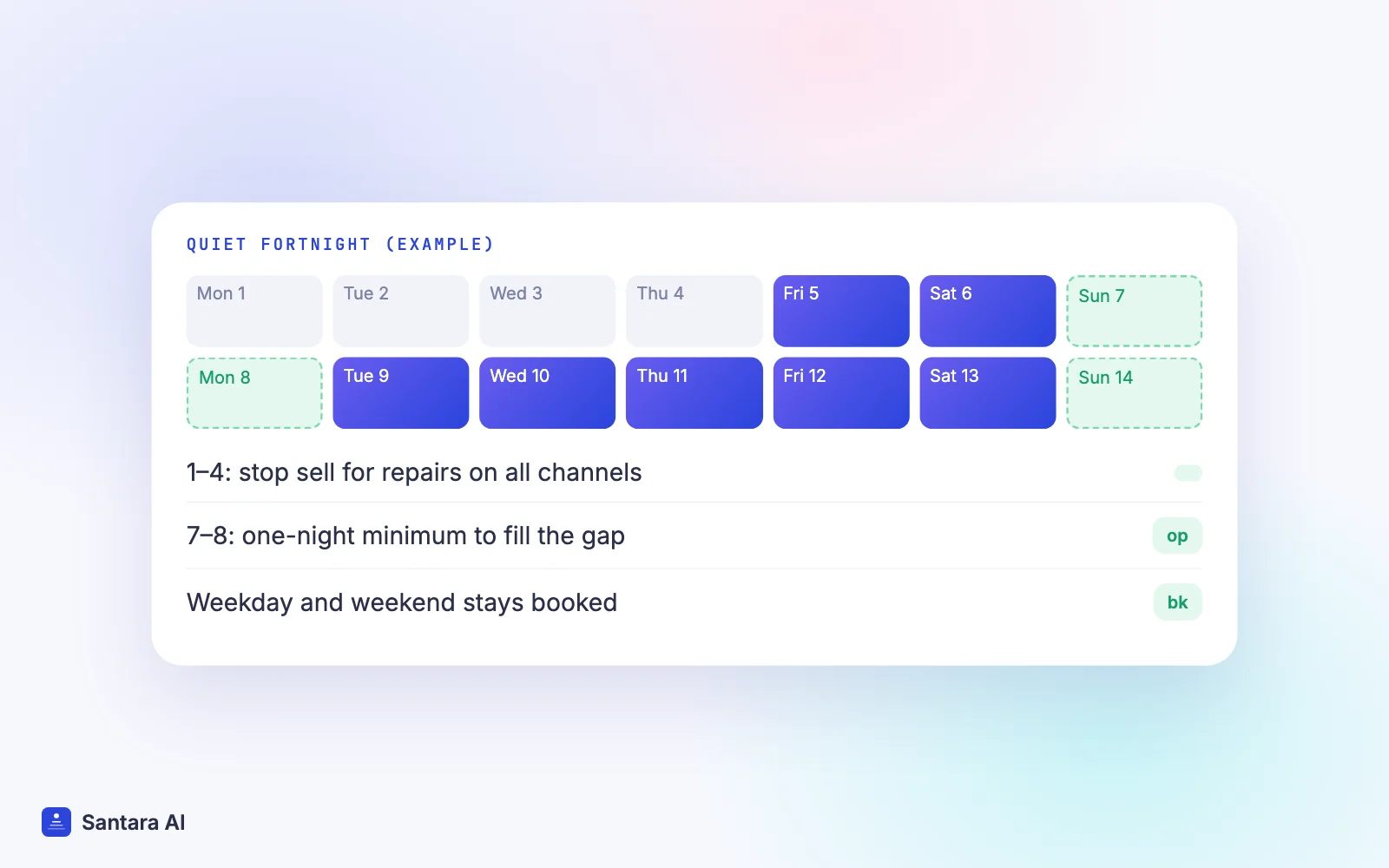
For a low season vacation rental, the quietest two weeks of the year are the best time for jobs that need an empty property: repainting, deep cleaning mattresses and sofas, servicing air-conditioners, fixing the pool pump, replacing linen. Plan it instead of squeezing it in:
- Pick dates from last year's data, not from today's empty calendar. If one week is reliably empty, book your contractors for it now.
- Block the dates on every channel at once. A repair week that is blocked on Airbnb but open on Agoda is how double bookings happen.
- Bundle jobs. One closure for painting, deep cleaning and a photo refresh costs less than three separate closures.
- Retake photos after the work. New photos show the property at its best before high season starts.
How Santara AI helps in low season
Santara AI keeps one calendar per room as the source of truth and pushes availability, nightly rates and restrictions to your connected channels. For low season, that means:
- Minimum stay per date. You can set minimum stay on arrival or through, maximum stay, closed to arrival and closed to departure as weekday defaults with per-date overrides on the rates calendar, and the same values go to every connected channel. Relaxing a peak rule happens once, not once per extranet.
- Seasons in smart pricing. The rule engine can set prices by season, weekend, last-minute and gap rules, so a lower low-season rate and a gap-night rule can run without you editing each date. Prices you set by hand are protected from being overwritten by rules.
- Maintenance windows. Stop sell closes the dates on all connected channels, so a repair week is blocked everywhere at once.
- Long-stay bookings land on the same calendar. A monthly booking on Airbnb or a direct booking on your own site lowers availability on all the others.
What Santara AI doesn't do here
Santara AI sends one price per room and date to every channel; it doesn't set different prices or channel-specific minimum stays per platform. Weekly and monthly discounts, Airbnb's long-term cancellation policy and Booking.com's 30+ night setting are chosen in each platform's own settings, so check them there. Santara AI also doesn't forecast your low season or register long-stay guests with the authorities.
FAQ
When is low season for vacation rentals in Vietnam?
It depends on the region. The national tourism authority lists September to January as rainy in Hội An, September to December in Nha Trang, May to November in Hồ Chí Minh City and July to September as stormy in Phú Quốc. Check your own booking history for the exact quiet weeks.
Should I lower my prices in low season?
Lower them where last year's data shows empty nights, and do it in steps. Often relaxing minimum stays and offering weekly or monthly rates fills more nights than cutting the nightly price alone.
How do I set a monthly rate for my Airbnb?
Use Airbnb's monthly discount for stays of 28 nights or more, or price a long stay directly. Start from what the month would realistically earn night by night, subtract the cleaning and gap costs you avoid, and check the long-term cancellation policy first.
Is low season a good time for maintenance?
Yes, if you plan it. Choose the quietest week from last year's calendar, book contractors early, close the dates on every channel at the same time and bundle several jobs into one closure.
Keep reading
Your first 3 months are free.
Join For Free