House manual template for vacation rentals (plus house rules)
A copyable house manual and house rules template, what Airbnb and Booking.com allow in house rules, official emergency numbers for Vietnam and Indonesia, and waste sorting.
 Tai Pham
Most guest questions are the same ten questions. Where is the key? What is the Wi-Fi password? How does the hot water work? Which bin is for what? What time is check-out? A good house manual answers all of them before the guest has to ask, and a clear set of house rules stops the awkward conversations before they start.
This post gives you a house manual template for a vacation rental that you can copy, fill in and print or send, plus a short house rules template. It also covers what Airbnb and Booking.com actually let you put in your house rules (from their own help pages), the safety information to include, the official emergency numbers for Vietnam and Indonesia, and the waste-sorting rules that apply where you are.
House rules and a house manual are not the same thing, and mixing them up causes most of the problems. So we start there.
House rules vs house manual
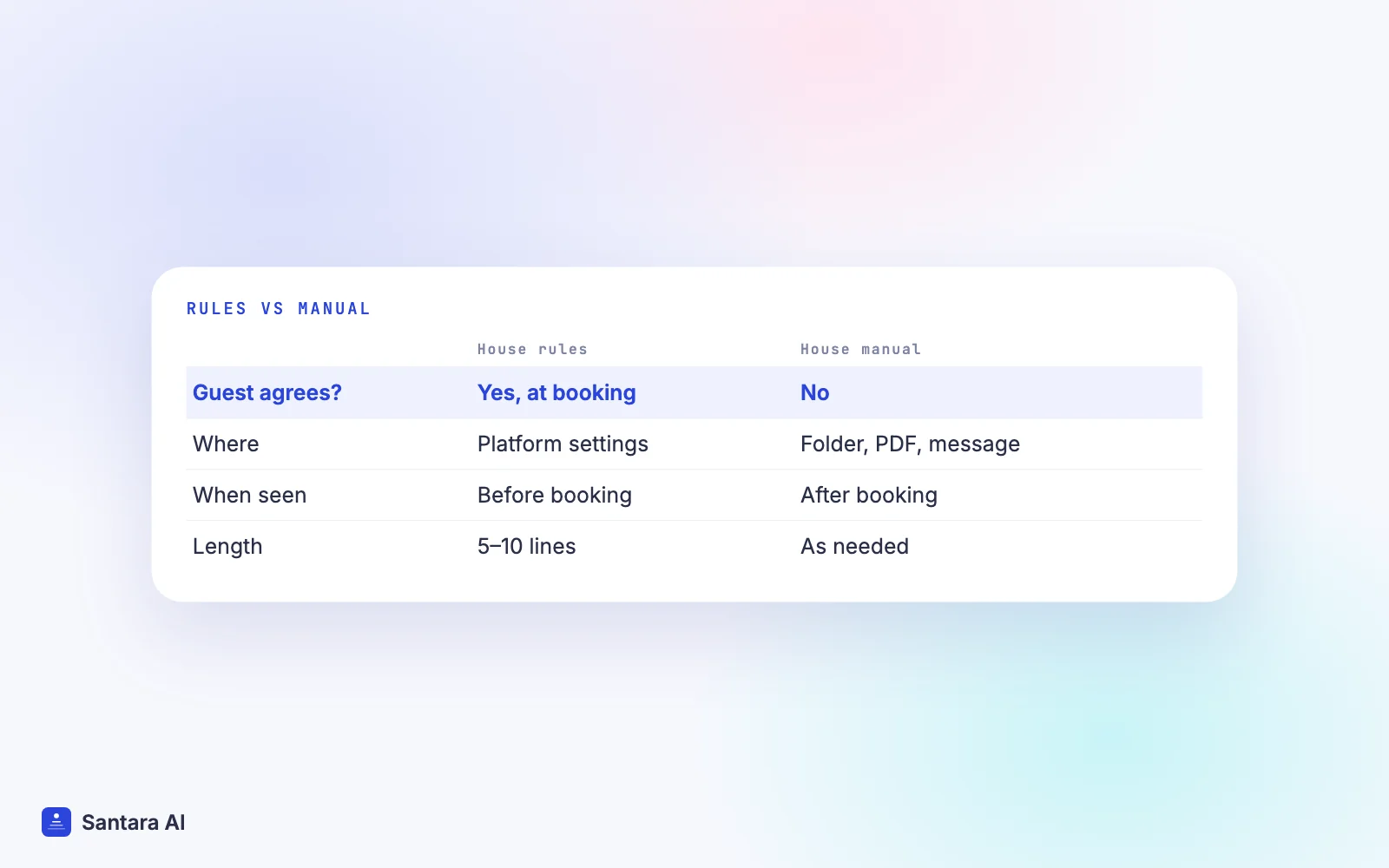
| House rules | House manual | |
| What it is | The conditions of the stay | How to use the home and the area |
| When the guest sees it | Before booking, on the listing | After booking, before and during the stay |
| Where it lives | In each platform's settings | A printed folder, a PDF or a message |
| Length | Short: 5 to 10 lines | As long as useful, in clear sections |
| Example | "No parties. Quiet hours 22:00 to 07:00." | "Type the gate code we send you, then press #." |
The rules have to be set on the platform, because that is what the guest agrees to. The manual is where everything practical goes.
What Airbnb and Booking.com let you put in house rules
Airbnb. According to Airbnb's house rules help article, the standard house rules cover pets, events, smoking and vaping, quiet hours, maximum overnight guests, commercial photography and filming, locking up at checkout, and which Airbnb services you allow in the home. Extra details now go under requests, which can apply "during the stay" or "before checkout", such as asking guests to take off shoes indoors. Three points from that page matter:
- Guests see your rules on the listing, in the booking terms, in automated emails and in the reservation details in their Trips tab.
- Changes apply only to future reservations. Guests who already booked keep the rules that were on the listing when they booked.
- Requests that may not comply with Airbnb's policies are flagged and can go to review.
Airbnb's safety requirements for homes add a few things you must cover: say whether smoke and carbon monoxide alarms are present (and keep them working), describe built-in risks such as a pool, a high balcony or nearby water in the listing, and change door codes between reservations.
Booking.com. Booking.com's guide to setting up house rules says guests must agree to the house rules to complete a reservation. You can set rules for pets, parties or events, smoking, quiet hours, curfew, check-in and check-out times, children and the maximum number of guests, under Property → Property policies → House rules. Anything else you want guests to know goes in "the fine print".
The lesson: put the conditions that matter in the platform's own fields. A rule that only exists in your printed manual was never agreed to.
House rules template
Copy this, keep what fits and set the same rules on every platform:
House rules for {property name}
Check-in from {15:00}. Check-out by {11:00}.
Maximum {4} guests overnight. Visitors only with the host's approval.
No parties or events.
No smoking or vaping inside, including balconies. Smoking area: {garden}.
Pets: {not allowed / allowed with approval}.
Quiet hours {22:00 to 07:00}. Our neighbours live close by.
Please lock the door and close the windows when you go out.
Please report any damage so we can fix it before the next guest.
Keep it to what you will actually enforce. Long lists of rules make guests nervous and don't stop the few who ignore them. If you charge for late check-out, say so and link it to your late check-out policy, not a vague warning.
House manual template
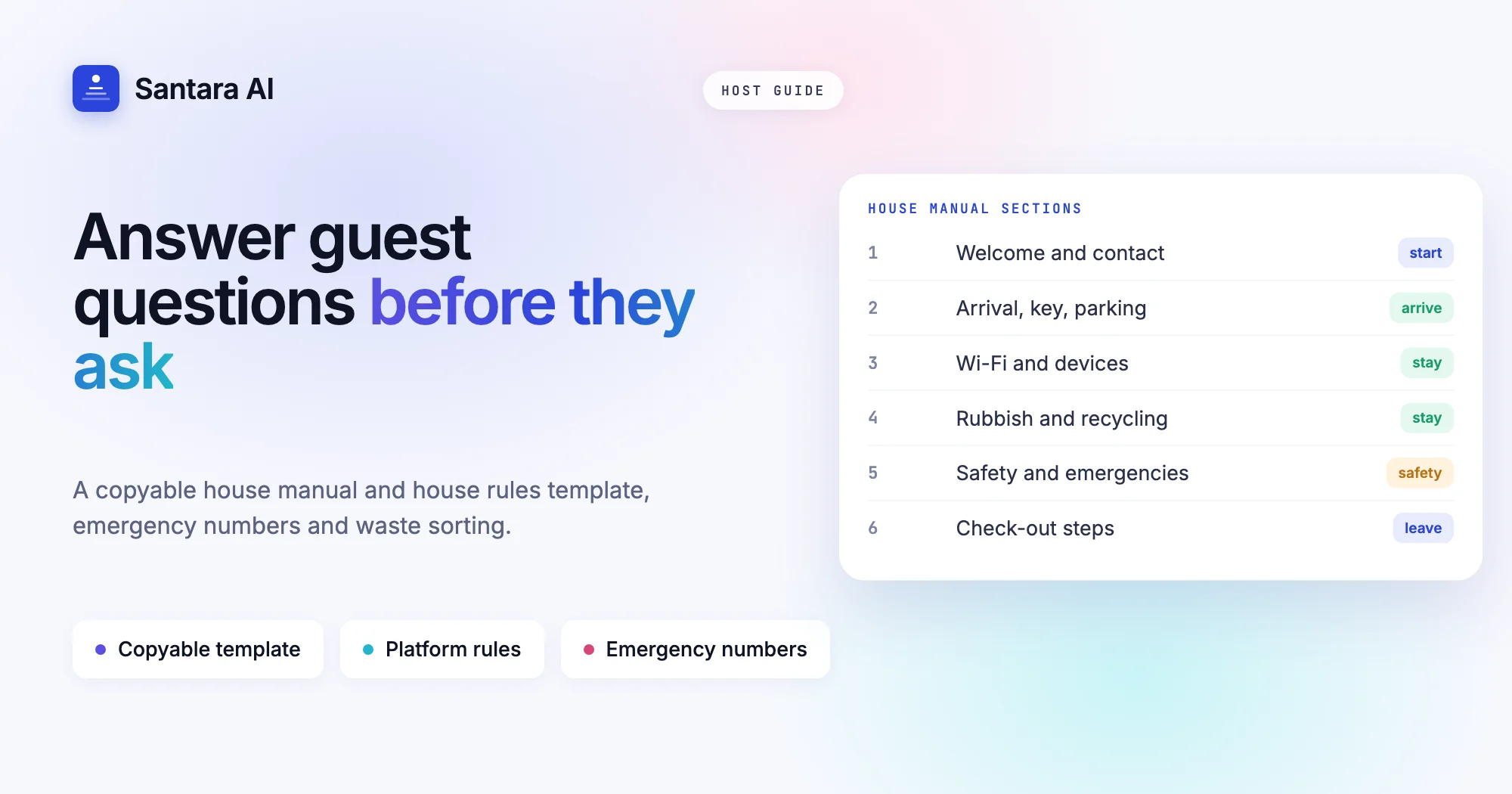
This house manual template follows the order of a guest's stay. Fill in the parts in braces and remove anything that doesn't apply.
1. Welcome
Welcome to {property name}. Your host is {name}, reachable on {WhatsApp/Zalo number} from {08:00 to 21:00}. For emergencies, call the numbers in section 6 first, then us.
2. Arriving
Address: {full address in the local language and English}. Map pin: {link}.
Key: {lockbox location}. Code: {sent on the day of arrival}.
Parking: {where, for cars and motorbikes}.
3. Wi-Fi and devices
Network: {name}. Password: {password}. If it stops working, unplug the router behind {location} for 30 seconds.
TV: {how to switch to streaming}. Air-conditioning remote: {where; recommended setting}.
4. Around the home
Hot water: {switch location; wait time}. Kitchen: {what's provided; gas cylinder rules}.
Pool: {opening hours; no lifeguard; children supervised at all times}.
Laundry: {machine, detergent, drying rack}.
5. Rubbish and recycling
{Bins and what goes where; collection days; see the waste section below}.
6. Safety and emergencies
Emergency numbers: {see table below}. Nearest hospital: {name, address, distance}.
Fire extinguisher: {location}. First-aid kit: {location}. Smoke alarm: {rooms}.
Exits: {main door and second exit}. Fuse box: {location}.
7. Checking out
Check-out by {11:00}. Please leave the key {where}, switch off the air-conditioning, put used towels {where} and take your rubbish to {where}. No need to strip the beds.
8. Local tips
{3 to 5 places you actually recommend: breakfast, a pharmacy, a market, a rainy-day option}.
Two tips. Write the address in both the local language and English, because a driver or ambulance dispatcher will need the local version. And never put the door code in a printed manual that stays in the house; send it before arrival and change it between guests, as Airbnb's safety page asks.
Emergency numbers to put in the manual
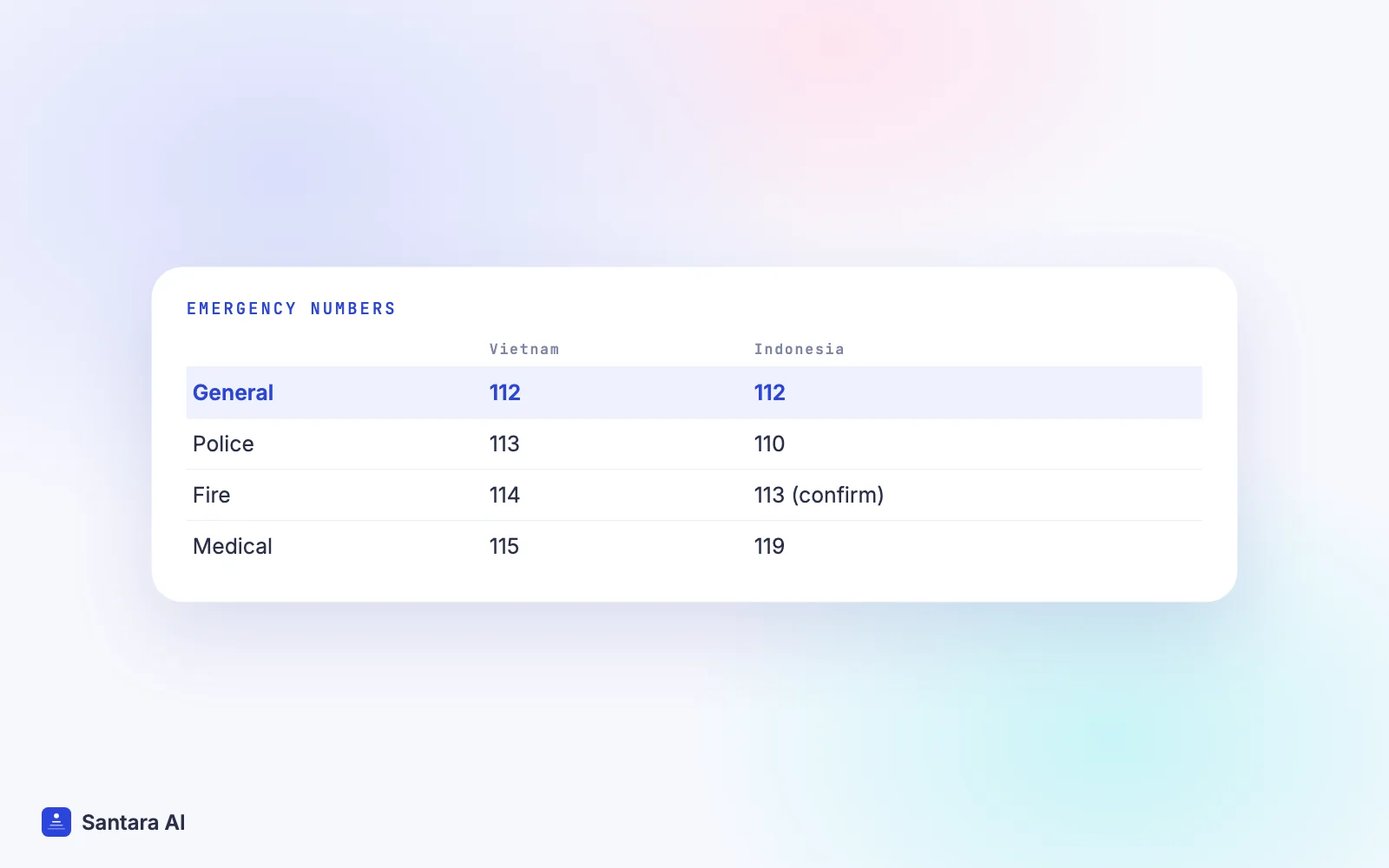
Guests from abroad do not know local numbers, and in a panic they dial the one from home. Put these on the first page and near the door.
| Country | Number | Service | Official source |
| Vietnam | 113 | Police | Decision 2023/QĐ-TTg (see below) |
| Vietnam | 114 | Fire and rescue | Same |
| Vietnam | 115 | Medical emergency | Same |
| Vietnam | 112 | Incidents, disasters, requests for help; linked to 113, 114, 115; free | Vietnam Law & Legal Forum |
| Indonesia | 112 | Single emergency number | Permenkominfo 10/2016 |
| Indonesia | 110 | Police | Polri |
| Indonesia | 119 | Medical emergency | Ministry of Health |
| Indonesia | 113 | Fire brigade | Widely listed; confirm locally |
Vietnam's 112 line was put in place by the Prime Minister's Decision 2023/QĐ-TTg of 15 September 2025, and calls to it are free. In Indonesia, 112 is the national single emergency number by regulation, but check that it is answered in your regency before relying on it alone. Some older lists show 118 for ambulances; the Ministry of Health promotes 119. We couldn't find an official national page for 113, so add your local fire brigade's landline and your nearest hospital's emergency number next to it. These numbers are correct as of October 2026; confirm with your local office.
Waste sorting: tell guests what goes where
Guests want to do the right thing with rubbish, but every country sorts differently. The rules are local, so write yours down.
- Vietnam. The Law on Environmental Protection 2020 (Article 75) sorts household waste into three groups: reusable and recyclable waste, food waste, and other waste, with sorting required no later than 31 December 2024, as summarised by the Vietnam Bar Federation's journal. Your province sets the details, so ask your ward or collection company.
- Bali. Governor Regulation 47/2019 on source-based waste management asks for sorting into at least five types: biodegradable, reusable, recyclable, hazardous (batteries, lamps, expired medicine) and residual waste. It also asks hotels and similar commercial sites to provide sorted bins, according to the regulation text.
In the manual, keep it physical: "green bin: food scraps; blue bin: bottles and cans; grey bin: everything else; batteries in the jar by the door". Labels on the bins with pictures work better than any paragraph.
Keep the manual current
Step 1
Check it after every change
New router, new lock, new gas supplier: update the manual the same day. A wrong Wi-Fi password causes more messages than no manual at all.
Step 2
Ask your cleaner to check the copy
At each turnover, the printed manual goes back in its place with no pages missing. Add it to your turnover checklist.
Step 3
Read your messages for gaps
If three guests ask the same question in a month, the answer belongs in the manual. Our guest message playbook has templates for the questions that remain.
Step 4
Review once a year
Recheck emergency numbers, opening hours of your tips, and local waste rules before high season.
How Santara AI fits in
Santara AI doesn't write your house rules or change them on Airbnb or Booking.com; rules are set in each platform's own settings, as above. Where it helps is around the manual:
- Questions still come in. Guest messages from Airbnb, Booking.com and Expedia, among the channels you can connect, arrive in one inbox. AI drafts a reply, and nothing is sent until you press Send, so you can paste the right section of your manual and check the details.
- Turnovers. New bookings create cleaning tasks automatically, and the Daily Brief (6am by default) lists arrivals, departures and cleans, with the day's cleaning grouped by property group and a WhatsApp share button per group. That is a natural moment to remind the cleaner to put the manual back and reset the door code.
Limits worth knowing
Messages from Agoda, Traveloka and Tiket.com don't come into the Santara AI inbox, so answer those in each platform. Santara AI doesn't send house rules to guests on your behalf, and the cleaning plan is shared by you; there is no cleaner app or automatic confirmation.
FAQ
What should be in a house manual for a vacation rental?
Arrival and key instructions, Wi-Fi, how appliances work, rubbish and recycling, safety equipment and emergency numbers, the nearest hospital, check-out steps and a few local tips. Put the address in the local language as well as English.
What is the difference between house rules and a house manual?
House rules are the conditions of the stay, set on Airbnb or Booking.com and agreed before booking. A house manual is the practical guide to the home, given after booking. A rule only in the manual was never agreed to.
What house rules can I set on Airbnb?
Airbnb's standard rules cover pets, events, smoking and vaping, quiet hours, maximum overnight guests, commercial photography, locking up at checkout and allowed services. Extra details go under requests. Changes apply to future reservations only.
What emergency numbers should I give guests in Vietnam and Indonesia?
Vietnam: 113 police, 114 fire and rescue, 115 ambulance, and 112 for incidents and disasters. Indonesia: 112 single emergency number, 110 police, 119 medical emergency and 113 fire. Add your nearest hospital and local fire brigade landline.
Keep reading
- Guest registration in Vietnam and Indonesia
- Early check-in fees on Airbnb
- How to reply to a bad review
Your first 3 months are free.
Join For Free