Short-term rental glossary: 46 terms hosts actually use
ADR, CTA, stop sell, allotment, VCC: plain definitions of the terms in your extranet and software, grouped by job, with links to the full guides.
 Tai Pham
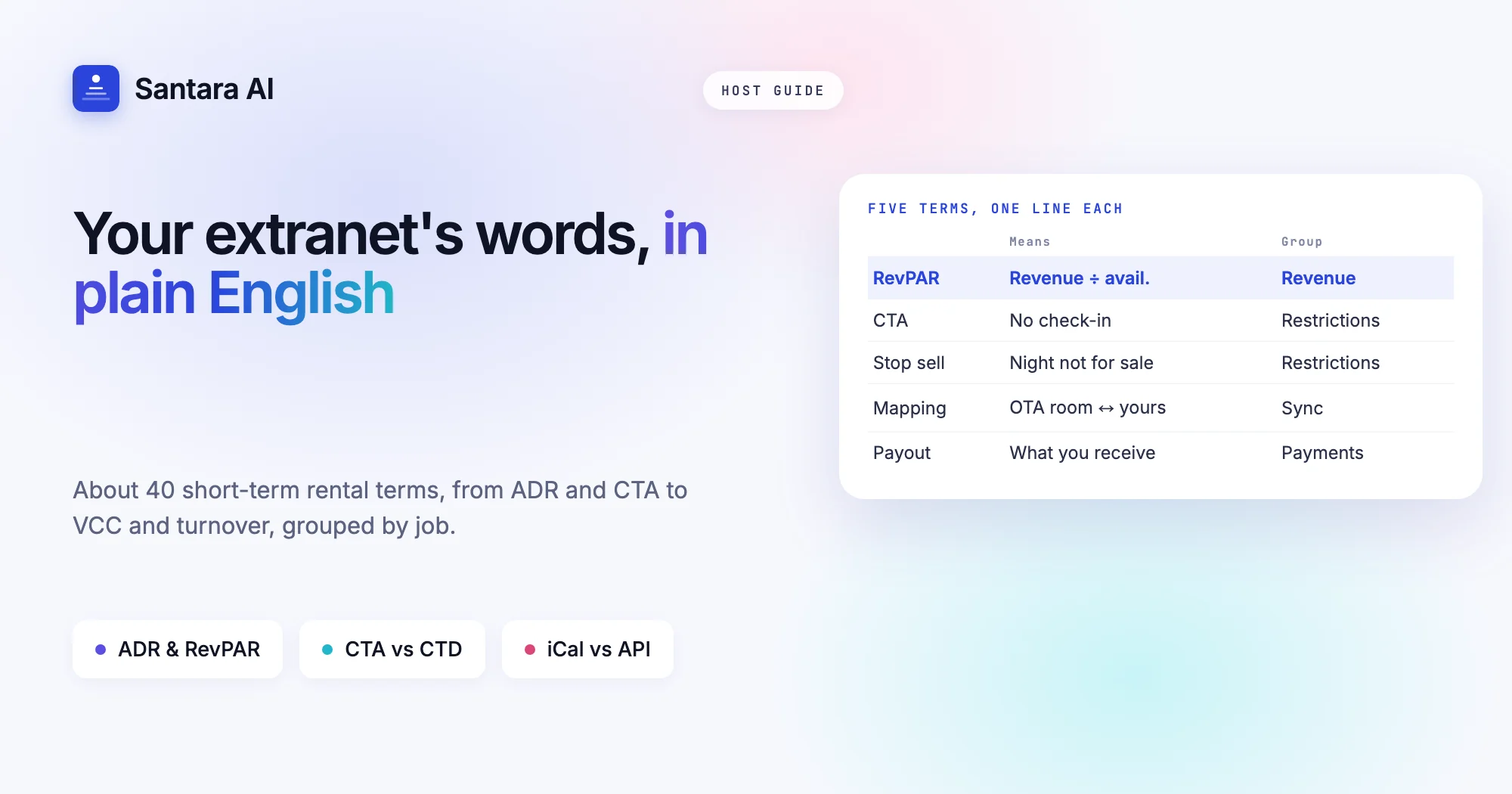
Every industry has its shorthand, and short-term rentals borrowed most of theirs from hotels. ADR, CTA, stop sell, allotment: you meet these words in the Booking.com extranet, in software menus and in conversations with other hosts, usually without anyone explaining them. This short-term rental glossary explains about 40 of them in plain English, grouped by the job they belong to.
Each definition is short on purpose. Where a term deserves more than three sentences, we link to the guide that covers it in full. Formulas follow the hotel industry's standard definitions from the CoStar (STR) glossary, the same ones we use in our occupancy, ADR and RevPAR guide. Platform rules come from the platforms' own help pages, checked in October 2026.
This short-term rental glossary has no market averages or benchmarks. A glossary should tell you what a word means, not what your number ought to be.
How to use this short-term rental glossary
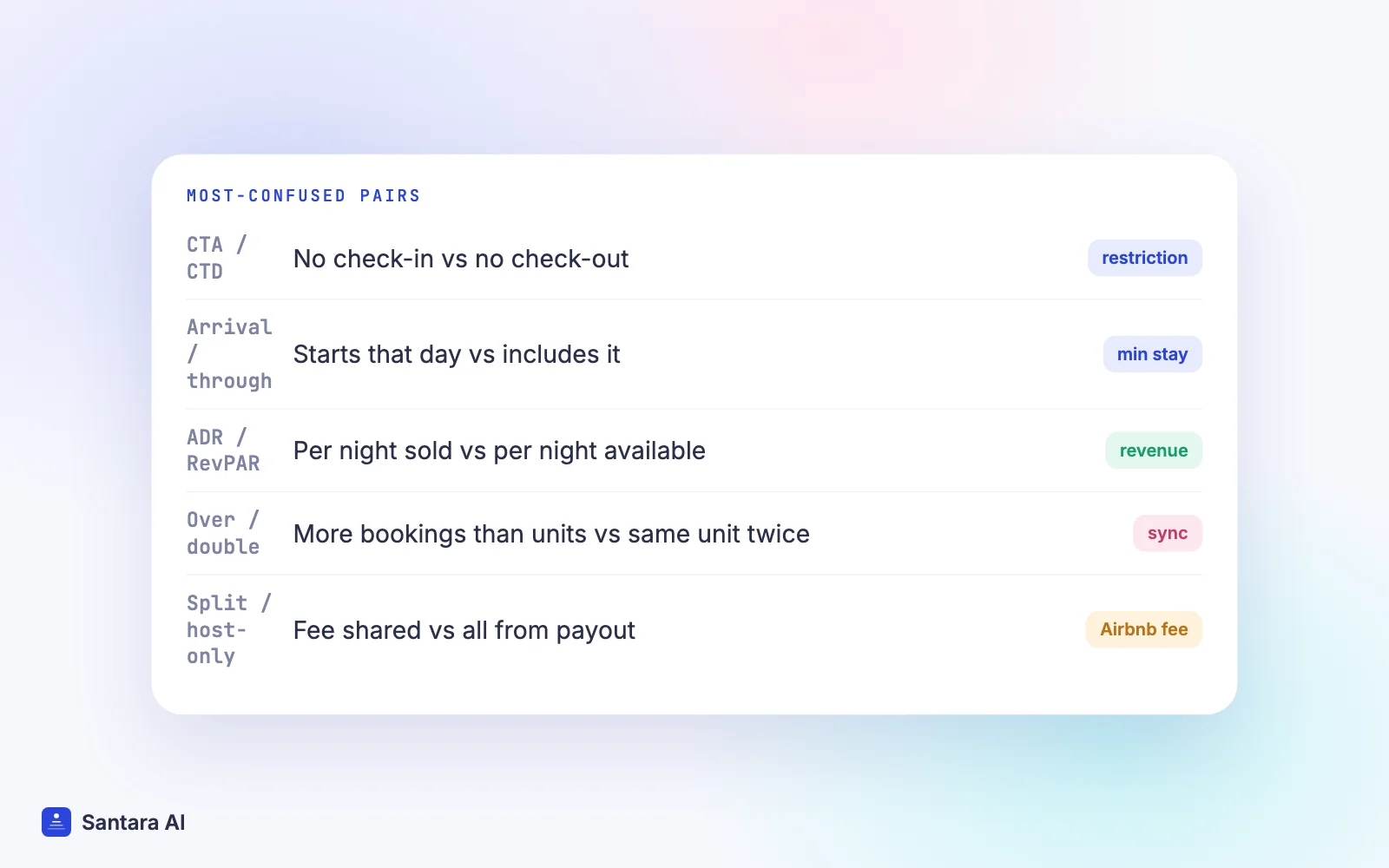
Read the section you need, not the whole page. If you run a few villas in Bali or a homestay in Da Nang and you are about to connect a second booking site, start with "Channels and sync". If a payout looks smaller than you expected, go to "Payments and fees". The terms people mix up most are in the panel below.
Revenue and performance
These are the numbers you use to judge a month. Two inputs sit under all of them: nights available and nights sold.
| Metric | Formula |
| Occupancy | Nights sold ÷ nights available |
| ADR | Room revenue ÷ nights sold |
| RevPAR | Room revenue ÷ nights available, or ADR × occupancy |
| Average length of stay | Nights sold ÷ number of bookings |
Nights available
Your number of units multiplied by the nights in the period. Three villas over a 30-night month give 90 nights available. Decide once whether owner stays and repair closures come out of this number, and keep that choice every month.
Nights sold
Paid nights that guests actually stayed. Complimentary nights and owner stays are not sales, and CoStar leaves complimentary rooms out of demand.
Occupancy rate
The share of the nights you could sell that you did sell: nights sold ÷ nights available. Airbnb's occupancy and rates article uses "total nights available to be booked" as the denominator, so check which one you compare against.
ADR (average daily rate)
The average price of a night you sold: room revenue ÷ nights sold. Room revenue means nightly rates only, without cleaning fees or taxes.
RevPAR (revenue per available room)
Room revenue spread over every night you could have sold: room revenue ÷ nights available. It also equals ADR × occupancy, which is why one number shows both price and fill. The worked example in the metrics guide linked above shows all three on one month.
Booking window (lead time)
How many days pass between the day a guest books and the day they arrive. A long booking window for a holiday week tells you demand is coming early, and that you can hold your price.
Length of stay (LOS)
The number of nights in one booking. Average length of stay is nights sold divided by the number of bookings, and it drives how many turnovers you pay for.
Pace
How quickly bookings for a future period are coming in, compared with the same point last year. Booking.com's Analytics tab has a Pace report. If pace for Christmas week is behind last year, you know early rather than on 20 December. Our peak season pricing playbook shows how to act on it.
Gap night (orphan night)
One or two unsold nights stuck between two bookings, usually shorter than your minimum stay, so nobody can book them. Shortening the minimum stay for those dates, or offering the night to the guest before or after, often fills it.
Rates and restrictions
These are the settings that decide who can book which nights, and at what price. Most of them work per date.
Rate plan
A price with its own conditions attached to a room, for example "flexible", "non-refundable" or "breakfast included". One room can have several rate plans, and each one shows to guests as a separate option.
Base rate
Your normal nightly price before any seasonal change, discount or rule. Many hosts set a base rate per weekday and then override specific dates.
Minimum stay on arrival
A stay that starts on this date must be at least N nights. A guest arriving earlier can still book a shorter stay that runs through it.
Minimum stay through
Any stay that includes this date must be at least N nights, wherever it starts. Use it for the single night everyone wants, such as New Year's Eve. Our guide to syncing prices and minimum stays works through both with an example.
Maximum stay
A stay starting on this date can't be longer than N nights. It protects dates you have already promised elsewhere, or limits long stays at a peak price.
Closed to arrival (CTA)
Guests can't check in on this date, but they can stay through it. Useful for days your team can't clean, or arrivals that would leave a gap night.
Closed to departure (CTD)
Guests can't check out on this date, but they can arrive or stay through it. Useful when cleaners are off, or to keep a long weekend from breaking up.
Stop sell
The night is not for sale at all, on any channel. Use it for owner stays, maintenance or a room you are holding back.
LOS pricing (length-of-stay pricing)
A nightly price that changes with the number of nights booked, such as a lower rate for stays of a week or more. Airbnb's weekly and monthly discounts are a simple form of it.
Channels and sync
This is where most expensive mistakes start: two calendars that disagree for a few hours.
OTA (online travel agency)
A booking site that sells your rooms to travellers, such as Airbnb, Booking.com, Agoda, Traveloka, Tiket.com, Expedia or Trip.com. The guest books there, and the OTA passes the booking to you.
Extranet
An OTA's back office for hosts, where you manage rates, availability, reservations and payouts. Booking.com calls it the extranet. Other platforms call it a partner portal or host dashboard.
Channel manager
Software that keeps availability, prices and restrictions in line across several OTAs and brings their bookings into one place. A booking on one channel closes the night on the others. See what a channel manager is and how sync works.
PMS (property management system)
Software that runs the operation behind the bookings: the calendar, guest details, cleaning, payments and reports. Some tools do both jobs, which our PMS vs channel manager guide explains.
iCal sync
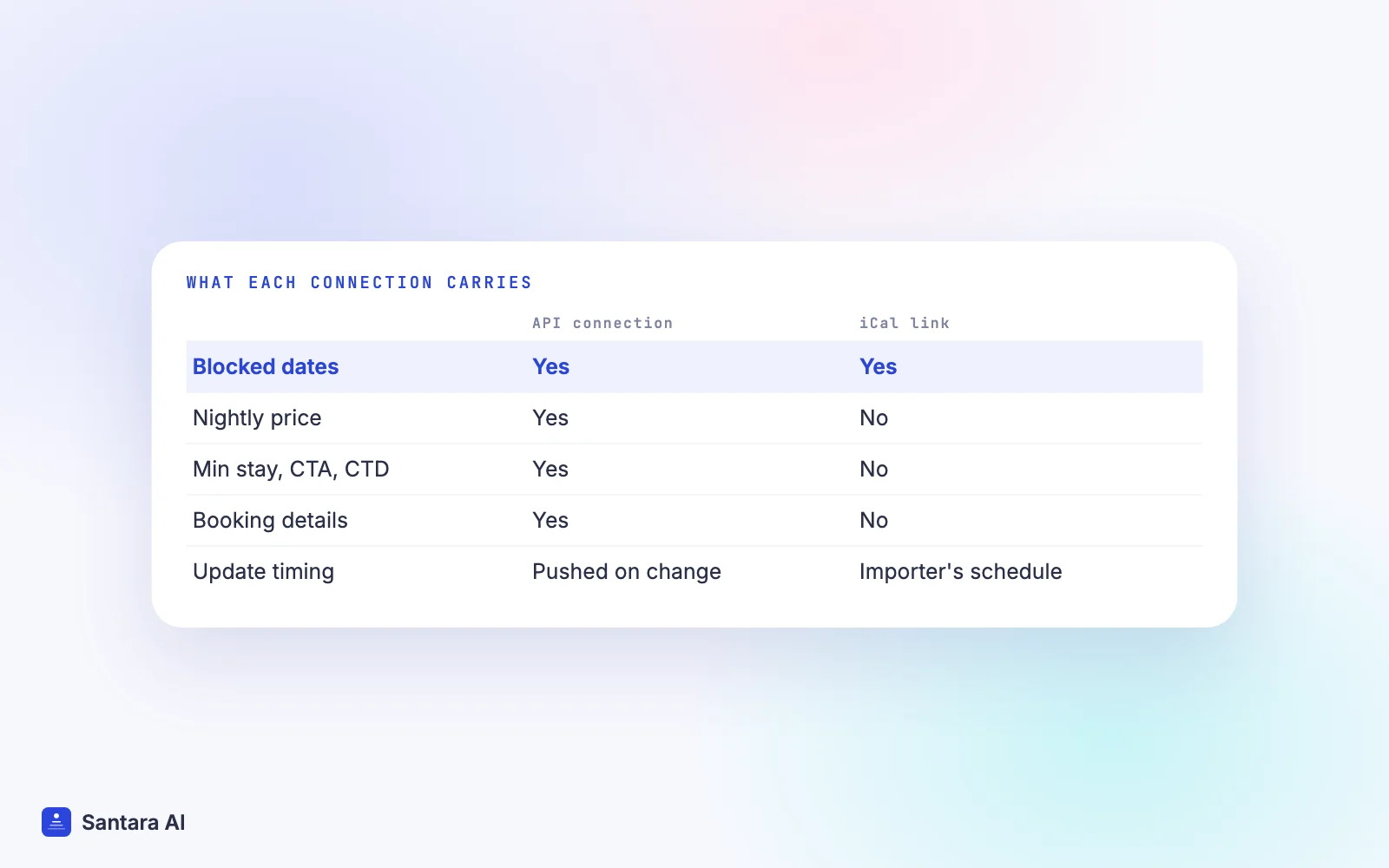
A calendar link one site publishes and another imports. It carries blocked dates only: no price, no minimum stay, no guest details. The importing site sets the schedule. Airbnb's help article says every 3 hours, and Booking.com's calendar sync page says up to two hours. Read why iCal sync runs late.
API connection
A direct software-to-software link with the OTA. It carries availability, rates and restrictions out, and bookings, changes and cancellations in, without waiting for a calendar import. Our iCal vs channel manager comparison covers the difference.
Unit count and allotment
Unit count is the number of identical units you sell under one room type: four identical bungalows means a unit count of 4. Allotment is the older hotel practice of giving each channel a fixed share of rooms. With a shared calendar, every channel sells from the same pool instead.
Mapping
Linking each room on an OTA to the matching room in your own calendar, so bookings land in the right place and updates go to the right listing. Wrong mapping is quiet: the sync runs, but on the wrong room. More in our Booking.com channel manager guide.
Overbooking
More bookings than units for the same night. Some hotels do it on purpose and expect cancellations. For a small host it is almost always a mistake.
Double booking
Two guests booked into the same unit for the same night, usually because one calendar had not caught up with the other. For a one-unit listing, overbooking and double booking are the same thing. If it has already happened, follow what to do in the first hour.
Direct booking
A reservation made on your own website, by message or by phone, with no OTA in between. It needs to close the dates on every channel just like an OTA booking. See our direct booking website guide.
Payments and fees
These terms explain the gap between what a guest pays and what reaches your bank account.
| Term | Who pays it | Where you see it |
| Commission | The host, per booking | OTA invoice or statement |
| Split fee (Airbnb) | Host and guest each pay a part | Payout details and guest checkout |
| Host-only fee (Airbnb) | The host pays all of it | Payout details |
| Payment or card charges | Usually the host | Bank or card statement |
Commission
The share of a booking an OTA keeps. Booking.com's commission page says yours depends on your country, property type and agreement, and Agoda calls its version "compensation". Compare them in our Airbnb vs Booking.com fees guide.
Split fee
Airbnb's older fee structure: the host pays a small service fee and the guest pays a separate one at checkout. Airbnb's service fees article says it is being phased out.
Host-only fee (single fee)
Airbnb's structure where the whole service fee comes out of the host's payout and the guest sees one price. Airbnb says most hosts must use it and can't switch back. Our Airbnb host fee change guide covers the repricing math.
Payout
The money a platform sends you after taking its fee. It is the number to compare across channels, because a higher price on one site can still leave you with less.
VCC (virtual credit card)
A single-use card number an OTA issues to pay you for a booking the guest paid to the OTA. You charge it like a normal card. Agoda's payment methods page says transaction fees on its virtual card are covered by the property.
Cleaning fee
A one-off charge per stay that pays for cleaning. Keep it out of ADR. On Booking.com, commission also applies to extra fees you charge, cleaning included, according to the commission page linked above.
Cancellation policy
The rules that decide how much a guest gets back if they cancel. Each OTA has its own set of options, so the same "flexible" label can mean different deadlines on different sites.
No-show
A guest with a confirmed booking who never arrives and doesn't cancel. What you can charge depends on the cancellation policy and the channel's rules, so mark it in the extranet promptly.
VAT
Value-added tax, a national tax on goods and services that, where it applies, can cover accommodation revenue and the fees platforms charge you. Whether you owe it depends on your country and your revenue, so confirm with your tax office. Our Vietnam homestay licence guide covers the Vietnamese rules.
PBJT
Indonesia's regional tax on hotel services, which replaced the old hotel tax under Law 1/2022 and applies to villas and homestays. Each regency sets and collects it. See our Bali villa licence guide.
Operations and guests
The words for what happens between one guest leaving and the next one arriving.
Turnover
Everything between a checkout and the next check-in: cleaning, laundry, restocking and a final check. Our turnover day guide has a full routine.
Same-day turnover
A checkout and a check-in on the same day in the same unit. Your check-out and check-in times decide how many hours the cleaner has, which is why early check-in requests matter.
Owner stay (blocked night)
A night the owner or family uses the property. It is not a sale, so keep it out of nights sold and close it with stop sell.
Guest registration
Reporting your guests to the authorities. In Vietnam hosts report overnight guests to the local police, and in Indonesia foreign guests are reported through immigration's APOA system. Our guest registration guide has deadlines and sources.
House rules
The written rules guests accept when they book: quiet hours, smoking, parties, extra guests, pets. Put the important ones in your listing and repeat them before arrival, because guests rarely reread the listing.
Review response
Your public reply to a guest's review. Airbnb guests have 14 days after checkout to review, and Booking.com checks replies before publishing them, according to their review and reply help pages. See how to respond to a bad review.
Upsell
A paid extra you offer a guest who has already booked, such as early check-in, late checkout or an extra night. The best ones come from your calendar: an empty night before arrival is an early check-in you can sell. See upsells hiding in your calendar.
Where these terms live in Santara AI
Most of the vocabulary in this short-term rental glossary maps to one place in Santara AI: a calendar with one row per room, which is the source of truth for every channel.
- Rates and restrictions. You set the nightly rate, minimum stay on arrival and through, maximum stay, closed to arrival, closed to departure and stop sell, as weekday defaults with per-date overrides. Changes push to connected channels.
- Unit count. Each room has a unit count, and availability is capped at it, so a one-unit room is never offered as two. You confirm it before anything goes live.
- Mapping. When you connect Booking.com, you map each Booking.com room to a room in Santara AI.
- Bookings in. New bookings, changes and cancellations from every connected channel land on the same calendar. A booking on one channel lowers availability on the others, and your direct booking site sells from the same calendar.
- Operations. New bookings create cleaning tasks, and the Daily Brief email lists arrivals, departures and cleans.
You can see the 54 channels on the integrations page.
What Santara AI doesn't do
Santara AI sends the same price to every channel. It has no per-channel prices or markups, and no channel-specific minimum stays. It does not offer iCal export or import as a feature, and it does not file guest registrations or taxes for you.
FAQ
What do CTA and CTD mean?
CTA means closed to arrival: no check-ins on that date, though guests can stay through it. CTD means closed to departure: no check-outs on that date. Both are per-date restrictions you set in a channel manager or an OTA extranet.
What is the difference between overbooking and double booking?
Overbooking means more bookings than units for one night. Double booking means two bookings for the same unit on the same night. For a listing with one unit they are the same thing, and both usually come from calendars that are out of step.
What is the difference between a PMS and a channel manager?
A channel manager keeps availability, prices and restrictions in line across booking sites. A PMS runs the operation behind the bookings, such as guests, cleaning and payments. Some software does both.
What is a good occupancy rate for a short-term rental?
There is no single good number. Occupancy depends on your market, season and price, and a high occupancy at a low price can earn less. Compare RevPAR with the same month last year rather than chasing an occupancy figure.
Keep reading
- Southeast Asia short-term rental statistics 2026
- How to choose villa management software
- Switch channel manager without losing bookings
Your first 3 months are free.
Join For Free