Agoda vs Booking.com for hosts: payments, no-shows, reviews
Agoda vs Booking.com compared from their own partner pages: who collects guest money, virtual cards, no-show deadlines, reviews and guest messages.
 Tai Pham
Most hosts in Southeast Asia end up asking the same thing: Agoda vs Booking.com for hosts, which one should come first, and is it worth running both? The two look alike from the guest side. Both sell hotel-style room types, both have an extranet, and both take a commission set in your contract. Behind the scenes they handle money, cancellations, reviews and guest messages differently, and those differences decide how much admin each one adds to your week.
This guide compares the two only on what their own partner help pages say, checked on 21 October 2026. It covers signing up, who collects the guest's money, how payouts and virtual cards work, cancellations and no-shows, reviews, and messaging. Where a platform does not publish something, we say so instead of guessing.
It does not pick a winner, because Agoda vs Booking.com for hosts is a question about your own operation, not about which brand is bigger. A villa in Canggu that sells mostly to regional travellers and a homestay in Hội An that sells mostly to European backpackers may reach opposite answers. What you will get is a checklist of the questions that matter, so you can decide with your own numbers.
Agoda vs Booking.com for hosts: the short version
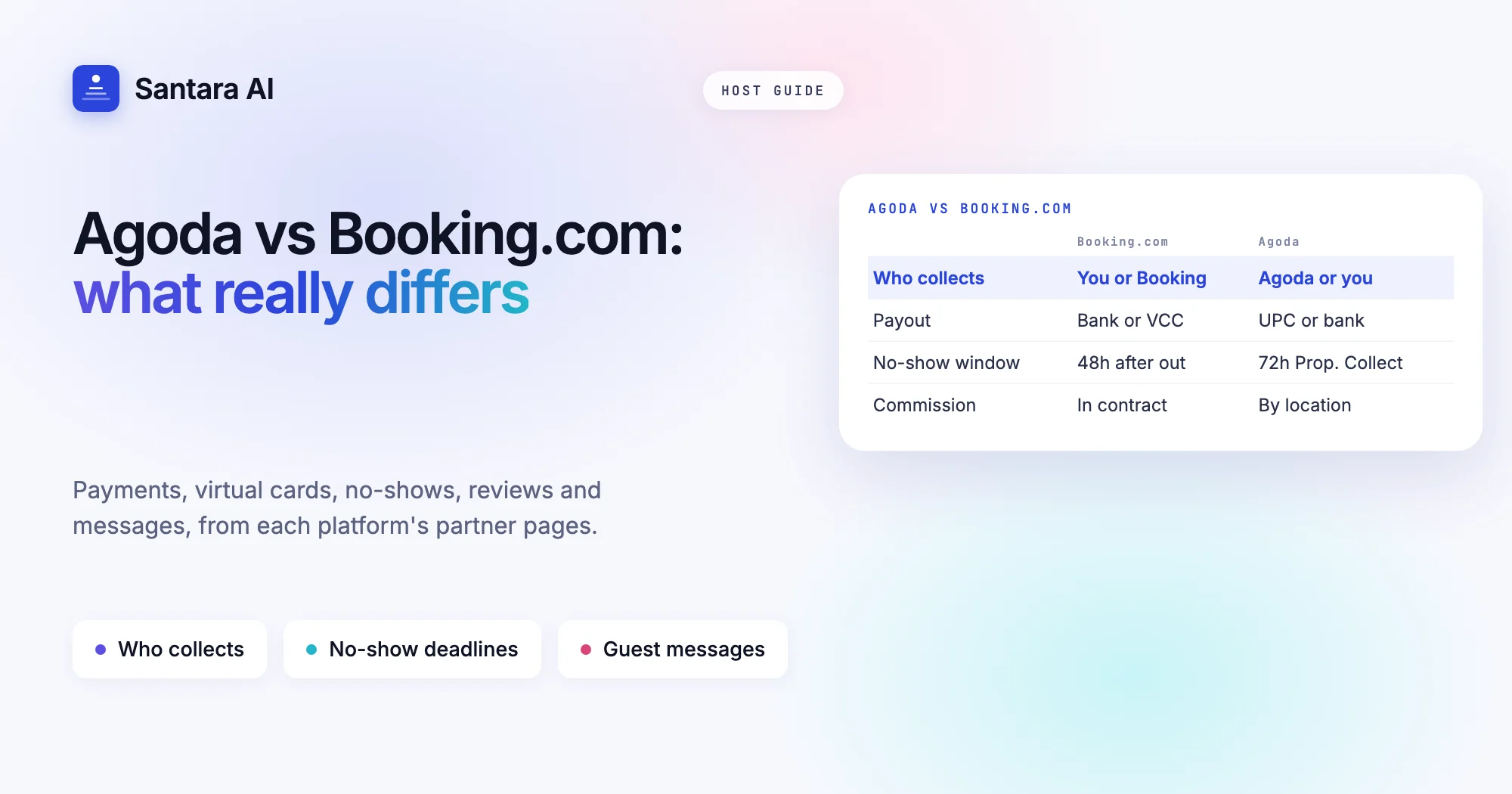
| Booking.com | Agoda | |
| Signing up | "Register for free" on the partner site | Sign up in the partner portal; listing checked for fraud first |
| Who collects guest money | You, or Booking.com through Payments by Booking.com where eligible | Agoda (prepaid), or you at check-in with Property Collect |
| Payout to you | Bank transfer after check-out, or a virtual card | Virtual card (UPC), batch card on ePass, or bank transfer |
| Commission | Set in your agreement, no public rate | "Compensation" set by location, no public rate |
| No-show reporting | From midnight on check-in day to 48 hours after check-out | After midnight on check-in day; Property Collect: 72 hours in the portal |
| Review replies | Checked before publishing | Moderated, can take up to 48 hours |
| Guest messages | Extranet inbox and Pulse app | Messages tab in the partner portal |
The rest of this post explains each row and what it means for a small operation.
Signing up and getting listed
Booking.com's property registration page says you can register for free, and for holiday homes it lets you choose between instant bookings and booking requests.
Agoda's guide to listing your property starts from its list-my-property page. If you already sell on Airbnb or Booking.com, you can pick "Import listings from other travel sites" instead of typing everything again. After registration, Agoda runs a fraud check that it says typically takes up to 72 hours, and the listing is not live during that time. Its new partner checklist lists what to add before your first booking: rooms, rates, availability, photos, facilities, a cancellation policy and a payment method.
Neither page publishes a signup fee. Both make their money from commission, which you will find in your contract, not on a public price list.
Who collects the guest's money
This is the biggest practical difference, and it shapes your cash flow.
Booking.com. By default many properties collect payment themselves. If you join Payments by Booking.com, guests pay through Booking.com and the money is sent to you after check-out by bank transfer or virtual credit card (VCC), depending on your location and settings. Booking.com says there is no setup fee. Bank transfer payouts carry a payment service fee, a percentage that depends on your country. VCC payouts carry a transaction fee charged by your own bank or payment provider. With VCC you can be paid once the reservation becomes non-refundable; bank transfers go out after the guest checks out. The service is not available in every region, and if you opt out you collect every payment yourself and pay commission monthly.
Agoda. Agoda's main model is prepaid: the guest pays Agoda, and Agoda pays you. Agoda also offers Property Collect, where the guest pays you the full amount at check-in, either with a credit card guarantee or without one. Agoda then deducts its compensation for those bookings from your other prepaid bookings, so there is no separate invoice.
For prepaid bookings, Agoda's payout guide lists the options:
- UPC, a Mastercard virtual card per booking. Agoda says the transaction fees are covered by the property.
- UPC on ePass, one card for a batch of bookings. It must be charged within 24 hours, in full, on a non-3DS terminal set up for lodging.
- Bank transfer, which can be charged 30 days after the booking's departure date and is not offered in every market.
On every method, payouts must be claimed within 150 days of departure or they are lost.
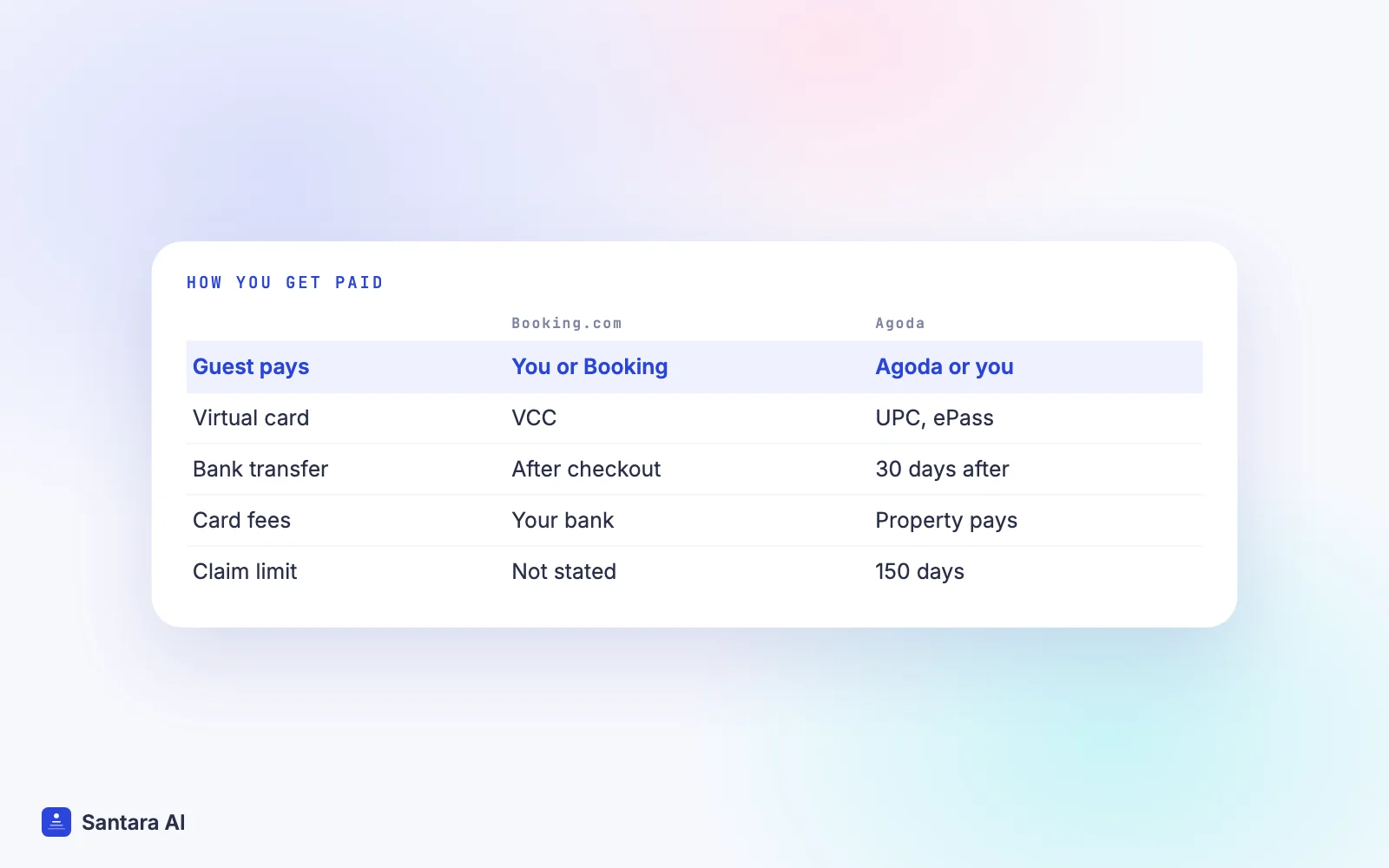
What to check before you choose. Do you have a card terminal that can charge virtual cards? If not, Agoda's card options are harder to use, and Booking.com's bank transfer may suit you better if your country is eligible. Write the 150-day Agoda limit into your monthly routine.
Cancellations and no-shows
Both platforms let you choose flexible or non-refundable policies. The details of how they apply differ.
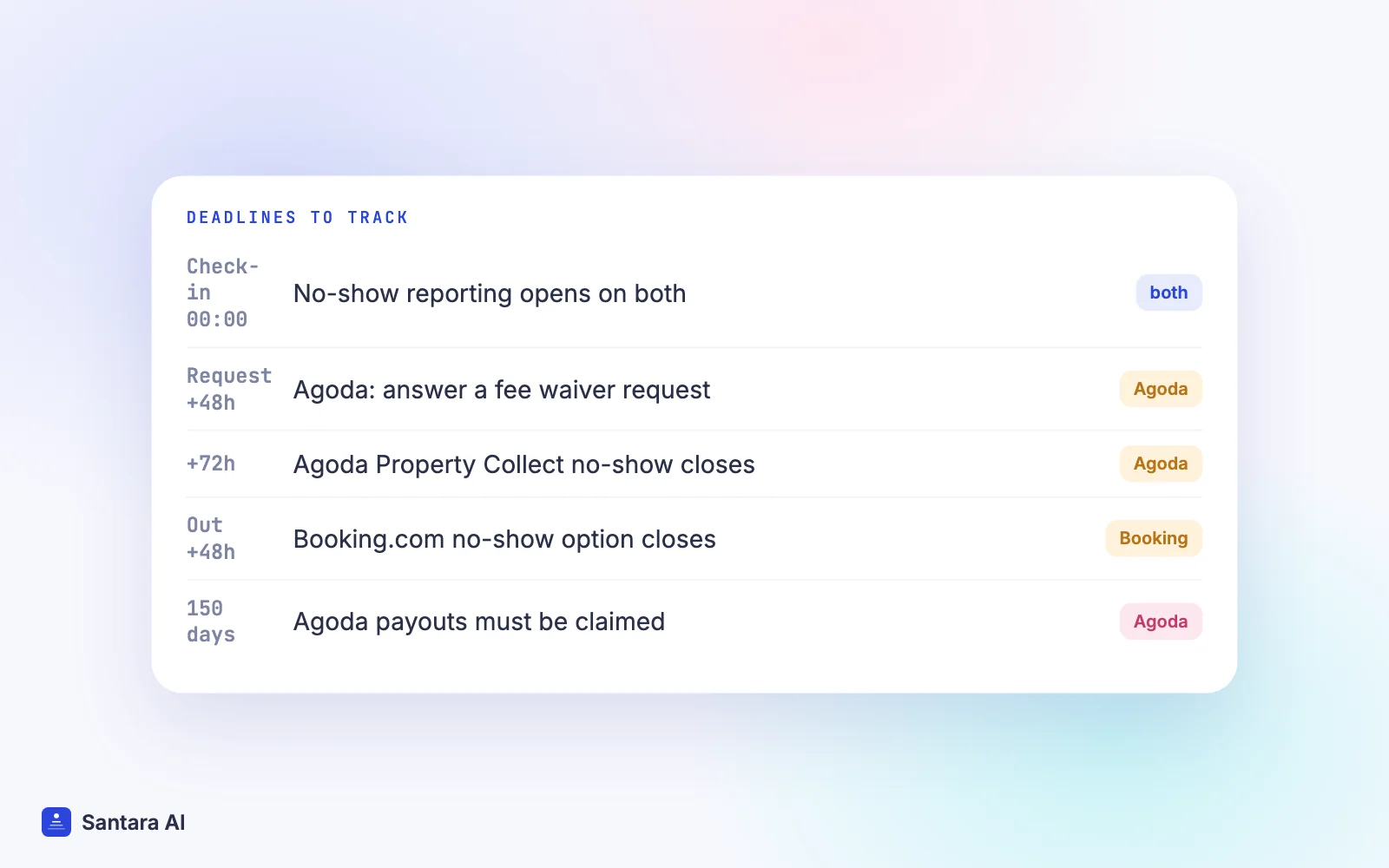
Booking.com sets reservation policies under Property, then Reservation policies in the extranet. You can offer flexible and non-refundable options, add policy exceptions for certain dates, and even allow guests to book without a credit card. To be paid a no-show or late cancellation fee, you must mark it in the extranet or Pulse. The no-show option is available only from midnight on the check-in date until 48 hours after the scheduled check-out. For non-prepaid bookings under Payments by Booking.com, Booking.com tries to collect the fee for you, and if that fails it waives the commission on that reservation. Note that Booking.com charges commission on non-refundable bookings even when the guest never arrives.
Agoda sets cancellation policies in the partner portal. Two details catch hosts out. If your property offers EasyCancel, that policy always applies. And if a rate plan comes from your channel manager without a cancellation policy, the strictest policy on your Cancellation policies page applies by default. For no-shows, you can report after midnight on the check-in date. For Property Collect bookings you can mark it yourself for 72 hours from midnight of the arrival date; for prepaid bookings you report through the Need Help button. Agoda then charges the fee according to your policy.
Step 1
Write both deadlines on your arrivals sheet
Booking.com: until 48 hours after check-out. Agoda Property Collect: 72 hours from midnight on arrival day.
Step 2
Wait before reporting
Agoda suggests checking for a late check-in request first. A guest delayed by a flight is not a no-show.
Step 3
Report on the platform, not by message
A no-show only counts once it is marked in the extranet or portal. A message to the guest does not start the fee process.
Reviews
Our post on replying to a bad review covers this in depth. The short comparison: Booking.com invites guests to review after check-out and checks your reply before publishing it, which can take up to 72 hours; it must be in the language of the review or English. Agoda moderates replies, shows them as pending for up to 48 hours, and asks you to use only the guest's first name.
Guest messages and extranet tools
Booking.com gives you two places to work: the extranet and the Pulse mobile app. Its guide to contacting guests says you reply under Inbox, then Reservation messages, or from the booking in Pulse. Some messaging functions can be handled through your connectivity provider, and the extranet's Connection management page shows which ones.
Agoda messages live in the partner portal. Its guide to booking enquiries says you can message from the Reservations page or the Messages tab. Special requests arrive through Agoda's customer messaging system. When a guest asks to waive a cancellation fee, you have 48 hours to agree or decline before the request expires.
In practice, running both means two inboxes, two sets of deadlines and two payout routines. That is manageable for one villa. With six rooms it is where mistakes start.
Commission: compare your own contracts
On commission, Agoda vs Booking.com for hosts comes down to your own contracts. Neither platform publishes one rate. Booking.com sets yours in your agreement. Agoda calls it compensation and sets it by location and, sometimes, payment model. Our Airbnb vs Booking.com fees guide explains what each one charges commission on, and the free OTA fee calculator lets you enter your own rates side by side.
How Santara AI fits with Agoda and Booking.com
You do not have to choose only one. Santara AI replaces both the PMS and the channel manager, and Agoda and Booking.com are both among its 54 channels. Each room has one calendar. Availability, nightly rate, minimum stay and other stay rules push from it to every connected channel, and new bookings, changes and cancellations from both land on the same calendar. A booking on Agoda lowers availability on Booking.com, and the other way round. Setup is covered in our guides to the Agoda and Booking.com connections.
Messages are where the two differ inside Santara AI. Booking.com guest messages arrive in the Santara AI inbox alongside Airbnb and Expedia, and AI drafts a reply that you check before pressing Send. Agoda guest messages do not come into Santara AI; you answer those in the Agoda portal.
What Santara AI doesn't do
Santara AI does not collect guest payments for Agoda or Booking.com, charge virtual cards, report no-shows or reply to reviews. Those stay in each platform's own tools. It also sends the same price to every channel, so it cannot set a higher rate on one OTA to cover a higher commission.
FAQ
Is Agoda or Booking.com better for hosts?
It depends on your guests, your contract and how you want to be paid. Booking.com can pay by bank transfer after check-out where Payments by Booking.com is available; Agoda pays mostly by virtual card, with bank transfer 30 days after departure in some markets. Compare your own commission and payout costs.
Does Agoda or Booking.com charge more commission?
Neither publishes a single rate. Booking.com sets it in your agreement, and Agoda sets its compensation by location. Check your contracts and run both through an OTA fee calculator.
How does Agoda pay hosts?
For prepaid bookings, by a virtual card per booking (UPC), one card for a batch on ePass, or bank transfer where offered. With Property Collect, the guest pays you at check-in. Payouts must be claimed within 150 days of departure.
Can I list my property on both Agoda and Booking.com?
Yes. The safe way is one calendar that feeds both, so a night sold on one closes on the other. Agoda even lets you import a listing from Booking.com when you sign up.
Keep reading
- What is a channel manager and how calendar sync works
- Double booking: what to do in the first hour
- The guest message playbook
Your first 3 months are free.
Join For Free