Guest registration in Vietnam and Indonesia: 2026 host guide
Who you must report, what to collect at check-in, deadlines, the online systems and the fines, for hosts in Vietnam (police reporting) and Indonesia (APOA), as of October 2026.
 Tai Pham
Every host in Vietnam and Indonesia has a legal duty that never shows up in an Airbnb or Booking.com dashboard: telling the authorities who is sleeping under your roof. Guest registration in Vietnam and Indonesia works differently in each country, but in both it falls on the host, not the guest and not the booking platform.
Vietnam tightened its rules in 2026. Since 1 July every overnight guest, Vietnamese or foreign, must be reported on the day they arrive, and since 24 July foreign guests must be declared online as soon as they walk in. Fines now scale with the number of guests you missed. In Indonesia, the immigration service has spent 2025 and 2026 reminding villa and homestay owners in Bali and beyond that foreign guests belong in its APOA system.
This guide covers both countries side by side as of October 2026: who must report, what to collect at check-in, the deadlines, the online systems and the penalties, with an official or named source for each point. Rules and local practice change, so confirm with your commune police in Vietnam or your local immigration office (Kantor Imigrasi) in Indonesia.
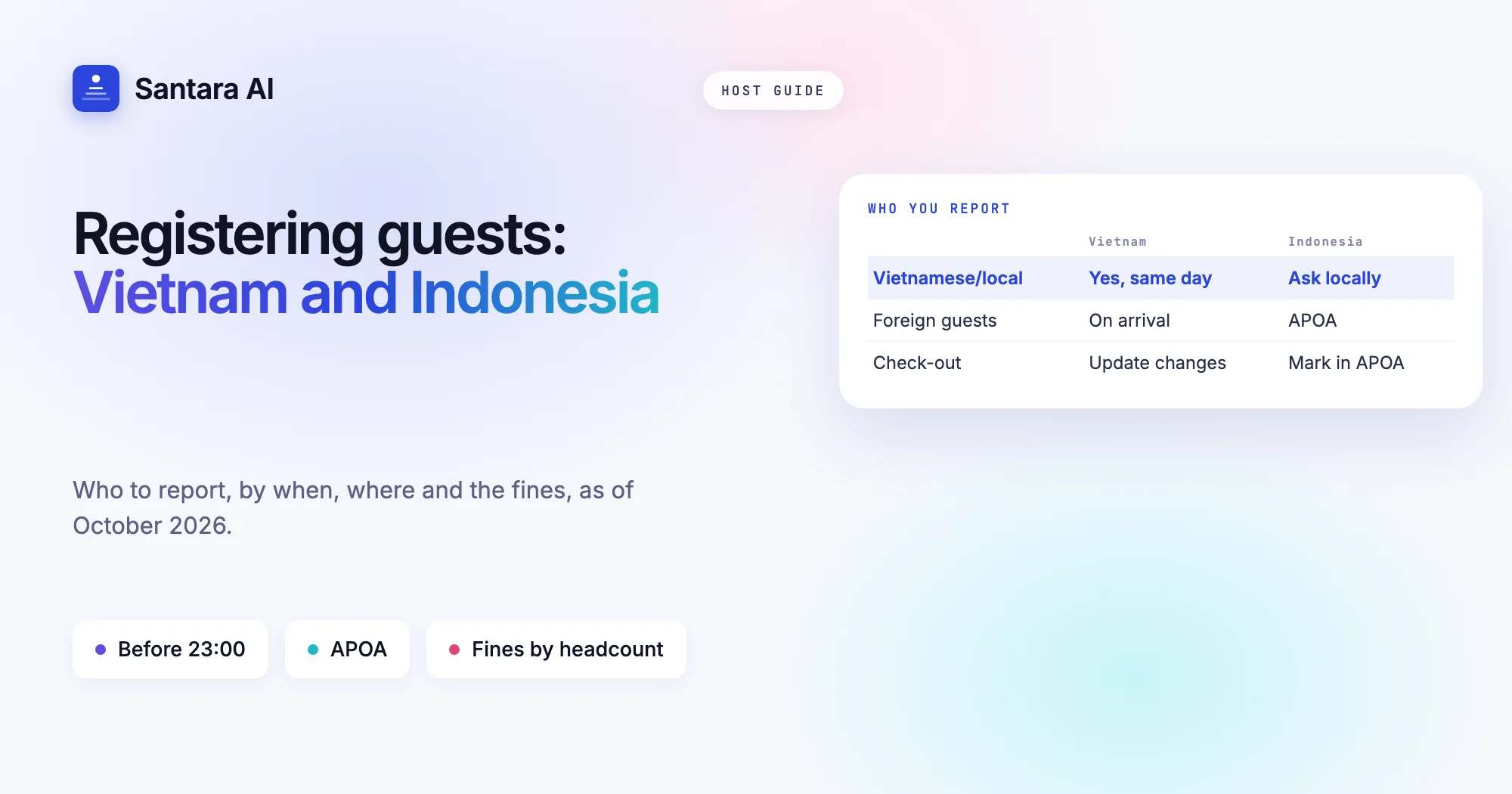
Guest registration in Vietnam and Indonesia at a glance
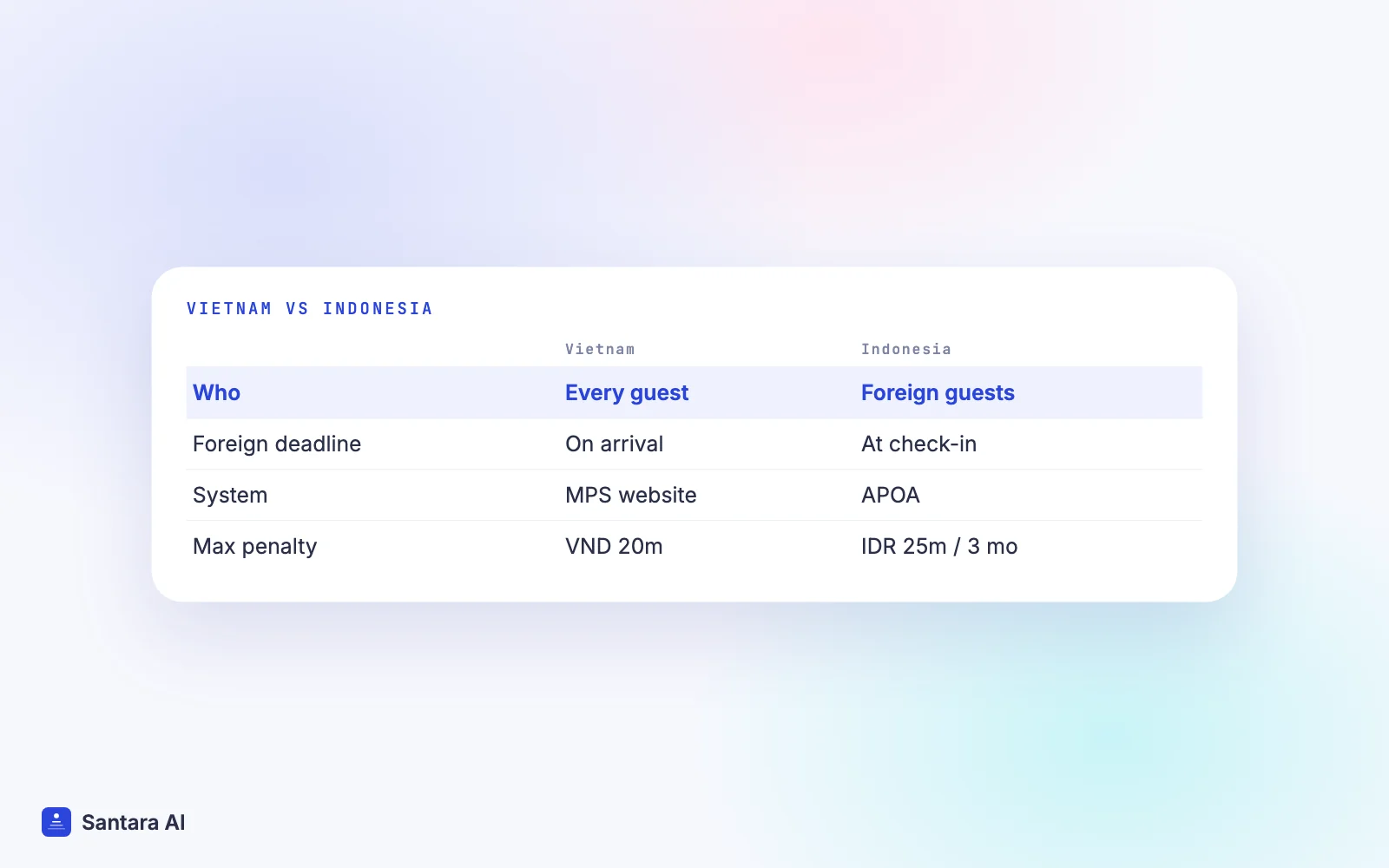
| Vietnam | Indonesia | |
| Who must be reported | Every overnight guest, Vietnamese and foreign | Foreign guests |
| Legal basis | Law on Residence, Art. 30 (amended by Law 118/2025/QH15); Law on Foreigners' Residence, Art. 33 | Immigration Law 6/2011, Art. 72, as amended |
| Deadline | Vietnamese: before 23:00 on day one. Foreign: online, as soon as they arrive | Immigration offices ask for reporting at check-in; one office cites 24 hours |
| Where | Ministry of Public Security system (tbltkbtt.bocongan.gov.vn) | APOA (apoa.imigrasi.go.id) |
| Penalty | Fines by number of guests not reported | Up to 3 months' detention or a fine up to IDR 25 million |
Vietnam: every guest, every night
Law 118/2025/QH15, which amends ten security-related laws, took effect on 1 July 2026 and rewrote Article 30 of the Law on Residence. As Sức khỏe & Đời sống reported, the representative of any tourist accommodation, explicitly including homestays and holiday villas, must notify each overnight stay:
- When: before 23:00 on the first day of the stay. If the guest arrives after 23:00, before 08:00 the next morning.
- What: full name, date of birth, personal ID number or passport number, reason for the stay, length of stay and address.
Fines under Article 10 of Decree 282/2025/ND-CP, for an accommodation business that does not notify, are VND 2–4 million for 1–3 guests, VND 4–8 million for 4–8 guests and VND 8–12 million for 9 or more. Those amounts apply to individuals; an organisation pays double.
Vietnam: foreign guests
Foreign guests have their own rule under Article 33 of the foreigners' residence law. The person running the accommodation declares the guest's temporary residence, and must ask to see the passport or other travel document before agreeing to let the guest stay.
Circular 87/2026/TT-BCA, in force since 24 July 2026, sets out how:
- Online declaration must be made as soon as the guest arrives. The commune police receive declarations around the clock.
- Paper form (NA17) is still allowed: send the information immediately by a suitable means, then deliver the form to the commune police within 12 hours, or 24 hours in remote areas.
- The declaration includes name, sex, date of birth, nationality, passport number, the validity of the visa or residence permit, and the expected length of stay.
- Your account is suspended if you make no declaration for 12 months, or if it is found to contain inaccurate information.
Khánh Hòa police add that groups must be entered one guest at a time, never one name for the whole party.
The fines are higher than for Vietnamese guests. Under Article 21 of Decree 282/2025/ND-CP, in force since 15 December 2025, an accommodation business that fails to declare pays VND 3–5 million for 1–3 foreigners, VND 10–15 million for 4–8 and VND 15–20 million for 9 or more (Khánh Hòa police).
One system since May 2026. From 21 May 2026 the Ministry of Public Security has used a single shared website, tbltkbtt.bocongan.gov.vn, for both Vietnamese and foreign guests at accommodation businesses. It replaced older separate tools, so if you still use a provincial page, check with your commune police.
Indonesia: APOA for foreign guests
Article 72 of Law 6/2011 on Immigration has two parts. Immigration officers may ask anyone who gives a foreigner a place to stay for that foreigner's details, and owners or managers of lodging must provide data on foreigners staying with them when asked. Article 117 sets the penalty for not providing it after being asked: up to three months' detention or a fine of up to IDR 25 million.
The Directorate General of Immigration collects this data through APOA, the foreigner reporting app. The process it describes:
- Log in to APOA, ask the guest for their passport, and upload or photograph the passport page.
- Enter and check the guest's details, submit, and keep the receipt (Surat Tanda Terima Pelaporan Orang Asing) as proof.
- At check-out, log in again, select the guest and confirm their departure.
Does a private villa count? The Yogyakarta immigration office said in April 2026 that hotels, villas, boarding houses and app-based rental hosts can all report themselves through APOA. In July 2026 the head of Bali's regional immigration office reminded accommodation owners of the duty and said officers were visiting businesses to explain it.
On timing, the current national guidance does not state a fixed deadline. The Kediri immigration office described a 1×24-hour window from the start of the stay. The safe habit is to report at check-in.
APOA covers foreign guests only. Whether your village or neighbourhood office also wants to know about Indonesian guests is a local matter, so ask them.
A check-in routine that works in both countries
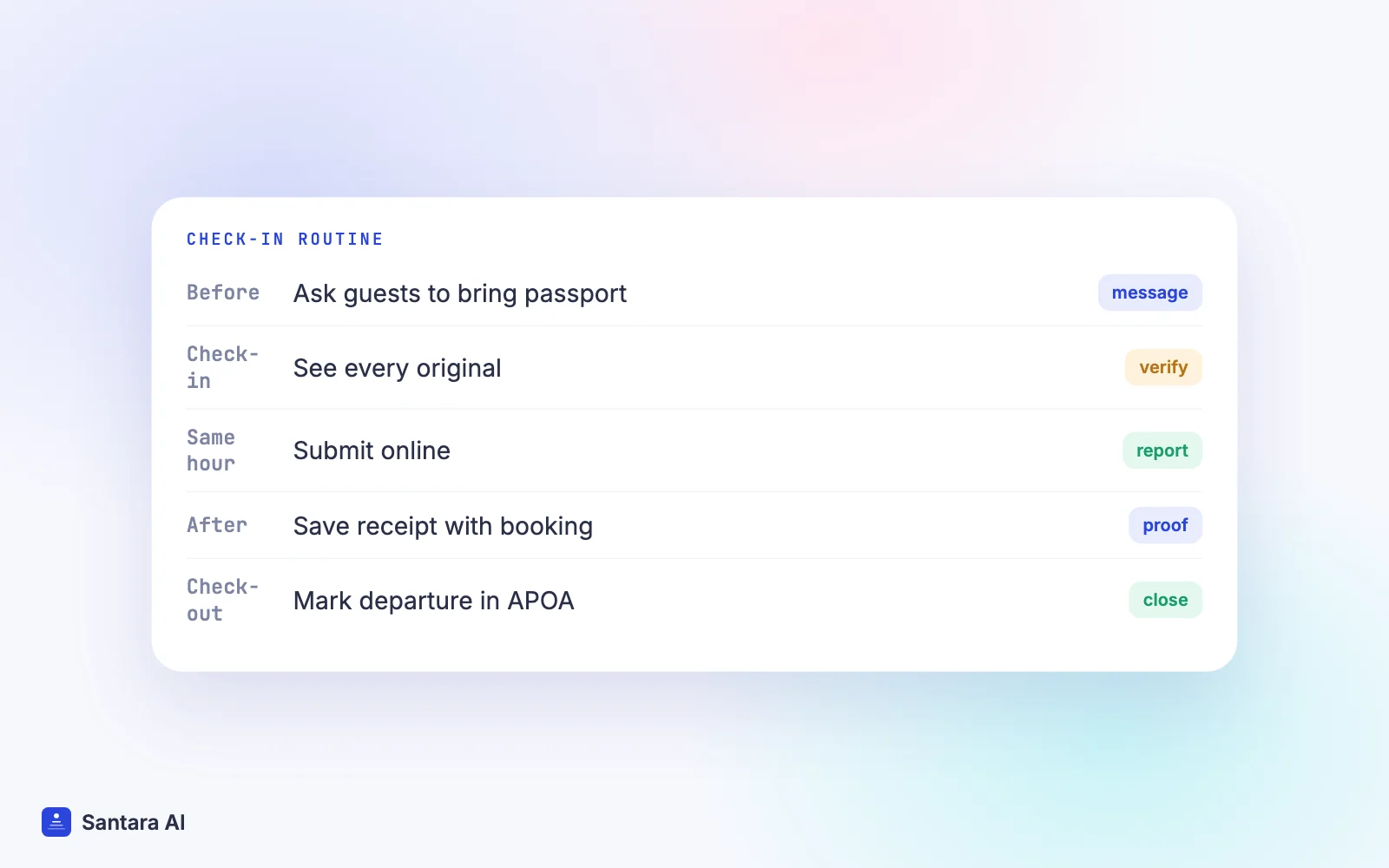
Step 1
Before arrival: ask for documents
In your pre-arrival message, tell guests to bring their passport or ID and that you will need it at check-in. A booking confirmation usually does not carry passport details, so plan to collect them yourself.
Step 2
At check-in: check and capture
See the original document for every adult guest, not one per group. Capture what the form asks for: name, date of birth, nationality, document number and, in Vietnam, visa validity.
Step 3
Within the hour: submit
Submit on tbltkbtt.bocongan.gov.vn (Vietnam) or APOA (Indonesia) right away. Late-night arrivals in Vietnam still need doing before 08:00.
Step 4
Keep the proof
Save the confirmation or the APOA receipt with the booking reference.
Step 5
At check-out: close it
In APOA, mark the guest as checked out. Update the record if a guest extends.
Self check-in properties need extra care. With a lockbox and no one on site, you still need the passport details before or at arrival. Collect them through the platform's messaging and check them against the guest at first contact.
Handling guest documents carefully
You will be holding copies of passports. Keep them only as long as you need them, in one place that only you and your manager can open, and never in a shared group chat with cleaners. Tell guests why you need the document and how long you keep it.
Where Santara AI fits
Santara AI does not do guest registration. It does not submit to the Vietnamese police system or APOA, and it does not store passport data. That stays your job.
What it does help with is knowing who arrives, so the registration happens on time:
- Daily Brief. An email each morning (6am by default) lists today's arrivals, departures and cleans, so you can see who needs registering.
- One calendar. Bookings, changes and cancellations from every connected channel land on one calendar, so a late extension or a new booking does not slip past you. See the channels on our integrations page.
- Message drafts. For Airbnb, Booking.com and Expedia guests, AI drafts replies in the inbox, such as a reminder to bring a passport. Nothing sends until you press Send.
Not legal advice
This guide summarises rules we could source as of October 2026. Local police and immigration offices may apply them differently. Confirm with them, and for a full licensing checklist see our Vietnam homestay licence guide and Bali villa licence guide.
FAQ
Do Airbnb hosts in Vietnam have to register guests with the police?
Yes. Since 1 July 2026, homestays and other tourist accommodation must notify every overnight guest before 23:00 on the first day, and declare foreign guests online as soon as they arrive.
What is APOA in Indonesia?
APOA is the Directorate General of Immigration's app for reporting foreign guests. Owners and managers of hotels, villas and other lodging log in, upload the guest's passport page at check-in and mark check-out when they leave.
What is the fine for not registering foreign guests in Vietnam?
Under Decree 282/2025, an accommodation business pays VND 3–5 million for 1–3 foreigners not declared, rising to VND 15–20 million for 9 or more.
Do I need to report Indonesian guests in APOA?
No. APOA is for foreign nationals. Ask your village or neighbourhood office whether it expects to be told about domestic guests.
Keep reading
- The guest message playbook
- Turnover day without chaos
- What is a channel manager and how calendar sync works
Your first 3 months are free.
Join For Free