Vietnam homestay licence guide 2026: six steps, in order
There is no single Vietnam homestay licence. Here are the six registrations a homestay needs, in the order that works, with the 2026 changes and the catch for foreign owners.
 Tai Pham
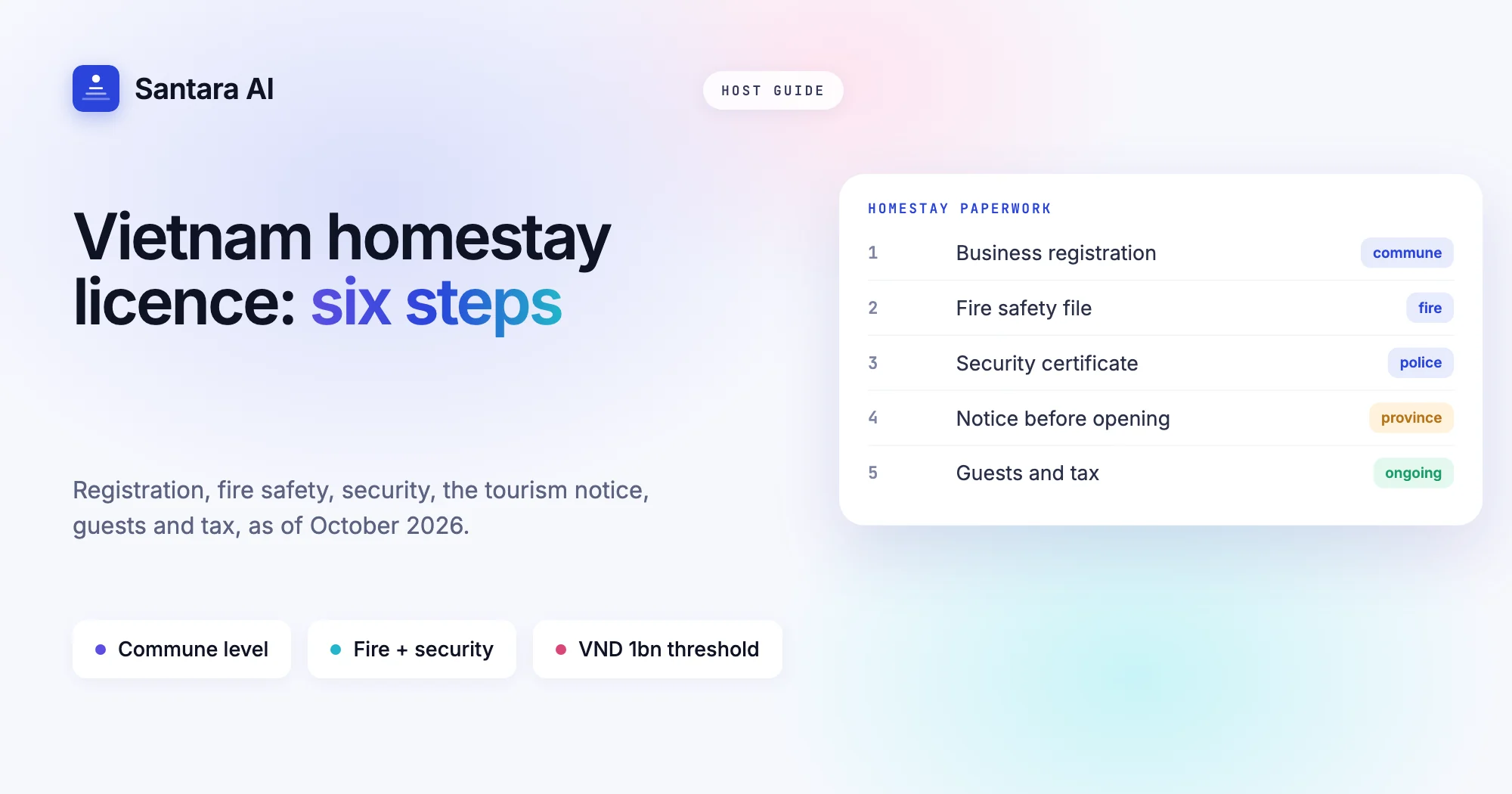
If you are searching for a "Vietnam homestay licence", you will not find a single document with that name. A legal homestay or short-term rental in Vietnam runs on a set of registrations held by different offices: a business registration, fire safety papers, a security and order certificate, a written notice to the provincial tourism department, and, once guests arrive, police registration of every overnight stay plus tax filing.
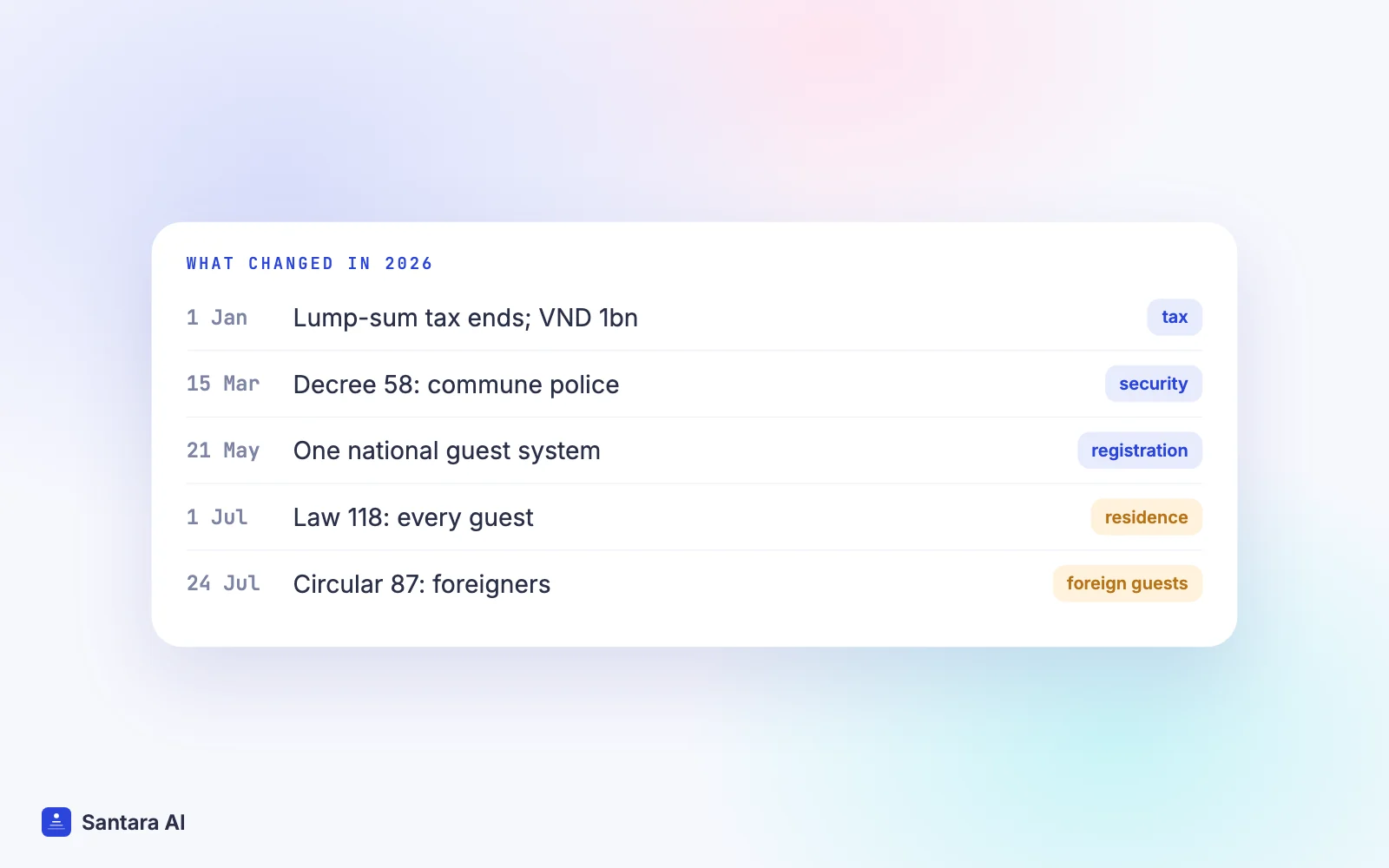
Most of these rules moved in 2025 and 2026. Districts were abolished, so paperwork now goes to the commune. The old lump-sum tax ended. Commune police took over security certificates for small properties. Since 1 July 2026 every overnight guest, Vietnamese or foreign, has to be reported on the day they arrive. Guides written before 2026 often get at least one of these wrong.
This post walks through each step in the order that works, as of October 2026, with the legal basis and an official or named source for each point. It is written with foreign owners and investors in mind, because one rule in particular catches them out. It is not legal advice. Use it as a checklist, then confirm with the commune People's Committee, the commune police and the tax office where your property is.
What a Vietnam homestay licence actually covers
| Requirement | Who handles it | Legal basis |
| Business registration with accommodation as a business line | Commune-level business registration office | Decree 168/2025/ND-CP |
| Fire prevention and fighting (PCCC) papers | Fire police; commune police | Decree 105/2025/ND-CP |
| Certificate of security and order | Commune police for 29 rooms or fewer | Decree 96/2016/ND-CP, amended by 56/2023 and 58/2026 |
| Minimum tourism standards and a notice before opening | Provincial Department of Culture, Sports and Tourism (or Tourism) | Law on Tourism 2017; Decree 168/2017/ND-CP |
| Report every overnight guest; declare foreign guests | Ministry of Public Security system | Law on Residence as amended by Law 118/2025/QH15; Law on Entry, Exit, Transit and Residence of Foreigners, Article 33 |
| File tax, or report revenue if under the threshold | Your tax office | PIT Law 109/2025/QH15; VAT Law 48/2024/QH15; Decrees 68/2026 and 141/2026 |
The catch for foreign owners
Start here if you are not a Vietnamese citizen. Most small homestays register as a household business (hộ kinh doanh), because it is the simplest structure. But Article 82 of Decree 168/2025/ND-CP says a household business is set up by individuals or household members who are Vietnamese citizens. Article 83 adds that each person can register only one household business nationwide.
So the household route is not open to you in your own name. Putting the business in a Vietnamese partner's name may look like a shortcut, but it leaves the legal ownership and liability with them. Talk to a licensed Vietnamese lawyer about which structure fits your case before you take a single booking.
The same article has one more detail that matters to everyone: the exemption that lets some low-income activities skip registration does not apply to conditional business lines. Accommodation is a conditional line, so even a two-room homestay must register.
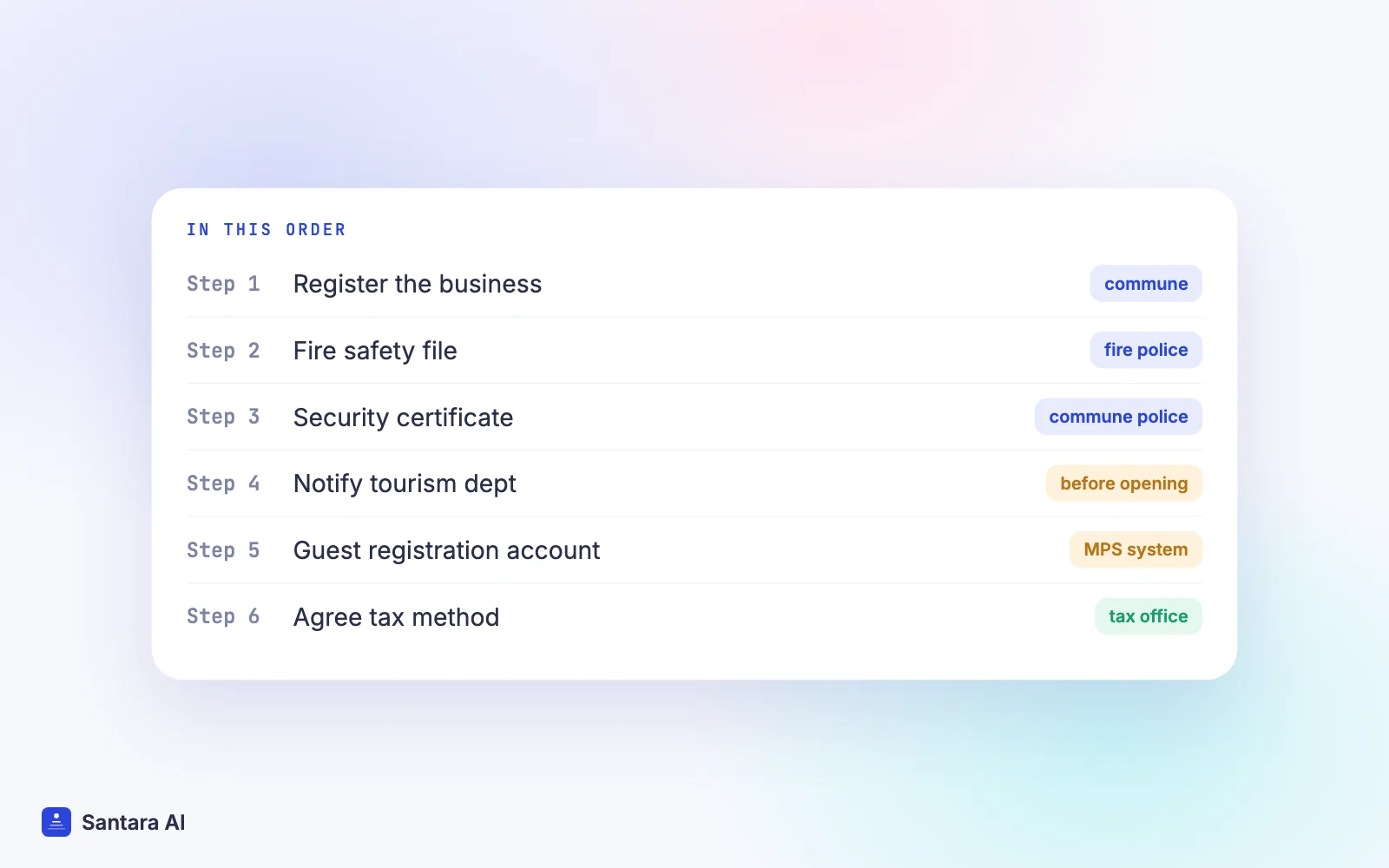
Step by step, in the right order
Order matters because each office asks for papers from the one before.
Step 1
1. Register the business
File at the commune-level business registration office, with accommodation listed as a business line. Since 1 July 2025 local government is province plus commune, and household businesses register at the commune level.
Step 2
2. Prepare the fire safety file
Write internal fire rules and a firefighting plan, fit the equipment your building needs, and keep design approval and acceptance papers if your building required them.
Step 3
3. Apply for the security and order certificate
At the commune police for 29 rooms or fewer, with your business registration and copies of the fire papers.
Step 4
4. Notify the provincial tourism department
Send the written notice before you open, and confirm the deadline the department applies.
Step 5
5. Open a guest registration account
Register your property on the Ministry of Public Security system before your first guest checks in.
Step 6
6. Agree your tax method with the tax office
Confirm whether you file quarterly or only report revenue, and when e-invoices become mandatory.
Fire safety and the security certificate
The fire police said in a public answer that lodging businesses fall under item 14 of Appendix I and item 19 of Appendix II of Decree 105/2025/ND-CP. A reproduction of Appendix I gives item 14 as lodging of two or more storeys or 50 m² or more of total floor area, which covers almost any homestay. The <a href="https://pbgdpl.gov.vn/Pages/tin-tuc-hd-pbpl.aspx?ItemID=9535&l=HoatdongPBGDPLodiap">Ministry of Justice summary lists the minimum fire file: internal rules, a firefighting plan, and approval and acceptance papers where the building needs them.
For the security certificate, Decree 58/2026/ND-CP, issued 13 February 2026 and in force from 15 March 2026, has commune police handle places with 29 rooms or fewer; provincial police handle 30 rooms or more. The Ministry of Justice lists the dossier: a request form, the business registration, copies of fire papers, and a personal declaration with a criminal record certificate for the person responsible. Foreign nationals attach a copy of their passport and residence papers.
Tourism standards and the opening notice
The Law on Tourism calls a homestay "nhà ở có phòng cho khách du lịch thuê", a home with rooms let to tourists. The Ministry of Culture, Sports and Tourism lists the minimum conditions under Article 27 of Decree 168/2017, as amended: business registration; security, fire, environmental and food-safety compliance; a sleeping area, kitchen, bathroom and toilet; bed, mattress or mat, blankets, pillows, mosquito net and towels, with covers and towels changed for each new guest.
The same page says Article 29 requires a written notice to the provincial department at least 15 days before you open, giving the name, type, size, address and legal representative, and committing to meet the conditions. An incomplete or late notice can cost VND 500,000 to 1,000,000 under Decree 45/2019/ND-CP as amended by Decree 129/2021 (<a href="https://pbgdpl.gov.vn/Pages/tin-tuc-hd-pbpl.aspx?ItemID=9535&l=HoatdongPBGDPLodiap">Ministry of Justice).
After opening: guest registration and tax
Guest registration is a daily task, not a one-off licence. Since Law 118/2025/QH15 took effect on 1 July 2026, a homestay must notify every overnight stay before 23:00 on the first night, and foreign guests must be declared as soon as they arrive. Deadlines, the online system and the fines are in our guest registration guide for Vietnam and Indonesia.
Tax changed in 2026 too:
- Lump-sum tax and the business licence fee ended on 1 January 2026 (Resolution 198/2025/QH15). Households now self-declare.
- Threshold: VND 1 billion a year. Decree 141/2026/ND-CP raised it from VND 500 million, applying from 1 January 2026. Older articles still quote 500 million.
- Under the threshold: no VAT or PIT, but you still report actual revenue to the tax office, with 31 January of the next year as the final date (Decree 68/2026 guidance).
- Over the threshold: file quarterly. A tax office has confirmed VAT of 5% of revenue for accommodation. Resident individuals with revenue up to VND 3 billion choose between 2% of revenue above the threshold or 15% of net income; above that, income-based rates apply (PIT Law 109/2025, Article 7).
- Non-residents pay PIT on total business revenue, 5% for services, under Article 20 of the same law. You count as resident if you spend 183 days or more in Vietnam in the period or have a regular residence there (same source).
- E-invoices are mandatory once annual revenue passes VND 1 billion (Decree 141/2026).
VAT revenue includes surcharges and extra fees, such as cleaning fees, so leave nothing out when you add up the year.
Common mistakes
- Assuming a two-room homestay does not need to register.
- Registering in a Vietnamese friend's name without advice on ownership and liability.
- Taking Airbnb or Booking.com bookings before the tourism department notice has gone in.
- Declaring foreign guests but not Vietnamese overnight guests.
- Using the old VND 500 million threshold for 2026.
- Looking for a district office that no longer exists.
If you are setting up your operations at the same time, our guide on how to choose villa management software lists the questions worth asking.
Where Santara AI fits
To be plain: Santara AI does not handle licences, tax filing or police guest registration. Those stay with you, or with whoever you authorise, on the government's own systems.
What Santara AI does is the daily operation around them:
- One calendar for every channel. Santara AI replaces both the PMS and the channel manager. Bookings, changes and cancellations from Airbnb, Booking.com, Agoda, Traveloka, Tiket.com and others land on one calendar, out of 54 channels you can see on the integrations page.
- A Daily Brief each morning. An email at 6am by default lists today's arrivals, departures and cleans. The arrivals list is a practical reminder of who you need to register that day.
- One inbox. Guest messages from Airbnb, Booking.com and Expedia arrive in one place, and AI drafts replies, for example asking guests to bring their passport. Nothing sends until you press Send.
- A direct booking site in every plan, selling from the same calendar.
What we do not do
Santara AI does not store or submit guest registration data, does not connect to police or tax systems, and does not review your legal paperwork. This guide reflects the rules we could source as of October 2026 and is not legal or tax advice.
FAQ
Do I need a licence to run a homestay in Vietnam?
Yes, though it is a set of registrations rather than one licence: a business registration, fire safety papers, a security and order certificate, and a notice to the provincial tourism department before you open. Accommodation is a conditional business line, so small homestays are not exempt.
Can a foreigner open a homestay in Vietnam?
Not as a household business in their own name, because Decree 168/2025 limits household businesses to Vietnamese citizens. Other structures exist. Get advice from a licensed Vietnamese lawyer before you invest or take bookings.
Is Airbnb legal in Vietnam?
Renting rooms to tourists is legal when the property meets the requirements above and every guest is registered with the police. Listing on Airbnb does not replace any of these steps.
What tax does a homestay pay in Vietnam in 2026?
Household businesses with annual revenue of VND 1 billion or less pay no VAT or PIT but must report revenue. Above that, accommodation pays VAT at 5% of revenue plus PIT, filed quarterly. Confirm with your tax office.
Keep reading
- What is a channel manager and how calendar sync works
- Direct booking websites for vacation rentals
- Turnover day without chaos
Your first 3 months are free.
Join For Free