Is Booking.com Genius worth it? Genius vs Preferred for hosts
Booking.com Genius, Preferred Partner and Visibility Booster explained from Booking.com's partner pages, with a break-even example you can redo with your own rate.
 Tai Pham
Once your property has a few reviews, Booking.com starts suggesting ways to "boost performance": Genius, the Preferred Partner Programme, the Visibility Booster. Each promises more visibility. Each costs you something, either a discount for the guest or a higher commission for Booking.com. So is Booking.com Genius worth it for a small villa or guesthouse, and what about Preferred?
There is no single answer, because the cost depends on your own rate, your contract and how many of your guests are Genius members. What you can do is understand exactly what each programme asks of you, then run the numbers. This guide explains the three programmes using only Booking.com's own partner pages, checked on 22 October 2026, and walks through a worked example you can repeat with your figures.
One more thing before we start. Booking.com publishes average results for these programmes, and we quote them below as Booking.com's own figures. They are averages across many properties, not a forecast for yours.
The three programmes in one table
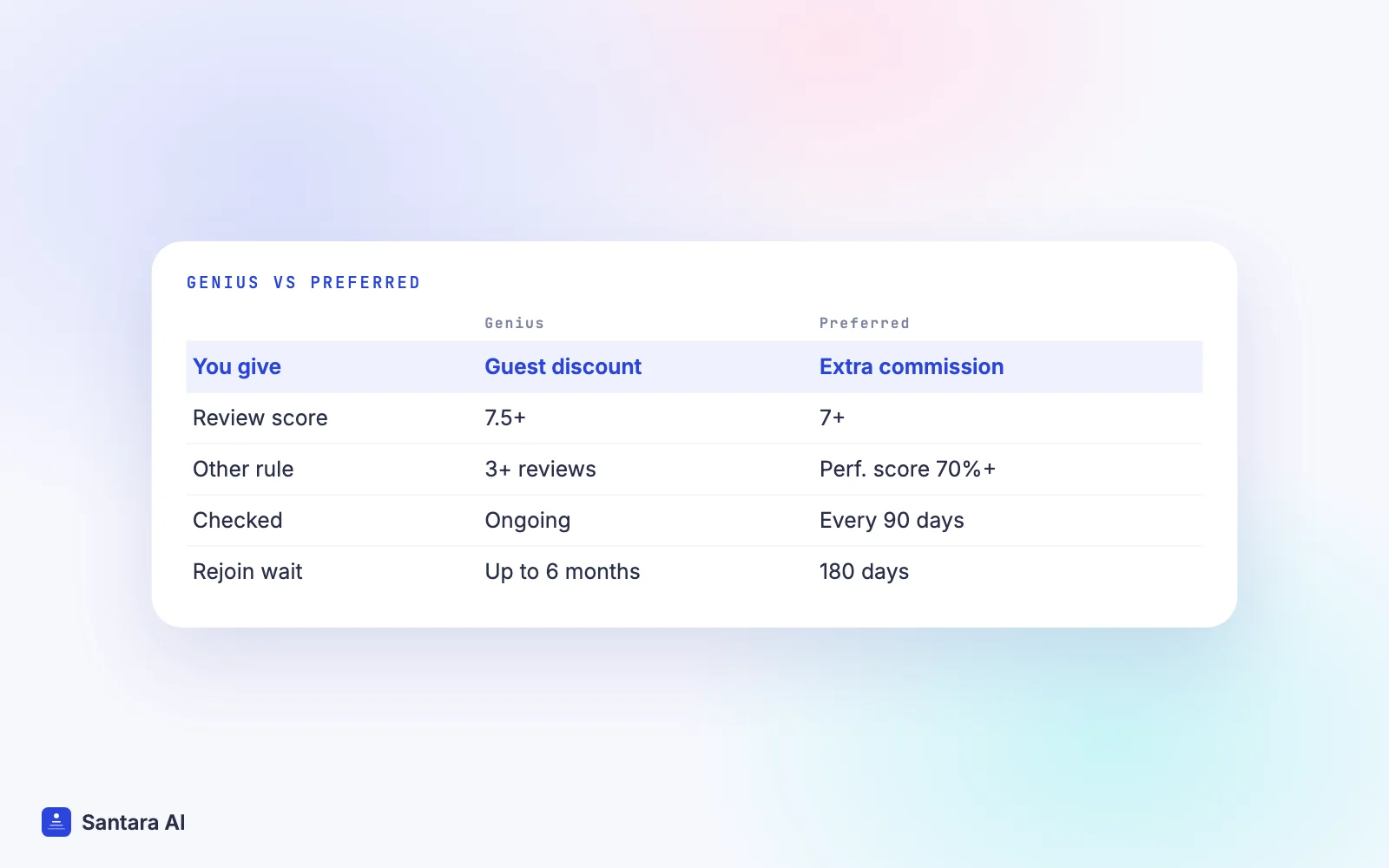
| Genius | Preferred Partner | Visibility Booster | |
| What you give | A discount (10% minimum) to Genius guests | A higher commission | A higher commission on dates you pick |
| Main entry rules | 3+ reviews, review score 7.5+ | Performance score 70%+, review score 7+ | Set it up in the extranet |
| Duration | Ongoing, with limited pause days | Ongoing, checked every 90 days | Short periods you choose |
| Leaving | Any time; rejoining may take six months | Any time; 180-day wait if removed | Switch off per period |
All three live in the extranet under Boost performance.
How Genius works for hosts
Booking.com's help article Understanding the Genius marketing programme is the main source here.
When you join, a 10% discount applies automatically to your least expensive and most popular room type. If those are the same room, only that room gets it. You can add deeper discounts for higher Genius levels and "value-adds" such as free breakfast or a room upgrade. Booking.com is clear that the standard Genius discount is funded by you, not by Booking.com.
To join you need at least three guest reviews and a review score of at least 7.5 out of 10. If your property is in a wide-parity or narrow-parity country, you must also offer competitive prices on Booking.com compared with other websites (wide parity) or your own website (narrow parity). Your General Delivery Terms say which applies to you. You must keep meeting these rules to stay in.
In return, Booking.com says Genius partners get Genius branding, appear in filtered searches and receive targeted marketing. It reports that, on average, partners who join see 30% more search result views, 45% more bookings and 40% more revenue "with the cost of the discount accounted for".
Genius levels: who actually gets the discount
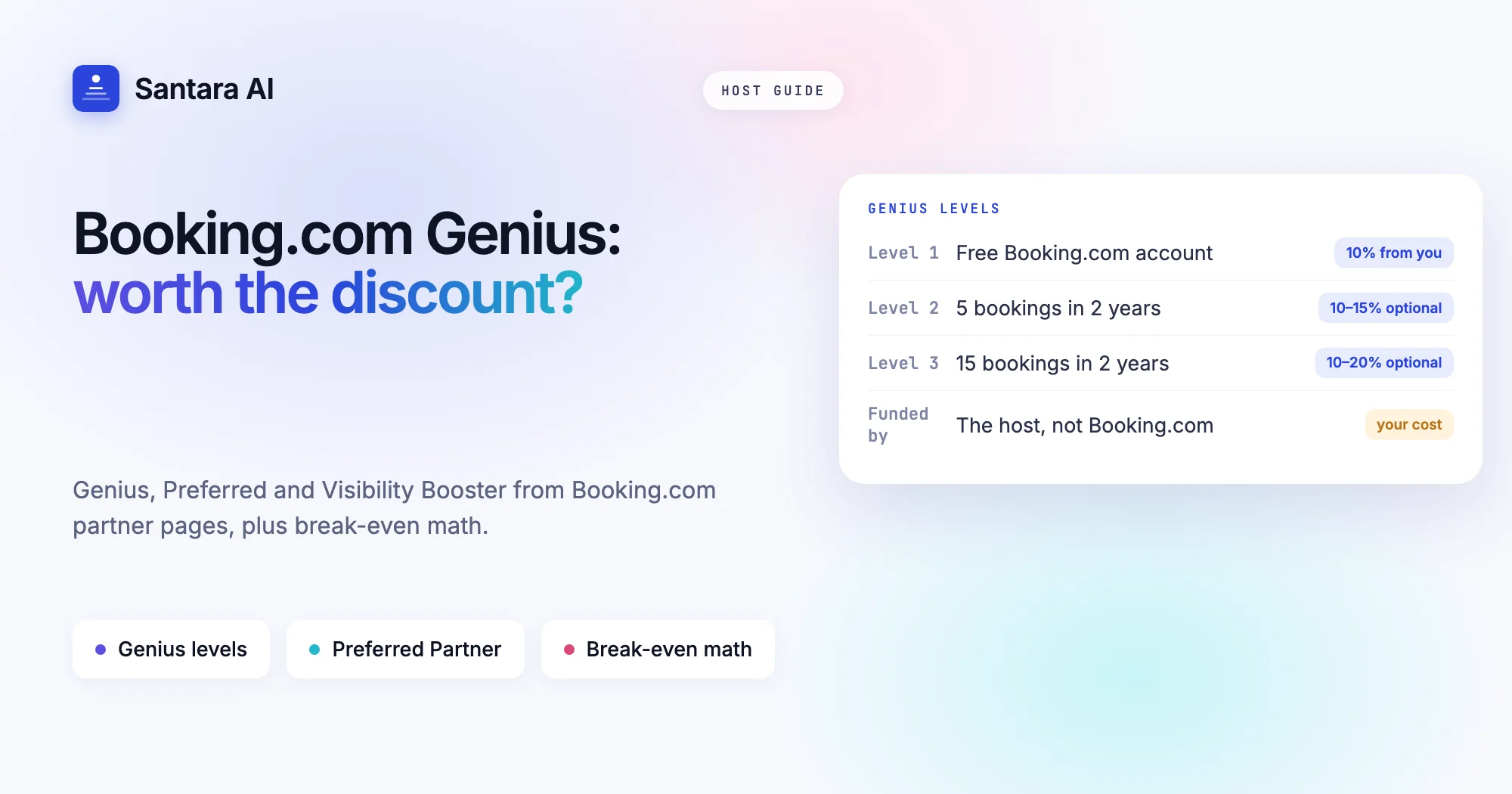
The guest side matters more than most hosts realise. Booking.com's Genius page for travellers says there are three levels:
- Level 1: unlocked as soon as a traveller creates a free Booking.com account.
- Level 2: after 5 completed bookings within 2 years.
- Level 3: after 15 completed bookings within 2 years.
Levels never go down. On the host side, every level gets your 10% discount. You can choose to offer 15% to Levels 2 and 3, and 20% to Level 3.
Two details change the maths. First, Level 1 only needs a free account, so a large share of signed-in guests may qualify. Second, the partner help page says that for properties in APAC and EMEA, guests can see the Genius 10% discount even while signed out. If you run a homestay in Da Nang or a villa in Bali, that is you.
Pausing Genius on peak dates
You can protect high-demand dates, within limits. According to the help page:
- With the 10% discount, you can suspend it for up to 30 days.
- If you offer 15% to Levels 2 and 3, you get an extra 30 days to pause the 15% discount only.
- If you offer 20% to Level 3, you get an extra 60 days to pause the 15% and 20% discounts only.
Booking.com's Genius solutions page adds that you can pause for 30 or 90 days a year depending on your level, with a maximum of 30 calendar days at a time. Blocked days do not have to be consecutive. Plan them around your real peaks, such as Christmas and New Year, Chinese New Year or local holidays. Our peak season pricing guide helps you find those dates.
You can leave Genius at any time with immediate effect, but Booking.com warns you may only be able to rejoin after a six-month waiting period. Do not quit for one busy week. Use the pause days instead.
Genius discounts can also stack with other promotions: up to three discounts in total, with only the highest discount from each promotion category applying. Check what a guest really pays before you add a mobile rate or a last-minute deal on top.
Preferred Partner Programme and Preferred Plus
The Preferred Partner Programme works the other way round. The guest pays your normal price, and you pay Booking.com more. Booking.com describes it as greater exposure in search results and a thumbs-up badge "in exchange for a small increase in commission". It does not publish that increase on the public page; your extranet shows what applies to you.
Eligibility: a performance score of at least 70% (based on the commission your property can generate and demand compared with similar properties already in the programme), a review score of at least 7 out of 10, and the same parity rule as Genius. Booking.com's programme page says only 30% of partners in a geographic area who meet the requirements can be Preferred at any time. It reports an average of 65% more search views and 20% more bookings.
Eligibility is checked every 90 days. You can opt out whenever you like, and your commission changes immediately. If you are removed, or leave after being told you no longer qualify, you can only rejoin after 180 days.
Preferred Plus is a higher tier for about 10% of Preferred partners. It needs a performance score of 80% and a review score of 8, and costs a further commission increase.
Visibility Booster
The Visibility Booster is short-term. You choose check-in dates, optionally a country of bookers to target, and a commission rate on a slider. Booking.com suggests it for high-demand dates, low-occupancy periods, and reselling rooms after last-minute cancellations. Booking.com's commission page confirms that both Preferred and the Visibility Booster add a percentage on top of your base commission.
Is Booking.com Genius worth it? Run your own numbers
Here is a worked example. All figures are hypothetical; replace them with yours.
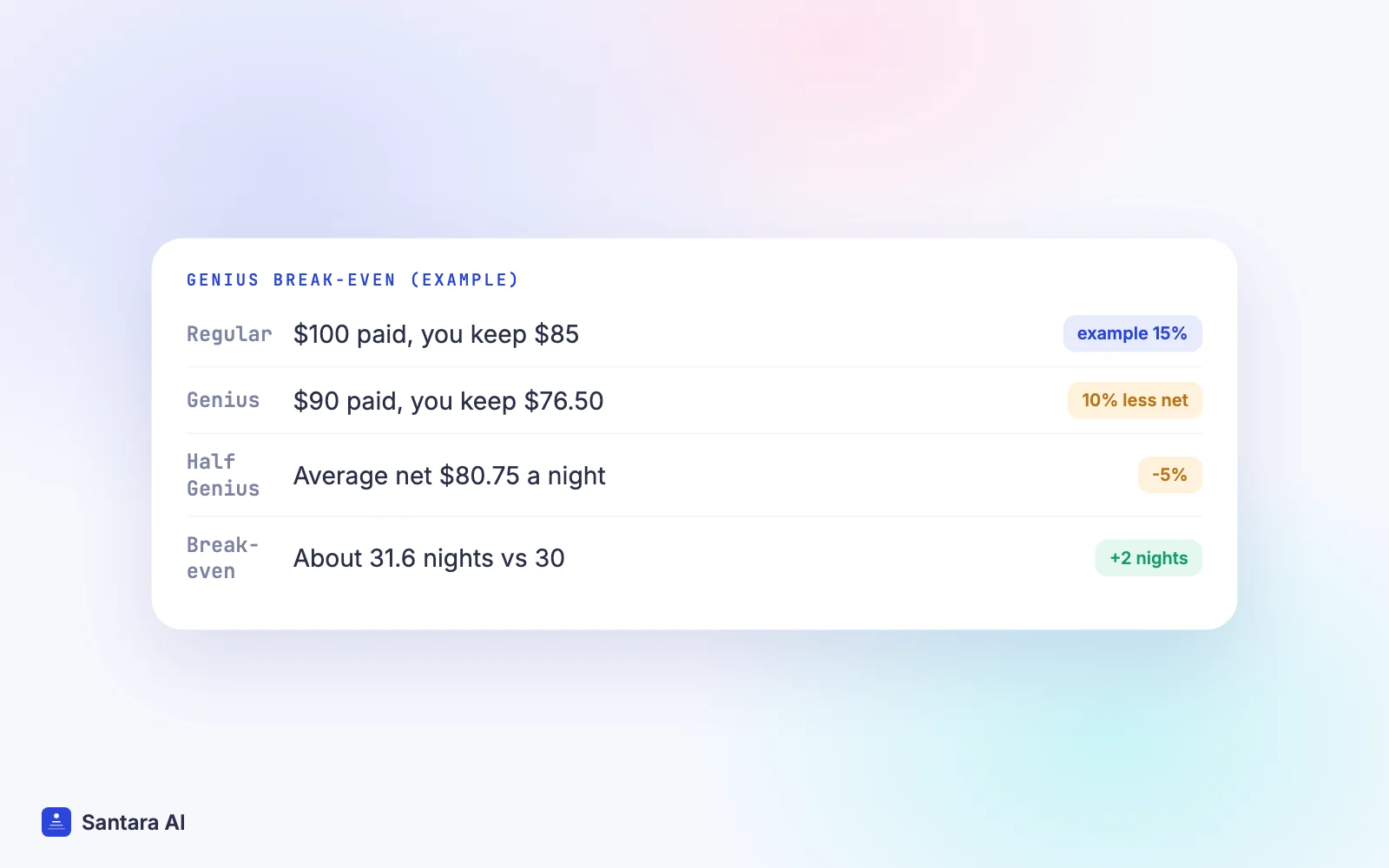
Say your villa's rate is $100 a night and your Booking.com contract commission is 15% (an example, not a typical rate). We assume commission is taken on the price the guest pays; check your reservation statement to confirm how yours is calculated.
| Regular guest | Genius guest (10%) | |
| Guest pays | $100 | $90 |
| Commission (example 15%) | $15.00 | $13.50 |
| You keep | $85.00 | $76.50 |
Each Genius night earns you $8.50 less, which is 10% of your net. Now suppose half of your Booking.com nights end up being Genius nights. Your average net per night falls from $85.00 to $80.75. If you sold 30 nights a month before, you need about 31.6 nights to earn the same $2,550. In other words, Genius pays for itself if it brings roughly two extra nights a month, and those must be nights you would not have sold anyway.
Preferred is simpler to test. Every extra commission point costs 1% of your Booking.com revenue. On $3,000 a month, one point is $30. At $85 net per night, that is about 0.35 extra nights a month per point. Read the uplift in your extranet, multiply, and compare with the bookings you actually gain over a full 90-day check.
To plug in your own rate and contract, use our free OTA fee calculator, and see what Booking.com charges commission on in our Airbnb vs Booking.com fees guide.
Step 1
Measure before you join
Write down three months of Booking.com nights, revenue and average rate, so you have a baseline.
Step 2
Join and watch the Genius report
Booking.com's extranet has a Genius report with bookings, room nights and revenue. Compare it with your baseline after 60 to 90 days.
Step 3
Protect your peaks
Spend your pause days on the dates you already sell out, not on random weekends.
Step 4
Decide on the extra levels last
Start with the 10% only. Add 15% or 20% for higher levels only if the data shows those guests book more or stay longer.
A good review score is the entry ticket to both programmes, so it is worth protecting. Our guide to replying to a bad review covers what to do when one lands.
How Santara AI handles Genius and Booking.com
Booking.com is one of the 54 channels Santara AI connects. Your rates, availability and stay rules come from one calendar per room, as explained in our Booking.com channel manager guide, and Booking.com reservations land on that same calendar.
Santara AI sends the same price to every channel. It does not set a different price or markup for Booking.com. That means a Genius discount, a Preferred commission or a Visibility Booster is set and paused in Booking.com's own extranet, and Booking.com applies it on top of the rate Santara AI sends. If you want to recover a Genius discount, you change your base rate for all channels, not just one.
What Santara AI doesn't do
Santara AI does not switch Genius, Preferred or the Visibility Booster on or off, schedule Genius pause days, or read your commission rate from your Booking.com contract. Those stay in the Booking.com extranet.
FAQ
Is Booking.com Genius worth it for small properties?
It can be if it brings extra nights you would not otherwise sell. Each Genius night pays you 10% less at the standard level, so work out how many extra nights you need using your own rate and commission, then check the Genius report after 60 to 90 days.
Who pays for the Genius discount, the host or Booking.com?
The host. Booking.com's help page says the standard Genius discount is funded by the accommodation partner. Booking.com may run separate campaigns that it announces separately.
Does the Preferred Partner Programme cost extra commission?
Yes. Booking.com describes it as more visibility in exchange for a small increase in commission. The exact increase is shown in your extranet, not on a public page.
Can I leave Genius and rejoin later?
You can leave at any time, effective immediately, but Booking.com says you may only be able to rejoin after six months. Pausing the discount on peak dates is usually the better option.
Keep reading
- Agoda vs Booking.com for hosts
- Occupancy, ADR and RevPAR explained
- Low season playbook for vacation rentals
Work out your own break-even in the OTA fee calculator.
Your first 3 months are free.
Join For Free