Monthly rental for digital nomads in Asia: a host's guide
Price a month, set Airbnb and Booking.com for 28+ night stays, prepare the Wi-Fi and desk nomads check, write a direct monthly agreement, and know the official visa basics.
 Tai Pham
A guest messages on a Tuesday: "I work remotely. Could I stay for six weeks, and is the Wi-Fi good enough for video calls?" For a host in Canggu, Chiang Mai or Da Nang, that one message can fill a month that would otherwise be a patchwork of two-night stays. It can also go wrong if the price, the payment schedule or the house simply isn't set up for someone who lives and works there for weeks.
This guide is about the monthly rental for digital nomads: how Airbnb and Booking.com handle stays of 28 nights and more, how to price a month, what remote workers check before they book, how to write a simple agreement for a direct monthly stay, and what the official immigration pages say about the visas your guests are likely to hold. Every platform and visa fact links to the official page we read in October 2026. Rules change, so confirm before you rely on them.
If you're looking at long stays mainly to fill a quiet season, read our low season playbook first. This post goes deeper on the guest who comes to work, and on the setup a monthly stay needs.
Who books a monthly stay, and why it's different
A nomad is not a long holiday guest. They need the home to work as an office on weekdays and as a home at weekends. That changes what they ask about:
- Internet first. Speed, stability and what happens during a power cut.
- A real place to work. A table at the right height and a chair they can sit in for six hours.
- Running a household. Laundry, a kitchen they can cook in, drinking water, rubbish collection.
- Clear money terms. What the month costs, what is included and when they pay.
- Paperwork. Whether their visa allows the length of stay, and whether you register them with the authorities.
Get these right and a monthly rental for digital nomads is one of the calmest bookings you can have: one check-in, one check-out and a guest who treats the place as home.
Monthly stays on Airbnb: discounts, payments and cancellation
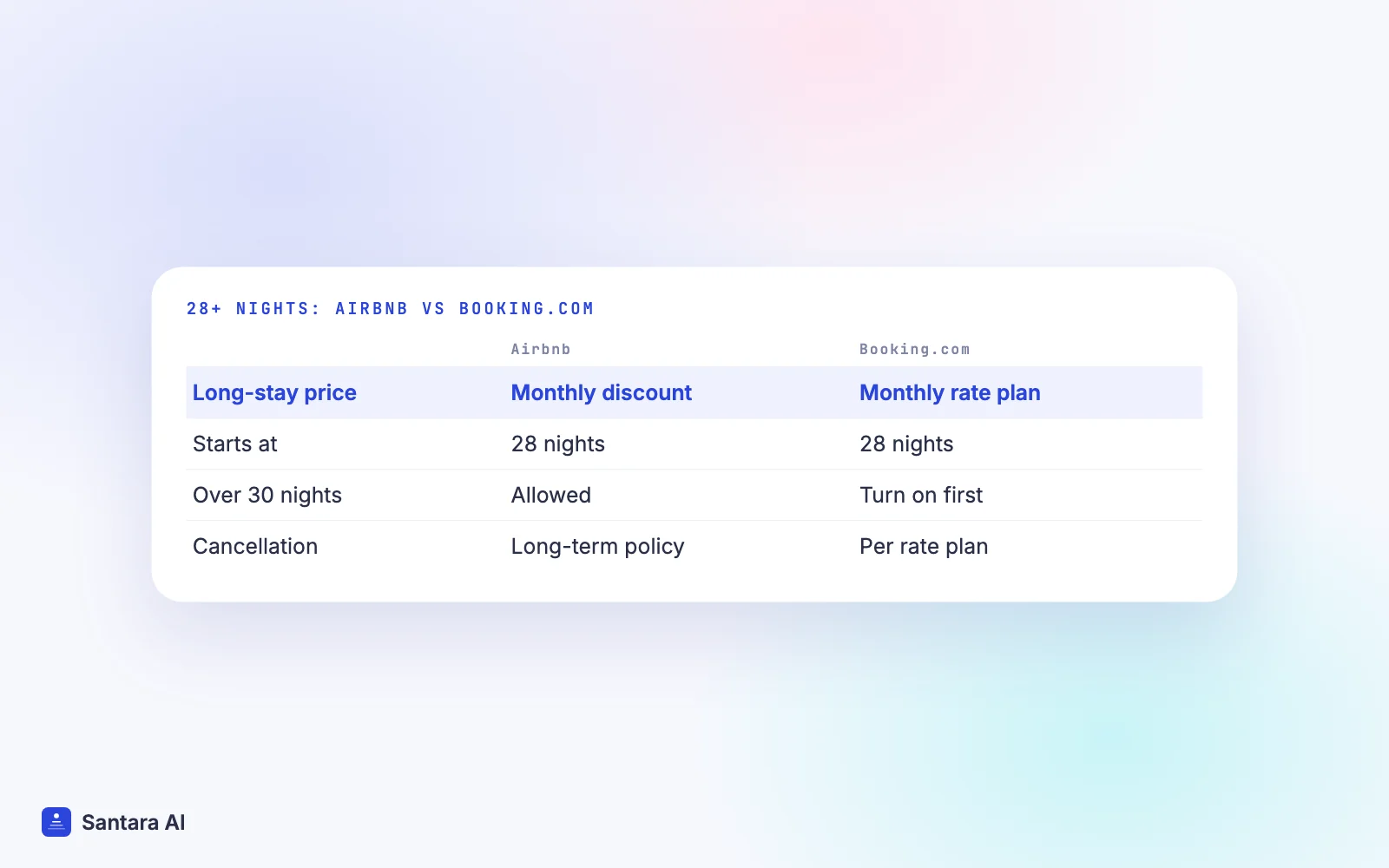
Discounts. Airbnb's discounts help article lets you set a weekly discount for 7 or more nights and a monthly discount for 28 or more nights, from Calendar → Discounts. Discounts of 10% or more are shown in search results. Airbnb sometimes adds its own Monthly Stay Savings to 28+ night stays; the article says this is paid by Airbnb and not deducted from your payout.
Payments. For stays of more than 28 nights, Airbnb's resource page on longer stays says the guest is charged for the first 30 nights when they book, that payment is released to you about 24 hours after check-in, and later nights are collected and paid out monthly. New hosts may see a delay on a first reservation while identity is verified.
Cancellation. Stays of 28 nights or more use Airbnb's long-term policies, set out in its cancellation policy article. Under Firm, the guest gets a full refund only if they cancel at least 30 days before check-in; after that, you're paid for nights spent plus 30 more (or all remaining nights if fewer than 30 are left). Under Strict, a full refund requires cancelling within 48 hours of booking and at least 28 days before check-in. Choose before you set a deep monthly discount, because the policy is part of the price.
Monthly stays on Booking.com: the 30-night limit and rate plans
Booking.com caps stays at 30 nights unless you change it. Its long-stay policy page says that, where your region allows it, you go to Property → Policies, find "30+ night stays (monthly stays)", click Edit, choose Yes and pick a maximum number of nights.
Discounts for long stays are separate rate plans. Booking.com's long-stay rate plans page says monthly rate plans cover 28 nights or more, are added under Rate plans → Add new rate plan → Monthly, and that you decide the discount. It also says Booking.com's own data shows a discount of 29% or more on your cheapest daily rate is competitive for a 28-night stay. That is Booking.com's view, not a rule; test it against your own numbers.
| Airbnb | Booking.com | |
| Where the long-stay price lives | Monthly discount (28+ nights) | Monthly rate plan (28+ nights) |
| Stays over 30 nights | Allowed | Off by default, turn on in Policies |
| How the guest pays | First 30 nights at booking, then monthly | Depends on your payment setup |
| Cancellation | Long-term Firm or Strict | Set in the rate plan |
How to price a monthly rental for digital nomads
There is no correct monthly discount, only one that works for your property. A simple way to set it:
Step 1
Estimate what the month earns night by night
Take last year's occupancy and average rate for the same month. If the month usually sells half its nights, that is your baseline, not "30 × nightly rate". Our occupancy, ADR and RevPAR guide shows how to count it.
Step 2
Subtract the costs a monthly guest saves you
Fewer turnovers, fewer laundry runs, fewer guest messages and no gap nights. A month with one check-in and one check-out costs less to run than a month of short stays.
Step 3
Add the costs a monthly guest adds
Electricity is the big one, especially air-conditioning used all day. Add mid-stay cleaning and linen changes if you include them, and higher Wi-Fi or backup-power costs.
Step 4
Set the discount and the minimum
Set the platform discount so the monthly total sits between the two numbers above. Run the result through our OTA fee calculator to see what you actually keep after platform fees.
Say you run a one-bedroom apartment in Da Nang and, purely as an example, your quietest month usually sells about half its nights with five turnovers. A 30-night guest at a lower nightly-equivalent price can still earn more, with one turnover instead of five. Do the sum with your own figures.
What digital nomads check before they book
Most of this costs little and shows up in reviews.
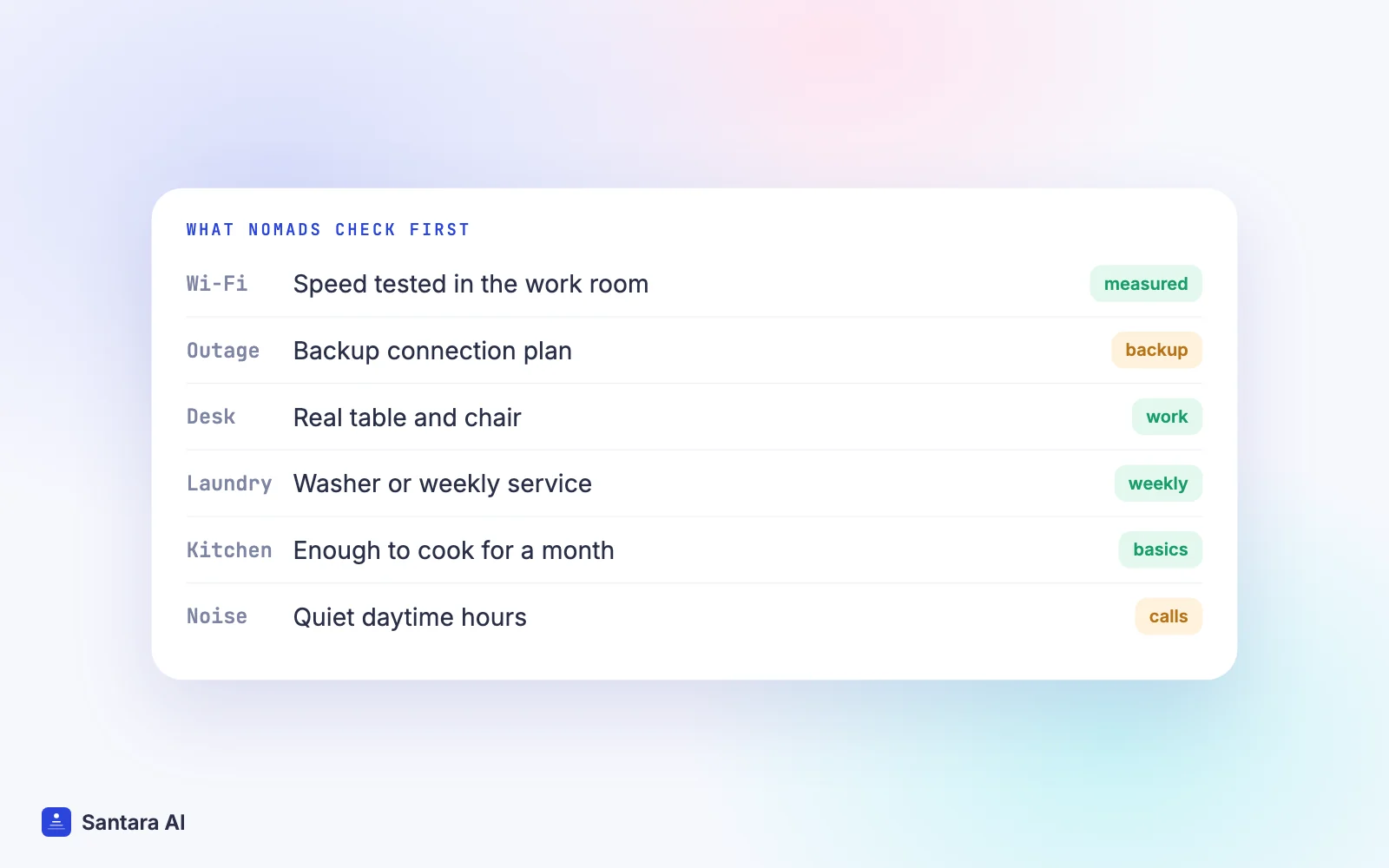
- Measured Wi-Fi. Airbnb's Wi-Fi speed test runs from the Airbnb app while you're at the property and connected to its network. Airbnb describes 25–49 Mbps as fast enough for 4K streaming and video calls, and 50 Mbps or more earns a "fast wifi" highlight on the listing. Run it in the room where the guest will actually work, not next to the router.
- A plan for outages. Tell guests what happens during a power or internet cut: a second connection, a mobile hotspot device, or the nearest co-working space.
- Desk and chair. A proper table and an adjustable chair near a window. Photograph them for the listing.
- Laundry. A washing machine, or a clear weekly laundry service with its price.
- Kitchen for a month. Enough pans, a sharp knife, storage containers, a kettle and a fridge with freezer space.
- Quiet daytime hours. Warn about construction, roosters or a busy road. A guest on calls at 9am will mind.
- Mid-stay cleaning. Say how often you clean and change linen, and what extra cleans cost.
Put these details in your house manual and listing so guests don't have to ask.
Visas: what the official pages say
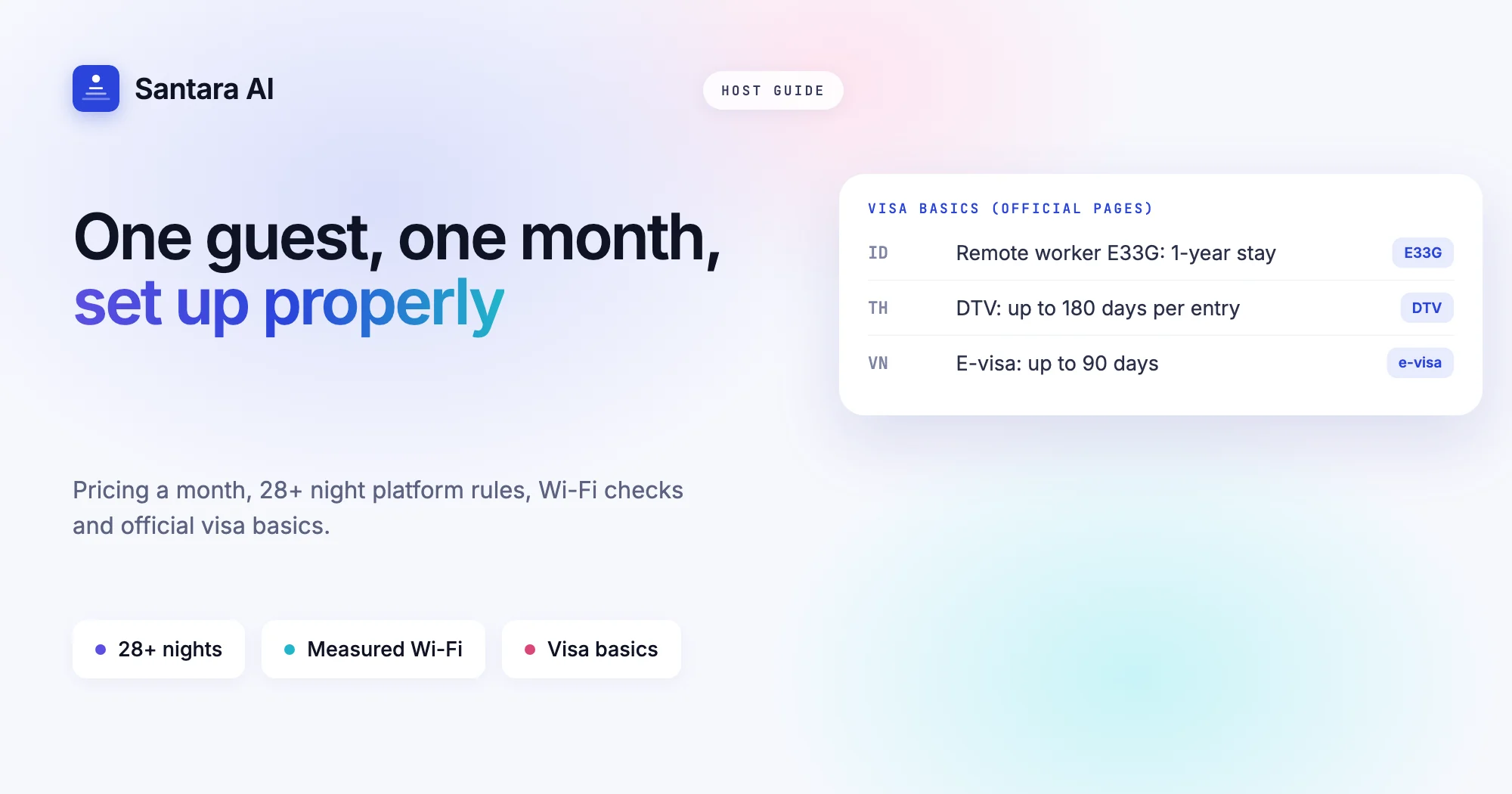
You are not an immigration office, and your guest is responsible for their own visa. It still helps to know the basics so you can answer questions and plan stay lengths. As of October 2026, the official pages say:
| Country | Visa | What the official page says | Source |
| Indonesia | E33G Remote Worker | Stay up to 1 year; income of at least US$60,000 a year; work contract with a company outside Indonesia; 3-month bank statement of at least US$2,000 | Directorate General of Immigration |
| Thailand | Destination Thailand Visa (DTV) | Up to 180 days per entry, 5-year validity, includes digital nomads and freelancers | Ministry of Foreign Affairs press release |
| Vietnam | E-visa | Up to 90 days, single or multiple entry, since 15 August 2023 | Embassy of Vietnam in the US |
Each Thai embassy publishes its own DTV document list; the Royal Thai Embassy in Washington, for example, asks for bank statements showing at least 500,000 baht. Point guests to the official page for their country rather than giving advice yourself. Whatever the visa, foreign guests still need registering with the local authorities; see our guest registration guide.
Direct monthly stays: a simple written agreement
Many nomads book the first month on a platform and ask to book the second month directly. For a direct monthly stay, write down:
- Dates and price, with what's included: electricity (or a monthly cap and the meter reading at check-in), water, Wi-Fi, cleaning and linen changes.
- Payment schedule, for example each month paid in advance by a set date, with receipts.
- Deposit: amount, how it's held, what can be deducted and when it's returned.
- Early departure: how much notice, and what happens to prepaid nights.
- House rules and visitors, and the ID details needed for guest registration.
Check with your local office whether a stay of this length counts as a lease where you are, as that can change your obligations. Never ask a guest who booked through a platform to cancel and pay you directly instead; that breaks platform rules.
How Santara AI helps with monthly stays
Santara AI replaces both the PMS and the channel manager, with one calendar per room as the source of truth. For long stays:
- One booking closes every channel. A 30-night booking on Airbnb lowers availability on Booking.com, Agoda and the other connected channels, and on your direct booking site.
- Stay rules per date. Minimum stay, maximum stay, closed to arrival and closed to departure can be set as weekday defaults with per-date overrides on the rates calendar, and the same values push to every connected channel.
- Stop sell for deals agreed off-platform. If you agree a direct month by message, stop sell closes those dates on every connected channel at once.
- Fewer turnovers to track. New bookings create cleaning tasks automatically, and the Daily Brief lists arrivals, departures and cleans each morning.
What Santara AI doesn't do here
Santara AI sends one nightly price per room and date to every channel. Airbnb's monthly discount, Booking.com's monthly rate plan and 30+ night setting, and each platform's long-term cancellation policy are set inside those platforms. The direct booking site has no promo codes or deposits. Santara AI doesn't check visas or register guests with the authorities.
FAQ
How do I offer a monthly rental for digital nomads on Airbnb?
Set a monthly discount for stays of 28 nights or more under Calendar → Discounts, and choose a long-term cancellation policy. Discounts of 10% or more appear in search. Make sure the listing shows a measured Wi-Fi speed and a proper workspace.
Can guests book more than 30 nights on Booking.com?
Only if you allow it. Booking.com's default maximum is 30 nights. Where your region allows it, go to Property → Policies → 30+ night stays, choose Yes and set the maximum nights. Add a monthly rate plan for the discount.
What Wi-Fi speed do digital nomads need?
Airbnb's speed test describes 25–49 Mbps as enough for video calls and 4K streaming, and highlights 50 Mbps or more as fast Wi-Fi. Test in the room where guests will work and have a backup plan for outages.
Which visa lets digital nomads stay in Bali for a long time?
Indonesia's immigration directorate lists the E33G Remote Worker visa, with a stay of up to one year for people employed by a company outside Indonesia who meet the income requirement. Guests should check the official page before they apply.
Keep reading
Your first 3 months are free.
Join For Free