OMS vs PMS: what OMS means and how it differs from a PMS
OMS can mean operations management, order management or something outside travel. Here is what each one is, how it compares to a PMS, and which one hosts need.
 Tai Pham
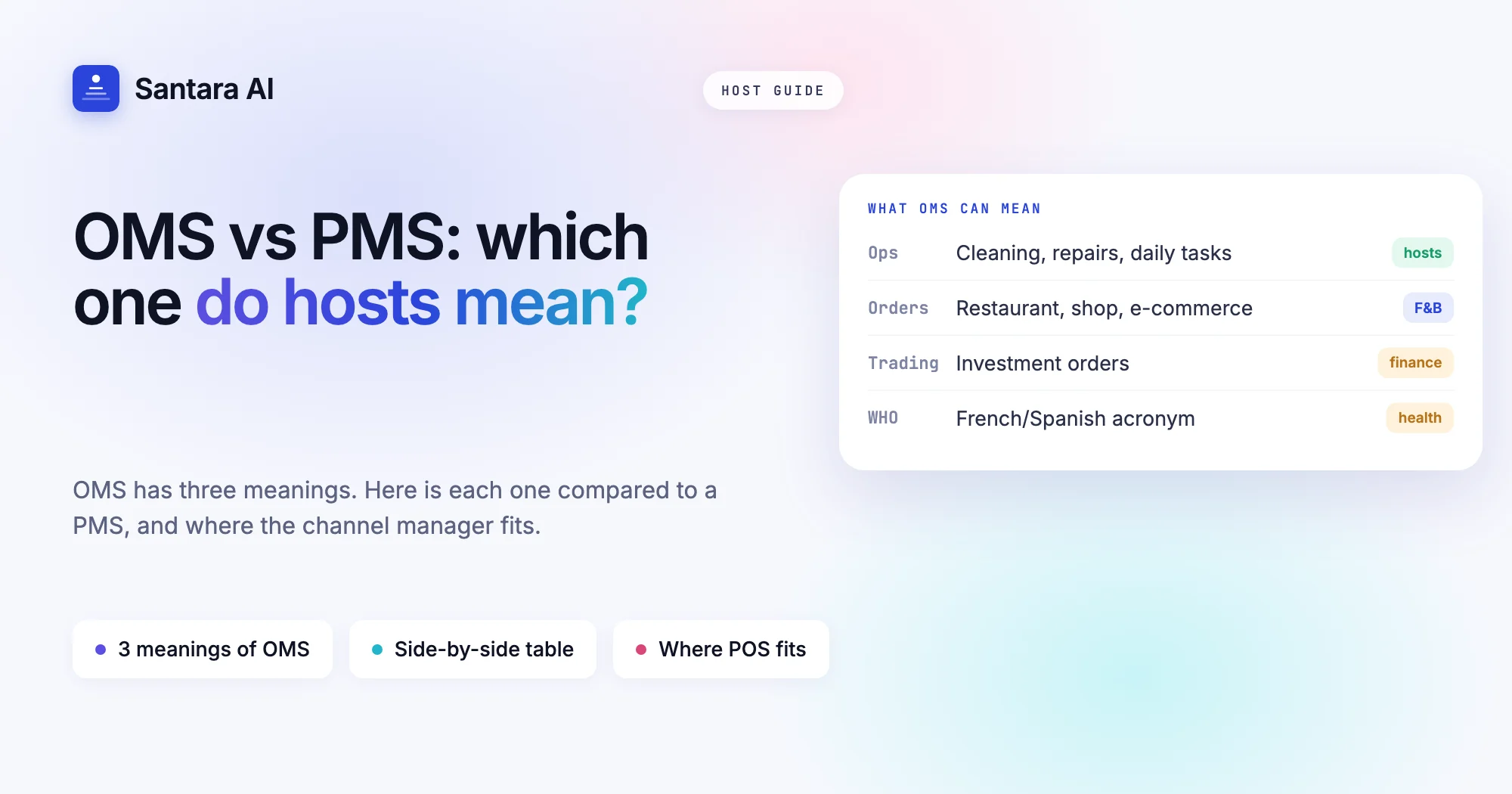
If you searched "OMS vs PMS", you probably met both acronyms on a software website or in a sales call and nobody stopped to explain them. PMS is easy: in hospitality it almost always means property management system. OMS is the slippery one. Depending on who is talking, it can mean operations management system, order management system, or something outside travel altogether.
That matters, because the answer to "do I need an OMS as well as a PMS?" changes completely with the meaning. A villa host in Canggu asking about housekeeping and a hotel restaurant manager in Phuket asking about room-service orders are asking two different questions with the same four letters.
This guide sorts out the meanings first, with sources, then compares each one to a PMS in plain terms: what it manages, who uses it, what data it holds, and where the two overlap. It ends with how one system can cover the parts a short-term rental host actually needs, and what it does not cover.
What does OMS mean? Three common meanings
There is no single official definition of "OMS" in hospitality. Here are the meanings you are most likely to meet, and where each comes from.
1. Operations management system (or software). This is the meaning most short-term rental software uses. It describes tools that run the work behind the bookings: cleaning, maintenance, tasks and the team doing them. The term is not standardised, and vendors use it loosely. Hotel Tech Report, a hotel software review site, groups these tools as housekeeping software, maintenance software and broader "operations platforms" that coordinate housekeeping, maintenance and front-office tasks. It also notes that such tools should sync room status with the property management system, and that some PMS products build housekeeping in directly.
2. Order management system. Outside hospitality this is the classic meaning. IBM describes an order management system as a digital way to manage the lifecycle of an order, from order entry to inventory, fulfilment and after-sales service. In retail and e-commerce it tracks orders, stock and shipping. In a hotel the nearest equivalent is the restaurant and bar side, where orders go through a point-of-sale (POS) system. Oracle, which sells both kinds of software, explains that connecting the hotel PMS and the POS lets restaurant transactions be posted to the guest's folio.
3. Meanings outside travel. In investment software, an OMS is a trading system that manages orders from creation to settlement, and "PMS" there usually means portfolio management system. And in French and Spanish, OMS is the World Health Organization: Organisation mondiale de la Santé and Organización Mundial de la Salud. If either of those brought you here, this is the wrong article.
| Meaning of OMS | Where you meet it | What it tracks | Relevant to a rental host? |
| Operations management system | Hotel and rental software | Cleans, repairs, tasks, staff | Yes, usually this one |
| Order management system | Retail, e-commerce, F&B | Orders, stock, delivery, bills | Only if you run a restaurant or shop |
| Order management system (trading) | Investment firms | Trades and settlement | No |
| Organisation mondiale de la Santé | French/Spanish name of WHO | Public health | No |
Which one do hosts usually mean? If you run villas, homestays or apartments and you came across OMS while comparing software, it almost certainly means operations. Hosts rarely run a full restaurant, so an order system is a side question. It only becomes real if you sell food, drinks or retail items on site and want those charges on the guest's bill.
What a PMS does
A property management system is the system of record for your stays. Oracle defines a hotel PMS as software that manages hotel business operations, traditionally the front-office jobs: reservations, check-in and checkout, room assignment, room rates and billing. The Xotels hotel glossary describes the PMS as the in-house administration system for reservations, availability and occupancy, check-in and check-out, guest profiles and reports, and lists the POS among the systems it can connect to.
For a short-term rental host, that translates into:
- One calendar per room or unit, with every booking on it
- Guest names, contact details, arrival and departure dates
- Nightly rates and stay rules
- Payment records and revenue reports
A PMS answers the question "who is staying where, when, and for how much?" It does not, by itself, make sure the room is clean when they arrive.
OMS vs PMS: side by side
Taking the operations meaning, since that is the one hosts usually mean, here is how OMS vs PMS compares. The order-management meaning is in the last column for completeness.
| PMS | Operations system (OMS) | Order system / POS | |
| Main job | Keep the record of stays | Get the work done between stays | Take and bill orders |
| Who uses it | Owner, manager, front desk | Cleaners, maintenance, supervisors | Restaurant, bar or shop staff |
| Typical data | Bookings, guests, rates, payments | Tasks, room status, tickets, assignees | Menu items, orders, bills, stock |
| Question it answers | Who stays where, when? | What must happen today, and by whom? | What did the guest order and pay? |
| Triggered by | A booking or change | Check-outs, check-ins, problems reported | A guest ordering |
| Overlap with a PMS | n/a | Room status, arrival and departure times | Charges posted to the guest bill |
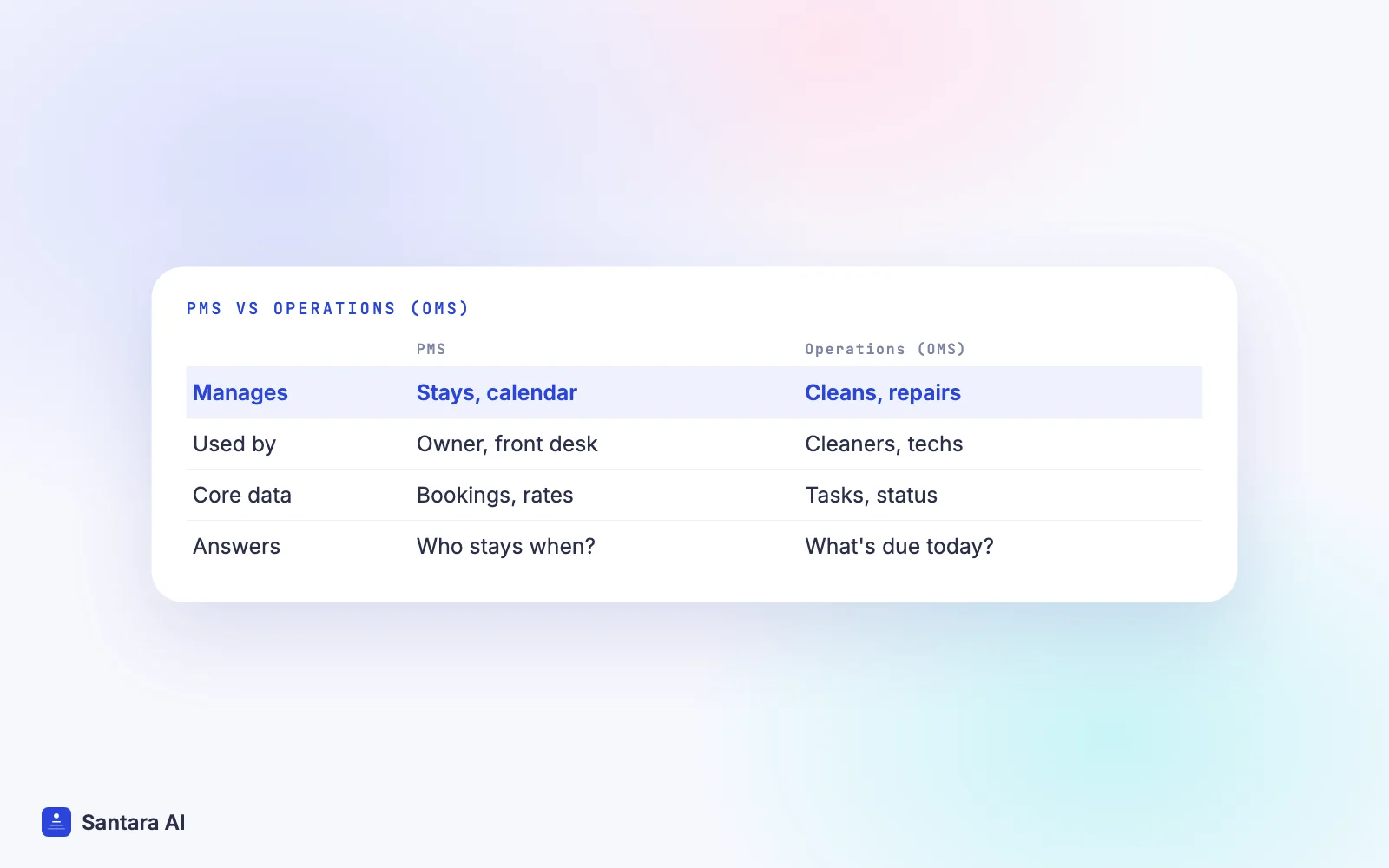
The overlap column is the important one. An operations tool is only as good as the booking data it reads. If a guest extends their stay in the PMS and the operations tool doesn't hear about it, a cleaner turns up to strip a bed that is still occupied. When the two are separate products, the connection between them is where the mistakes happen.
Where the two overlap, and why it causes trouble
Most hosts don't buy an "OMS" on purpose. They end up with one in pieces: a PMS or a booking site for the calendar, a WhatsApp group for the cleaners, a notes app for repairs, and a spreadsheet that ties them together. That works for one villa. With five or six units it starts to leak:
- A late booking for tonight lands after the cleaner has received the day's plan
- A repair reported by a guest lives in a chat thread nobody can search
- Two people mark the same room ready, or nobody does
The fix is not more software. It is making sure the operations side is generated from the booking record, not typed again from it. When a booking creates the cleaning job, a change to the booking changes the job.
Where the channel manager fits
There is a third tool in this conversation, and it is a different one again. A channel manager keeps availability, prices and stay rules in line across booking sites such as Airbnb, Booking.com and Agoda. It sits between your PMS and the OTAs. It does not run cleaning and it does not take restaurant orders.
We cover that comparison in detail in PMS vs channel manager: do short-term rental hosts need both?, so we won't repeat it here. If any of the other acronyms (OTA, ADR, unit count, stop sell) are new to you, the short-term rental glossary explains them in one line each.
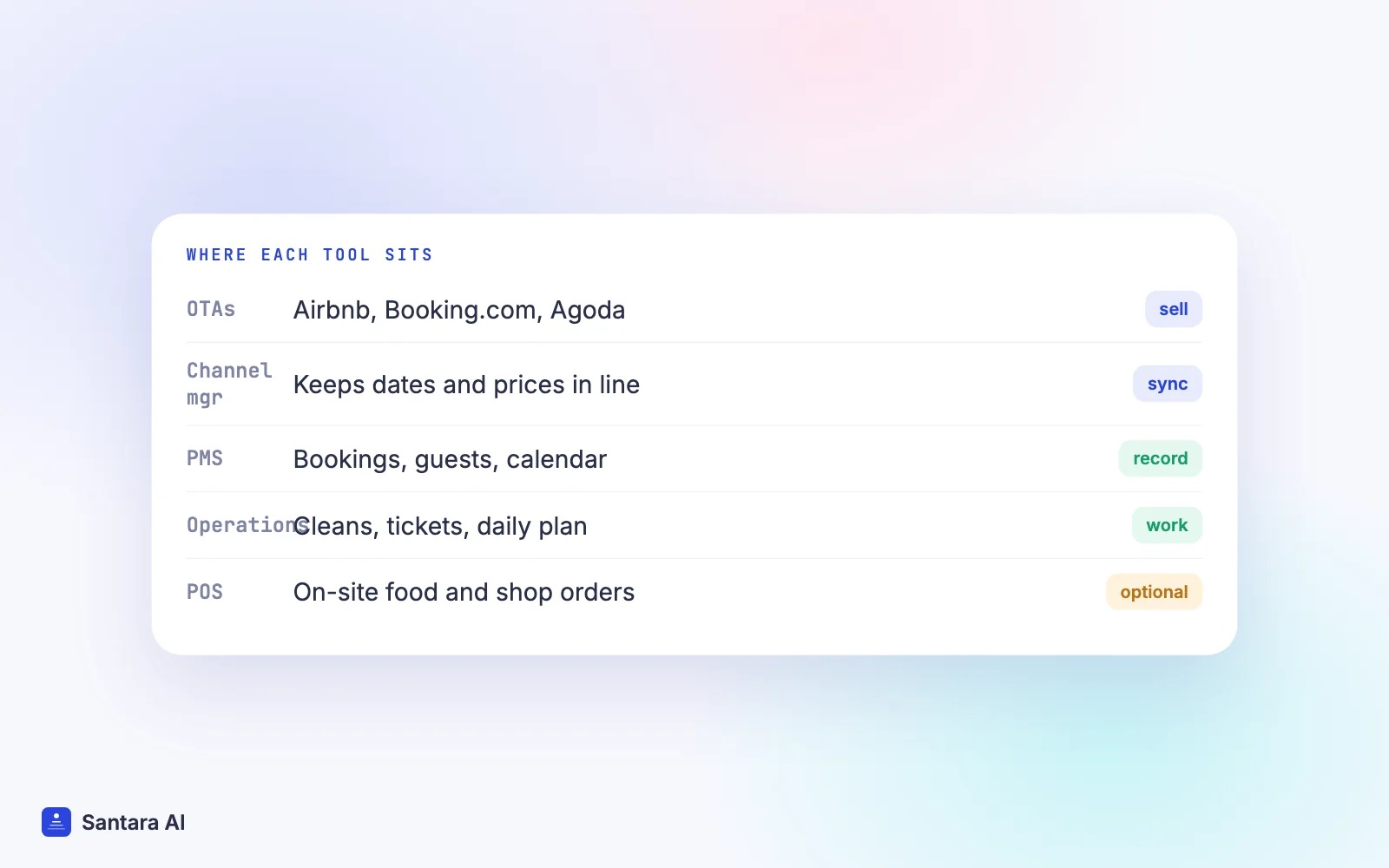
Put together, a typical host stack looks like three layers: the channel manager talks to the booking sites, the PMS holds the record, and the operations layer turns that record into today's work. An order system or POS only joins if you sell food, drinks or goods on site.
Do you need a separate OMS? Five questions
Step 1
How many units do you run?
With one or two units, a shared calendar and a checklist often cover operations. From around five units, or several cleaners, tasks start getting lost without a system.
Step 2
Who creates the cleaning jobs today?
If someone reads the calendar each morning and types out the plan, that is a manual OMS. It works until that person is sick or busy.
Step 3
Where do repairs and complaints go?
If a broken AC is reported in a chat and fixed "sometime", you need a ticket with an owner and a status, whatever tool holds it.
Step 4
Do you sell food, drinks or goods on site?
Only then is an order system or POS relevant. Check whether it can post charges to the guest's bill in your PMS, the way Oracle describes for hotels.
Step 5
How many copies of your calendar exist?
Every extra tool that stores bookings is another place to disagree. Prefer operations features that read the same calendar as your PMS.
How Santara AI handles it
Santara AI is a PMS and a channel manager in one. One calendar per room is the source of truth, and up to 54 sales channels, including Airbnb, Booking.com, Agoda and Expedia, are fed from it. On our PMS vs OMS page we explain why we describe it as operations software rather than only a PMS: the record is the base, and the day's work is built on top of it.
The operations pieces it really has:
- Automatic cleaning tasks. A new booking creates its cleaning task, so the job comes from the booking, not from someone retyping the calendar.
- A cleaning board. Jobs are listed by day, and you can assign each one and mark it done. See the cleaning page.
- Maintenance tickets. Log a repair or a complaint as a ticket, set a priority, assign it and move it to done, with photos attached.
- The Daily Brief. An email at 6am by default with the day's arrivals, departures and cleans, grouped by property group with a WhatsApp share button per group. More on the Daily Brief page.
What Santara AI is not
Santara AI is not an order management system. It has no POS, no restaurant or bar ordering, no retail stock and no shipping. If you run a café or shop on site, you still need a POS for that. It also has no separate cleaner app and does not send the cleaning plan automatically: you share it to WhatsApp or Zalo yourself.
FAQ
What is the difference between OMS and PMS?
A PMS (property management system) holds the record of your stays: bookings, guests, rates and payments. An OMS, in short-term rentals, usually means an operations management system that turns that record into work: cleaning, maintenance and tasks. In retail or restaurants, OMS means order management system instead.
What does OMS stand for in hotels?
It depends on the speaker. Hotel and rental software vendors usually mean operations management system or software. In food and beverage or retail, it means order management system, and in hotels that role is usually played by the POS.
Is an OMS the same as a POS?
No. A POS takes and bills sales at a counter or table. An order management system tracks orders through their whole life, from entry to fulfilment. In a hotel restaurant, the POS is the part guests and staff actually touch, and it can post charges to the PMS.
Do I need both an OMS and a PMS for an Airbnb?
Not as two separate products. You need the PMS functions (calendar, bookings, guests) and some operations functions (cleaning, repairs). One system that does both from the same calendar avoids the hand-off where mistakes happen.
Keep reading
- How to choose villa management software
- Turnover day without chaos
- What is a channel manager and how calendar sync works
Your first 3 months are free.
Join For Free