Vacation rental profit and break-even worksheet (with formulas)
A line-by-line vacation rental profit worksheet: formulas for revenue, fees, tax, depreciation and financing, then break-even, ROI and payback, with a worked example.
 Tai Pham
A full calendar feels like a profitable one. It often isn't. Once channel fees, cleaning, staff, the pool guy, the slow drip of broken kettles and the loan payment come out, many vacation rentals make far less than the booking total suggests, and some lose money in the months that look busy.
This post gives you a vacation rental profit and break-even worksheet you can rebuild in any spreadsheet. It covers every line from revenue down to net profit, with the formula for each, then turns them into three numbers that answer the real questions: how many nights you need to sell to cover costs, what return you make on the money you put in, and how long it takes to get that money back.
We use one hypothetical villa all the way through, so you can see the arithmetic. Every figure in it is illustrative, not a benchmark. The only real numbers in this post are official fee and tax rates, each linked to its source and checked as of October 2026.
The vacation rental profit worksheet, line by line
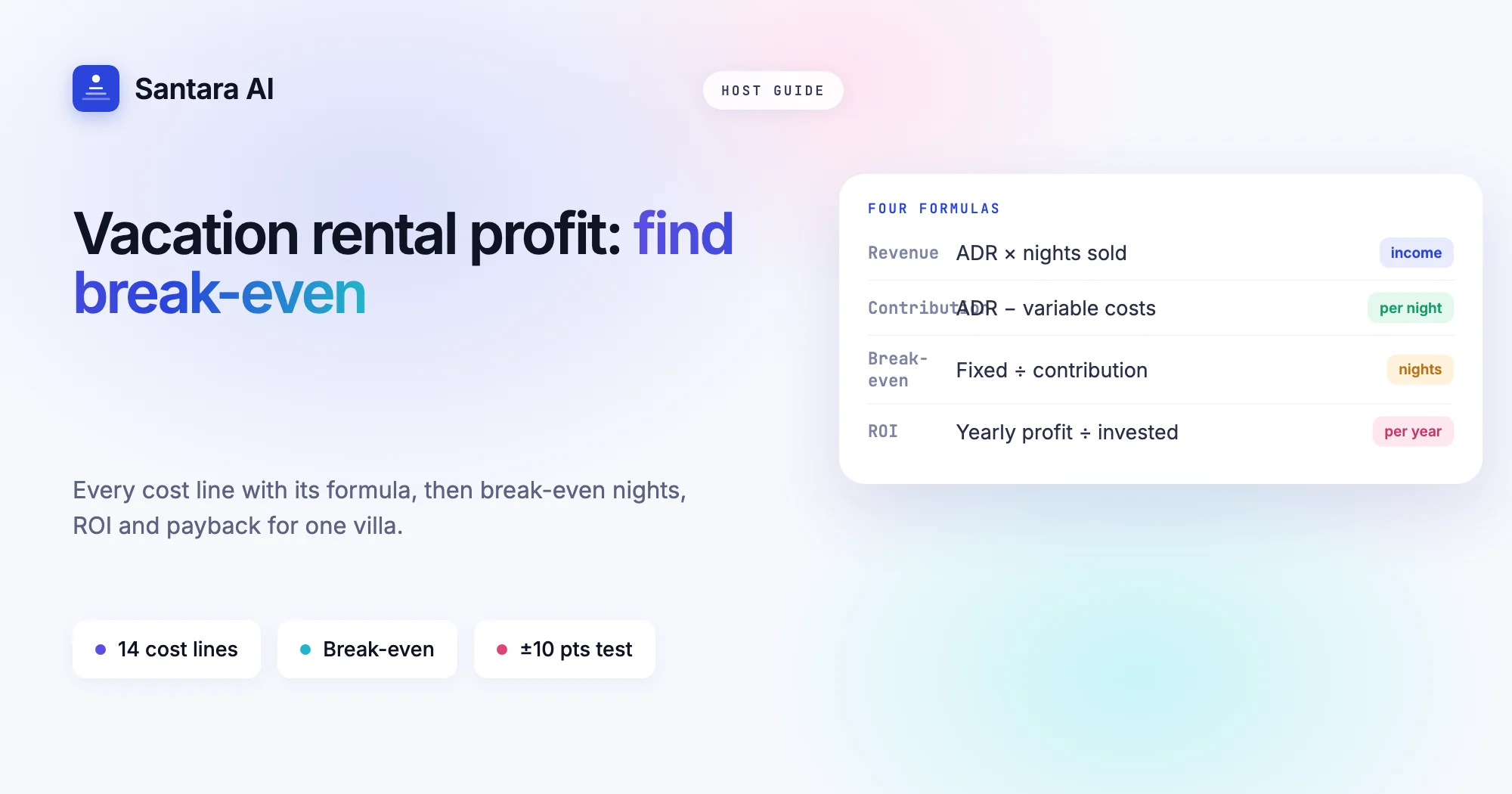
Work in months. Monthly figures match how bills arrive, how the OTAs pay you and how most hosts think about a season. Split every cost into two groups: variable costs, which rise with each night or stay you sell, and fixed costs, which you pay even in an empty month.
| Line | Type | Formula |
| Room revenue | Income | ADR × nights sold |
| Channel fees | Variable | Revenue × your fee rate per channel |
| Tax included in your price | Variable | Revenue × tax ÷ (1 + tax), if your price includes it |
| Cleaning and laundry | Variable | Cost per turnover × number of stays |
| Guest supplies | Variable | Cost per night × nights sold |
| Utilities and internet | Fixed (mostly) | Average of recent bills, adjusted for guest use |
| Staff | Fixed | Monthly wages for anyone not paid per clean |
| Pool, garden, pest control | Fixed | Contract price per month |
| Maintenance reserve | Fixed | A set amount you put aside every month |
| Software and subscriptions | Fixed | Monthly plans |
| Depreciation of furniture | Fixed | Purchase cost ÷ months you expect it to last |
| Lease or rent | Fixed | Monthly rent, or prepaid lease ÷ months in the lease |
| Loan interest | Fixed | Interest part of the monthly repayment |
| Income tax set-aside | Variable | Your rate under your tax status |
Revenue starts with ADR and nights sold. If you have not calculated those carefully before, read our guide to occupancy, ADR and RevPAR first. It explains why owner stays and cleaning fees should not be mixed into the figures.
Channel fees and taxes: use official rates only
Channel fees are usually the largest variable cost, and the easiest one to guess wrong. Do not use a "typical commission" from a forum. Use the rate in each contract.
Airbnb publishes its rate. Under its single fee, Airbnb says most hosts pay 15.5% of the booking subtotal, others typically 14% to 16%. Booking.com and Agoda set the rate in your own agreement. Our Airbnb vs Booking.com fees guide explains what each one charges on, and the free OTA fee calculator works out what you keep per booking. If your bookings come from several channels, use a blended rate: total fees on last year's statements ÷ total revenue.
Tax depends on where the property is and how you are registered. Two examples from our licence guides:
- Vietnam. Household businesses with annual revenue up to VND 1 billion pay no VAT or personal income tax but still report revenue. Above it, a tax office answer gives VAT of 5% of revenue for accommodation, and income tax of 2% on the revenue above the threshold; households that can document their costs may instead pay income tax on net income. The Vietnam homestay licence guide has the details.
- Indonesia. Villas pay regional hotel tax (PBJT) at no more than 10%, set by each regency. Gianyar, which includes Ubud, sets it at 10% in Bylaw 7/2023. For income tax, individuals on the final SME scheme pay 0.5% of turnover, and the first Rp500 million a year is not taxed. See the Bali villa licence guide.
Confirm your own rates with the local tax office. They change, and your status decides which one applies.
Depreciation and financing: the two lines hosts skip
Depreciation is the cost of wearing out what you bought. A $12,000 furniture and fittings package that lasts five years costs you $200 a month, whether you notice it or not. Leave it out and your profit looks better every month until the day you have to refurnish with money you never set aside. The five years here is your own planning assumption, not a tax rule.
Financing has two parts that belong in different places. The interest on a loan is a cost, so it goes into the profit calculation. The principal you repay is not a cost; it reduces the debt. It still leaves your bank account, so track it in cash flow. Mixing the two makes a property look worse on paper than it is, or better in the bank than it is.
The same logic applies to a prepaid lease, common for Bali villas. If you paid ten years upfront, divide the lease by 120 and treat that as monthly rent. Otherwise the first year looks terrible and the next nine look too good.
A worked example: a two-bedroom villa in Ubud
This is a hypothetical villa. Prices are in US dollars to keep the arithmetic easy. The owner owns the building, spent $40,000 on renovation and furniture (half of it borrowed), and sells the whole villa as one unit at $140 a night, including the 10% PBJT. In a 30-night month, the villa sells 18 nights (60% occupancy) in 6 stays of 3 nights. All bookings come through Airbnb on the single fee.
| Line | Calculation | Month |
| Room revenue | 18 nights × $140 | $2,520 |
| Channel fees | $2,520 × 15.5% | −$391 |
| PBJT included in the price | $2,520 × 10 ÷ 110 | −$229 |
| Cleaning and laundry | 6 stays × $25 | −$150 |
| Guest supplies | 18 nights × $4 | −$72 |
| Income tax set-aside | 0.5% of revenue after PBJT, a cautious upper bound | −$11 |
| Contribution | $1,667 | |
| Utilities and internet, software | $250 + $70 | −$320 |
| Staff | Part-time villa attendant | −$400 |
| Pool and garden | Contract | −$120 |
| Maintenance reserve | Fixed amount | −$120 |
| Depreciation | $12,000 ÷ 60 months | −$200 |
| Loan interest | Interest part only | −$150 |
| Net profit | $357 |
The income tax line is deliberately cautious: it applies 0.5% to all turnover, while the real figure is lower if your yearly turnover stays under Rp500 million. Replace it with your own calculation.
Break-even, ROI and payback
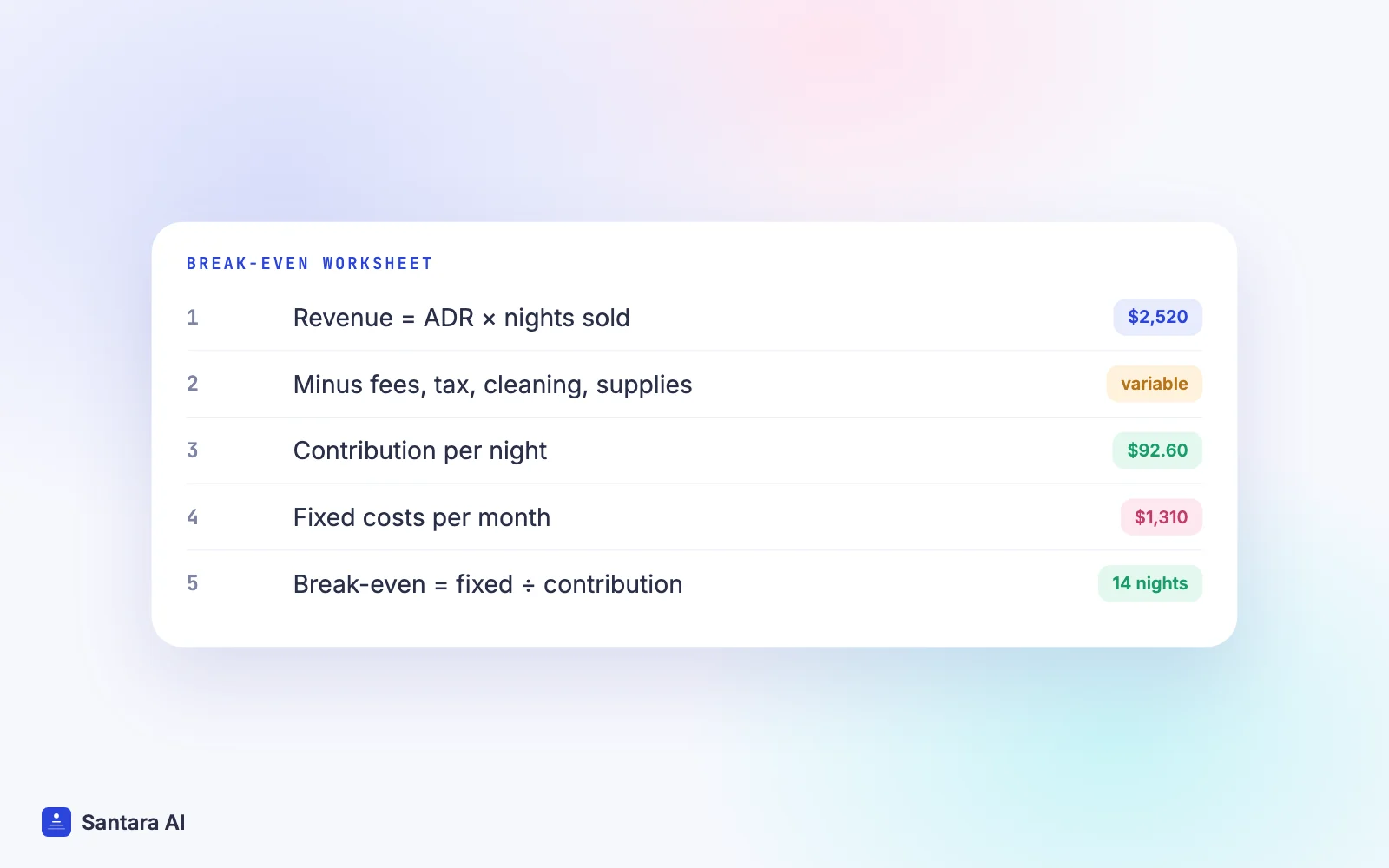
Three formulas turn the worksheet into answers.
Step 1
Contribution per night
ADR minus every variable cost per night. Here: $140 − $21.70 fees − $12.73 PBJT − $8.33 cleaning (25 ÷ 3) − $4 supplies − $0.64 tax ≈ $92.60.
Step 2
Break-even nights and occupancy
Fixed costs ÷ contribution per night. Here: $1,310 ÷ $92.60 ≈ 14.1 nights, so the villa covers its costs at about 47% occupancy. Every night above that adds about $93 of profit.
Step 3
Return on investment
Annual net profit ÷ money invested. Here: $357 × 12 = $4,282 ÷ $40,000 ≈ 10.7% a year.
Step 4
Payback period
Money invested ÷ yearly cash from operations (net profit plus depreciation, which is not cash). Here: $40,000 ÷ ($557 × 12) ≈ 6 years. Loan principal of $250 a month then comes out of that cash.
Sensitivity: occupancy ±10 points
Vacation rental profit is more sensitive to occupancy than most hosts expect. Change one number to see it. Hold the price and every other cost still, and move occupancy 10 points either way.
| Occupancy | Nights sold | Revenue | Net profit / month | ROI / year | Payback |
| 50% | 15 | $2,100 | $79 | 2.4% | about 12 years |
| 60% (base) | 18 | $2,520 | $357 | 10.7% | about 6 years |
| 70% | 21 | $2,940 | $635 | 19.0% | about 4 years |
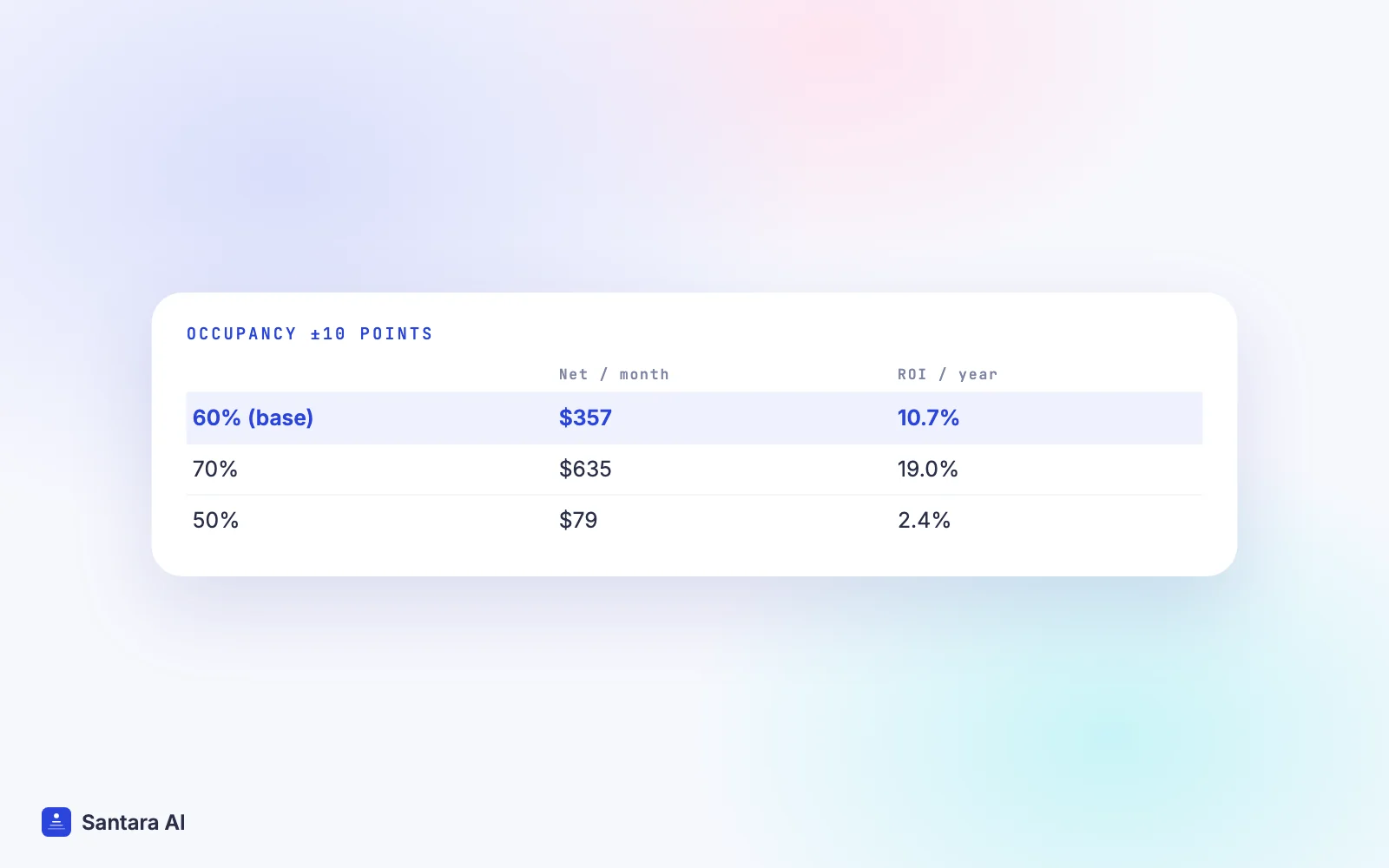
Ten points of occupancy moves monthly profit by almost $280 in each direction, because fixed costs do not move at all. That is the real lesson of a break-even worksheet: the villa above is a fine business at 70% and barely worth the effort at 50%. Before you buy, build or sign a lease, run the low case first. If you can't live with it, change the plan, not the assumptions. Our low season playbook covers what to do about the quiet months, and the cost to open a homestay checklist helps you price the investment side.
Run the same table for price (ADR ±10%) and for your fee rate if you plan to shift bookings between channels.
How Santara AI fits into the numbers
Santara AI does not forecast profit, calculate ROI or file taxes. What it gives you is the actual side of this worksheet, so you can compare your plan with what really happened.
The Reports screen shows one monthly statement per property: gross booking revenue, minus channel fees, minus the expenses you add, equals the owner's net. You can add expenses such as utilities, repairs or staff, and download the statement as CSV to drop into your own worksheet. Revenue is counted at checkout, and currencies are never converted, so a villa earning in rupiah stays in rupiah.
Because Santara AI replaces both the PMS and the channel manager, those bookings come from one calendar that feeds Airbnb, Booking.com, Agoda and the rest of 54 channels, so the revenue line is not split across extranets.
What the Reports screen does not do
It does not calculate a management fee, depreciation, loan interest, tax or break-even. It shows only the expenses you enter, and it does not forecast future months.
FAQ
How do I calculate the break-even occupancy for a vacation rental?
Work out your contribution per night: ADR minus channel fees, included tax, cleaning per night and supplies. Divide your fixed monthly costs by it to get break-even nights, then divide by the nights available in the month.
What is a good ROI for a villa or homestay?
There is no official benchmark, and figures quoted online rarely say how they were calculated. Compare your ROI with what the same money would earn elsewhere at similar risk, and test it at lower occupancy.
Should depreciation be in my vacation rental profit calculation?
Yes. Furniture, linen and appliances wear out. Spreading their cost over the months you expect them to last shows the real profit and makes you save for replacements.
Is the loan repayment a cost?
Only the interest. The principal reduces your debt, so it belongs in cash flow, not in profit. Track both, because the bank needs the full payment either way.
Keep reading
Your first 3 months are free.
Join For Free