Rate parity for vacation rentals: can each OTA have its own price?
What Booking.com, Expedia, Agoda and Airbnb publish about rate parity, the EU and Asian regulator picture, and the maths for pricing OTAs to keep the same payout.
 Tai Pham
Yes, you can usually charge a different price on Airbnb, Booking.com and Agoda, and many hosts price the higher-commission channels higher so every booking pays them about the same. Check each OTA's rate parity terms first: Booking.com applies no, narrow or wide parity depending on your country, Expedia's standard contract compares its rates with your own online channels, and Airbnb's and Agoda's public help pages publish no parity rule we could find. To keep the same payout, set each channel's price to your target net divided by (1 − that channel's commission).
This guide explains what rate parity for vacation rentals means, quotes what each OTA and regulator has published as of November 2026, shows the markup maths in a table, and walks through the effects that quietly cancel a markup, such as Genius discounts and Agoda promotions. Every platform fact links to the OTA's own partner page, contract or a regulator page. It is not legal advice: your signed contract is what binds you.
Can you charge different prices on each OTA? The short version
| Channel | What it publishes about parity (as of November 2026) | Source |
| Booking.com | No parity, narrow or wide parity, depending on the property's country; full wording in your General Delivery Terms | Booking.com partner page |
| Booking.com in the EEA | All parity requirements removed under the EU Digital Markets Act | European Commission |
| Expedia | Rates equal to or better than your own online public channels (not in Australia) | <a href="https://api.expediapartnercentral.com/contract/ext/templatepdf?language=2057&version=323">Expedia Lodging Agreement |
| Agoda | Terms contain "Fair Competition" provisions; the wording is only in your Partner Portal | Agoda Partner Hub |
| Airbnb | No rule on prices elsewhere; bans offering discounts to book off Airbnb | Airbnb Help |
The pattern is clear. The common contract terms limit how cheap you can be on your own website compared with the OTA. Few published terms stop you from charging one OTA more than another.
What does rate parity mean?
Rate parity is a contract term in which you promise an OTA that it gets prices (and sometimes conditions and availability) at least as good as somewhere else. Booking.com's explanation of its parity regimes gives the three versions:
- No parity: no specific obligation on rates, conditions and availability compared with other online and offline channels.
- Narrow parity: the same or better rates and conditions on Booking.com than you offer on your own online channels.
- Wide parity: the same or better rates, conditions and availability than you offer on any channel, online or offline, including other OTAs.
Malaysia's competition regulator uses the same split in its OTA market review with a simple example: if your website shows a room at MYR 200, narrow parity means the OTA must get MYR 200 too, while other OTAs may be lower or higher. Under wide parity, every channel gets MYR 200.
Notice the direction. Parity protects the OTA from being undercut. Charging an OTA more than your website would break narrow parity; charging Agoda more than Booking.com would only matter under Booking.com's or another OTA's wide parity.
What do Booking.com, Agoda, Airbnb and Expedia say about rate parity?
Booking.com
Booking.com says it applies one regime "depending on the country where the property is located", and that Article 2.1.4 (no parity countries) or Article 2.2 (wide and narrow parity countries) of your General Delivery Terms holds the full wording. Where the help page and the GDTs differ, the GDTs win. Booking.com does not publish a country list on that page, so open your GDTs in the extranet to see which applies to your property in Vietnam, Indonesia or Thailand.
Parity also touches programmes. Our Booking.com Genius guide covers the rule that, in wide-parity or narrow-parity countries, Genius partners must offer competitive prices compared with other websites or their own site.
Expedia
Expedia's standard <a href="https://api.expediapartnercentral.com/contract/ext/templatepdf?language=2057&version=323">Lodging Agreement says that, unless you are in Australia, your rates on Expedia "will be equal to or better than" those on your own Online Public booking or distribution channels, and your rules and cancellation conditions on Expedia must not be more restrictive. "Online Public" excludes bookings at your reception or by phone, as long as those rates are not marketed or published online. The same agreement asks you to treat Expedia guests the same as direct guests, including on hotel fees. Your own signed version may differ, so check it in Partner Central.
Agoda
Agoda's public help pages don't quote a parity clause. Its terms update page refers to "Fair Competition (clause 6)" provisions and says they were made "less restrictive with a focus on working together on pricing" in 2021. The current text sits in the Partner Portal under Resources, then Terms & Conditions. Read it before you price Agoda differently.
Airbnb
Airbnb's Pricing and payment transparency policy does not mention prices on other websites. It does say hosts may not "offer or solicit discounts to book off of Airbnb" or put links in listings or messages that take people off the platform, and that mandatory fees must be shown in the right fee field or in the nightly price. So a lower price on your website is your business; telling an Airbnb guest to book there instead is not allowed.
Have regulators banned rate parity clauses?
In some places, yes. Check the date and the country before you rely on any of these:
- European Economic Area. The European Commission says the Digital Markets Act "bans parity requirements of any kind" for Booking.com, and that contractual parity was fully removed in July 2024. In the EEA, Booking.com does not use external prices for default ranking, parity is no longer a condition for Genius, Preferred and Preferred Plus, and since September 2026 external prices no longer decide eligibility for Booking Sponsored Benefits. This applies to EEA properties only, not to a villa in Bali.
- Hong Kong. The Competition Commission accepted commitments from Booking.com, Expedia and Trip.com on 13 May 2020 to drop wide parity for Hong Kong properties. Its commitments register shows those commitments expired in July and August 2025.
- Malaysia. MyCC's market review, published 10 February 2026, calls price parity clauses "a core competition concern" and says MyCC reserves the right to investigate. It is a review with recommendations, not a ban.
- Vietnam and Indonesia. As of November 2026 we found no regulator page on OTA parity clauses. Your contract terms are what count.
How much should you mark up to keep the same payout?
The most common mistake is adding the commission percentage on top of your price. If your target is $100 and the OTA takes 15%, a $115 price leaves you $97.75, because the commission is also taken from the extra $15. The right formula is:
List price = desired net ÷ (1 − commission)
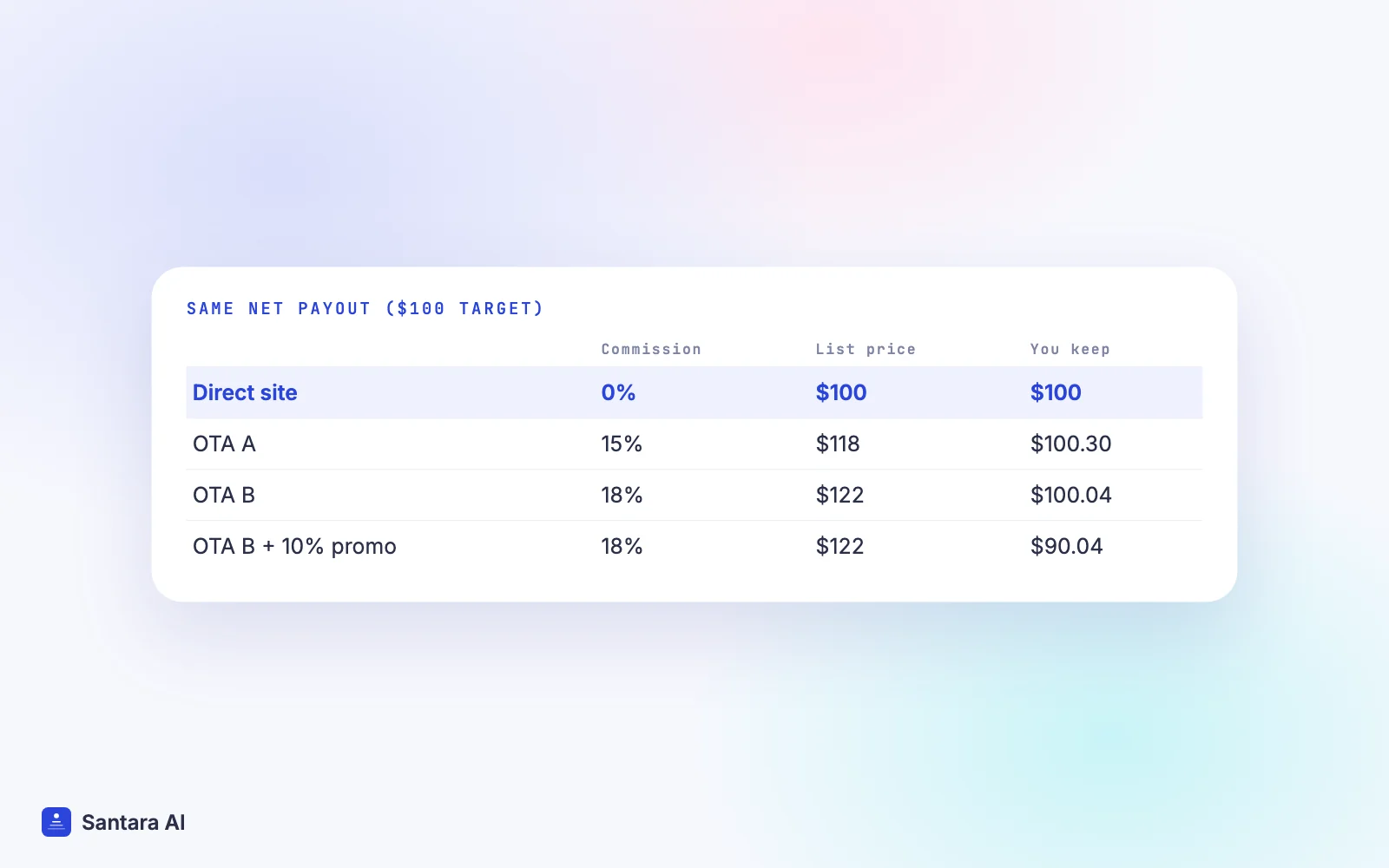
Here is the same $100 target at three hypothetical commission levels. The rates are illustrative; your real numbers are in each contract, and our OTA fees comparison lists what each platform publishes.
| Channel (illustrative) | Commission | List price | You keep | If you just add the % |
| Direct booking | 0% | $100 | $100 | $100 |
| OTA A | 15% | $118 | $100.30 | $115 → $97.75 |
| OTA B | 18% | $122 | $100.04 | $118 → $96.76 |
| OTA B with a 10% promotion | 18% | $122 | $90.04 | not enough |
To do this with your own contract rates, plug them into the free OTA fee calculator; it shows the net payout for each OTA side by side. Payment processing, VAT on commission and currency conversion can take a little more, so round up, not down.
What can cancel out your OTA markup?
A markup that looks right in a spreadsheet can disappear once the OTA's own tools apply.
- Promotions are taken from your marked-up price. Booking.com's standard Genius discount is 10%, funded by you. Agoda's base rate example shows compensation worked out on the price after the promotion: $100 loaded, 10% off, 20% compensation, $72 to you. To keep $100 net with a 10% promotion and an 18% commission, the price would need to be $100 ÷ (0.9 × 0.82) = $135.50.
- Agoda may already work as a markup. Agoda says its compensation is "either a percent of the reference sell rate or a markup added to your loaded rate" (Agoda). If yours is a markup, adding your own on top charges the guest twice. Check Finance, then Contracted compensation. Our Agoda commission guide explains both models.
- Rate-matching programmes. Agoda's Dynamic Rates (ADR+), which you activate in YCS, compares direct Agoda rates with third-party rates and adjusts when the third-party rate is better. If you join, the higher Agoda price you set may not be what the guest sees.
- Guests compare totals, not nightly rates. Each OTA displays taxes, cleaning and service fees its own way. Compare the total a guest pays for the same dates, guests and cancellation policy, or your "higher" channel may actually look cheaper.
- Conditions count too. Expedia's agreement covers cancellation conditions, not just price. A cheaper non-refundable rate on your website next to a flexible Expedia rate needs checking against your contract.
Should your direct booking price be lower than the OTAs?
It is the obvious place to pass on the commission you save, and it is where narrow parity bites hardest. If your Booking.com or Expedia contract has narrow parity, a lower price published on your own website may break it. Outside the EEA, many hosts keep the website price equal and add value instead: a late checkout, an airport pickup or a free night on long stays. Malaysia's regulator notes that discounts on extras rather than the room rate are a common way hotels encourage direct bookings.
Our direct booking website guide covers the whole channel, and is booking direct safe? covers the trust signals that make guests comfortable paying you directly. Remember the Airbnb rule above: never invite an Airbnb guest to rebook off the platform.
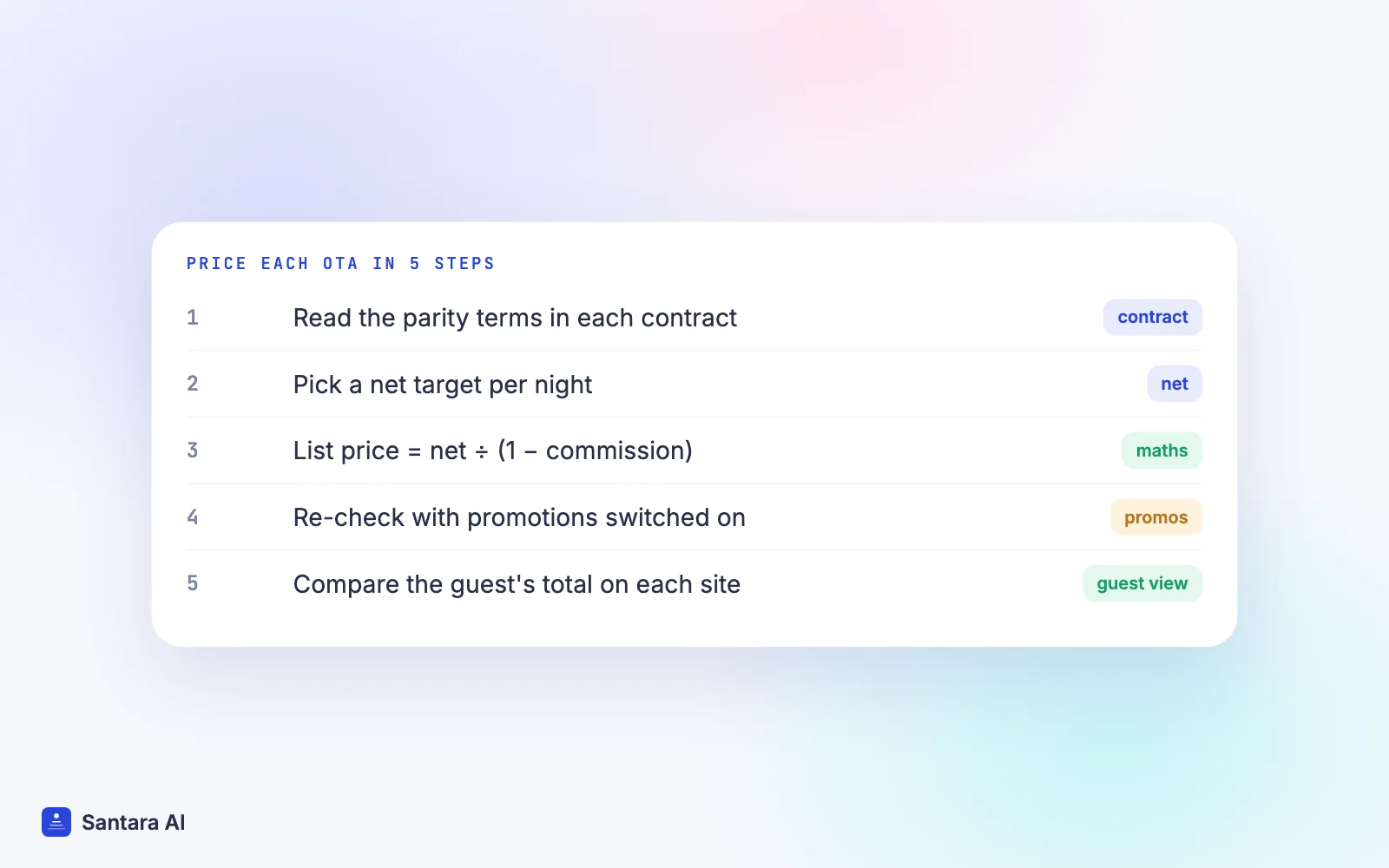
How to set different prices on each OTA, step by step
Step 1
1. Read the parity terms in every contract
Open Booking.com's General Delivery Terms, your Expedia agreement in Partner Central and Agoda's Terms & Conditions in the Partner Portal. Note whether each one compares against your website only, all channels, or nothing.
Step 2
2. Pick a net target per night
Decide what you need to keep per night for each season, after cleaning and costs. That number, not the list price, is what you protect.
Step 3
3. Work out each channel's list price
Divide the net target by (1 − commission) for every channel, using your contracted rates. Check whether Agoda applies compensation as a markup before adding your own.
Step 4
4. Re-check with promotions switched on
Apply Genius, Agoda promotions and any mobile or last-minute deals to the marked-up price and confirm the net still holds. Adjust the price or drop the promotion.
Step 5
5. Load the prices and compare what guests see
Set the price in each extranet, or in your channel manager if it supports per-channel pricing. If software manages your rates, extranet edits may be overwritten on its next update. Then search your own listing as a guest on each site and compare the totals.
How Santara AI fits
In Santara AI, each room has one calendar, and the rates, availability and minimum stays you set there are pushed to the channels you have mapped, out of the 63 channels on the integrations page. Bookings from every connected channel land on the same calendar, so a night sold on one channel closes on the others. To decide where your single price should sit, the OTA fee calculator shows the net payout per OTA at that price.
What Santara AI does not do
Santara AI sends the same rate from the one calendar to every mapped channel. It does not add a percentage markup for one channel, read your commission from OTA contracts, or check your parity terms. If you want per-channel prices, set them in a way your contracts allow and make sure no two tools manage the same rates.
FAQ
Is rate parity legal?
It depends on where your property is. The EU's Digital Markets Act bans parity requirements of any kind for Booking.com in the EEA. Malaysia's competition regulator has flagged them as a concern. Elsewhere, including Vietnam and Indonesia as of November 2026, the terms in your contract apply.
Can I charge more on Booking.com than on Airbnb?
Usually yes. Booking.com's parity terms limit offering better prices elsewhere than on Booking.com, not charging Booking.com guests more. Check whether your GDTs apply narrow or wide parity before pricing any channel below Booking.com.
Can my website be cheaper than Airbnb or Booking.com?
Airbnb's published policy doesn't address prices on other sites, but it bans offering discounts to book off Airbnb. Under Booking.com narrow parity or Expedia's standard agreement, a cheaper rate published on your own website may breach the contract. Phone and walk-in prices not published online are outside Expedia's definition.
How do I calculate a price that covers OTA commission?
Divide your desired net by (1 − commission). For a $100 net at 18%, that is $100 ÷ 0.82 = $122, not $118. Then check again with any promotions applied.
What happens if I break a parity clause?
Your contract decides. Booking.com's parity page refers you to the General Delivery Terms rather than listing consequences, so read the remedies and termination sections of each agreement and ask your account manager if unsure.
Keep reading
- Sync prices and minimum stays across channels
- Agoda vs Booking.com for hosts
- Airbnb host-only fee 2026
Your first 3 months are free.
Join For Free