
Minimum stay for vacation rentals: how to fill gap nights
Why a fixed 2–3 night minimum stay leaves orphan gap nights, how Airbnb, Booking.com and Agoda set minimum stays per date, and three ways to fill the gaps.
 Tai Pham
A minimum stay is the fewest nights a guest can book at your vacation rental, set per listing and often per date. A fixed rule of two or three nights leaves short holes between bookings, usually one or two nights, that nobody is allowed to book. You fix those gap nights in three ways: lower the minimum stay only for the gap dates, price the gap nights to sell, or offer them to the guest staying just before or after.
Most hosts set one minimum stay for the year and forget it. That works until the calendar fills up and the bookings start landing a night or two apart. Each of those stranded nights is income you have already lost unless you change a setting. This guide shows where gap nights come from, how Airbnb, Booking.com and Agoda let you set a minimum stay for a vacation rental (from their own help pages, as of November 2026), and which fix to use in which season.
One line on scope: if you want to keep the same prices and rules identical on every OTA, or need the difference between "minimum stay on arrival" and "minimum stay through" in detail, read how to sync prices and minimum stays across channels. This post is about the nights your minimum stay leaves behind.
The three fixes at a glance
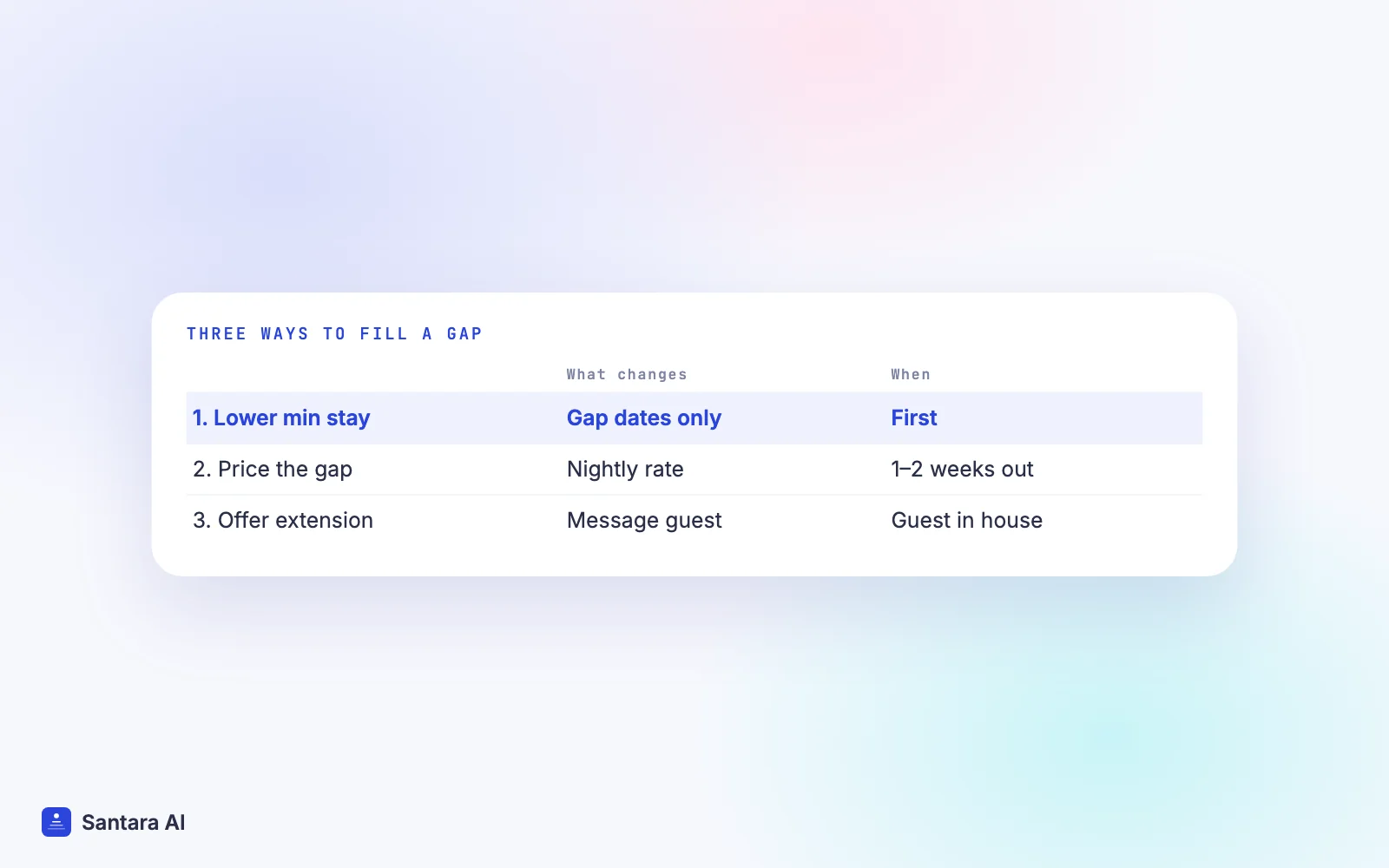
| Fix | What you change | Best when | Watch out for |
| 1. Lower the minimum for the gap only | Minimum stay on the gap's arrival date (for example from 3 to 2 or 1) | The gap is 1–3 nights and the rest of the period should keep its rule | Change the gap dates only, not the whole month |
| 2. Price the gap night | The nightly rate on the gap dates | The gap still hasn't sold a week or two out | Don't drop below what a night costs you to clean and run |
| 3. Offer it to the neighbour guest | Nothing on the OTA; you message the guest before or after | The guest already in the house might stay one more night | Confirm the turnover still fits; put a deadline on the offer |
Most of the time you use them in that order: open the gap to short stays first, then adjust the price if it still sits empty, and offer an extension when a guest is in the house. The stay-extension offer has its own guide, so here it gets one paragraph and a link.
What is a gap night?
A gap night (also called an orphan night) is one or two unsold nights stuck between two bookings, shorter than your minimum stay, so no guest can book them. Our short-term rental glossary defines it alongside closed to arrival (CTA) and closed to departure (CTD), which come up below.
Gap nights are not caused by low demand. They are caused by arithmetic. If your minimum is three nights and a guest checks out on Friday while the next one arrives on Sunday, the two nights in between can only be sold as a two-night stay, and your own rule forbids it.
Why does a 3-night minimum stay leave orphan gaps?
Here is a worked example. It is hypothetical, to show the mechanics, not data from a real property.
Say you run a two-bedroom villa in Canggu with a three-night minimum stay on every date. Over two weeks:
- Guest A books Monday 1 to Friday 5 (four nights, checks out Friday morning).
- Guest B books Sunday 7 to Thursday 11 (four nights, arrives Sunday afternoon).
- Friday 5 and Saturday 6 are free. That is two nights, the weekend.
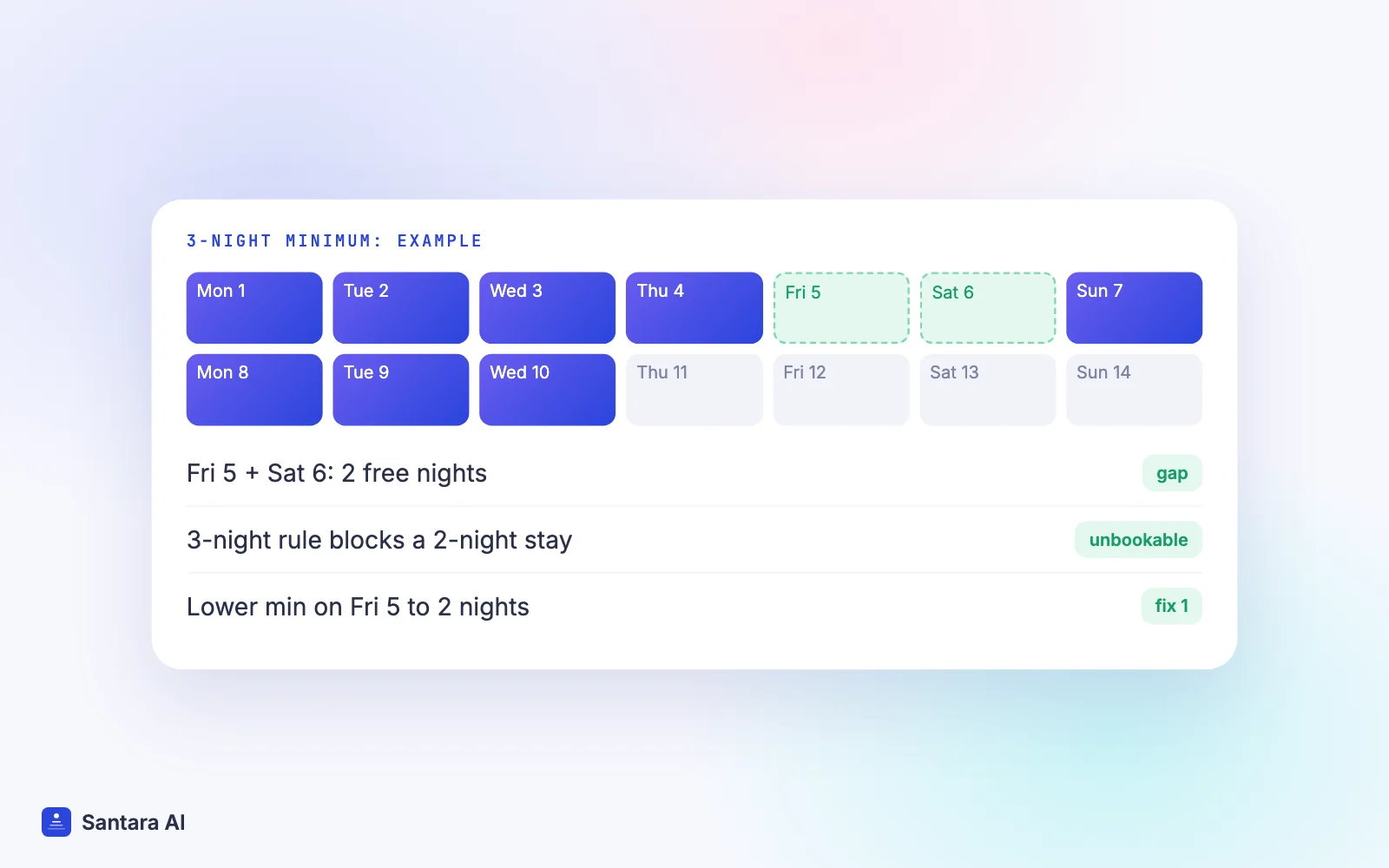
Any guest who wants the weekend has to book Friday to Sunday, a two-night stay. Your three-night rule blocks it on every channel that carries the rule. The villa sits empty on the two nights many guests want most, and both neighbouring bookings were perfectly good ones. No price change helps, because the dates aren't bookable at any price. Only a change to the minimum stay, or an extra night for Guest A or Guest B, can fill them.
The same thing happens with one-night gaps: a Tuesday check-out and a Wednesday arrival under a two-night minimum leaves Tuesday night stranded.
How does each OTA handle minimum stay? (as of November 2026)
Each platform calls the setting something different. This is what their own help pages say.
| Platform | Where you set it | Per-date control | Source |
| Airbnb | Calendar → Availability → minimum and maximum nights | Custom rules by check-in day; custom trip lengths for specific dates; rule-sets in professional tools | Airbnb Help, Resource Center |
| Booking.com | Extranet → Rates & Availability → Calendar (List view for all restrictions) | Minimum and maximum length of stay, length of stay from arrival, exact stay, no arrivals/departures | Partner Hub |
| Agoda | Rates & Availability → Calendar → room type → dates → Advanced tab | Min Stay (arrival date only) and Min Night for Stay Through | Agoda Partner Hub |
Airbnb
Airbnb's help article on minimum and maximum nights has you open the listing calendar, click Availability and update the numbers. It also lets you "create custom rules for each day of the week", for example two nights for a Friday check-in and one night otherwise. The Resource Center adds that "you can create custom trip lengths for specific dates" (Manage your calendar). If you use professional hosting tools, a rule-set can carry its own trip length, and Airbnb says a rule-set will "override any existing minimum-night rules" while it is in effect (How rule-sets work).
Airbnb also flags gaps itself. Its availability guide gives the example of a five-night minimum with four unbooked nights between reservations, where you'll see a tip to lower the minimum for those nights.
Booking.com
Booking.com's restrictions guide lists minimum and maximum length of stay, minimum and maximum length of stay "from arrival" (the nights a guest can stay when arriving on a specific date), exact stay, and no arrivals and departures. You set them in the extranet calendar; List view shows the widest range of restriction options, and Monthly view handles minimum length of stay too. If you have a channel manager, Booking.com says to update restrictions in that system instead. The page doesn't use the term "minimum stay through", so check a sample date in your own extranet to see how a plain minimum is applied across a stay.
Agoda
Agoda's length-of-stay help page is the clearest of the three. "Min Stay" applies only to bookings arriving on that date. "Min Night for Stay Through" applies to any booking that includes the date, but not to bookings checking out on it. If you work with a channel manager, Agoda says to set these rules there, and updates from it "will override any changes" in the Agoda calendar. Agoda's help page doesn't cover arrival or departure closures, so set those in your extranet or channel manager and test a date.
How to fix gap nights, step by step
Step 1
Find the gaps every week
Scan the next 60 days for any run of free nights shorter than your minimum stay. Weekends first, because a stranded Friday and Saturday costs the most.
Step 2
Lower the minimum on the gap's arrival date
In the example above, set a two-night (or one-night) minimum stay on arrival for Friday 5 only. On Airbnb use a custom trip length for those dates; on Booking.com a minimum length of stay from arrival; on Agoda the Min Stay setting. Leave every other date on three nights.
Step 3
Check nothing else blocks it
A closed-to-arrival on Friday, a "through" rule covering Saturday or a check-in day rule will still block the booking. Open the date as a guest would on each channel and try to book two nights.
Step 4
Adjust the price if it still hasn't sold
If the gap is still empty about one to two weeks out, change the rate on those nights. Some hosts discount, some hold the weekend rate because the dates are now bookable. Use your own numbers, and never go below the cost of the turnover.
Step 5
Offer the night to the guest next door
Message the guest checking out before the gap, or the one arriving after it, with a short, priced offer for one more night and a deadline. Our stay extension guide has the wording and the checks.
Gap nights are one of several openings in a calendar; early check-in and late checkout around the same turnovers are covered in the upsells hiding in your calendar.
Which minimum stay should you use in each season?
There is no single right number. Use your own booking history; this table is a starting point for thinking, not a benchmark.
| Season | Minimum stay that usually fits | Where gaps appear | First fix |
| Peak (Tết, Lebaran, Christmas and New Year) | Longer minimums on the core nights, "through" rule on the one night everyone wants | Shoulder nights just before and after the holiday | Lower the minimum on the shoulder arrival dates; keep the core rule |
| Normal season | Two or three nights, maybe higher on Friday check-ins | Single weekday nights between bookings | Lower the minimum on the gap only |
| Low season | One or two nights | Gaps are rare; whole empty weeks are the problem | Relax restrictions broadly, longer-stay discounts |
| Last 7–14 days before any date | Shorter than usual | Any leftover 1–2 night hole | Price change or extension offer |
For holiday dates, read Tết and Lebaran pricing and Christmas and New Year pricing. For quiet months, the low season playbook covers relaxing minimum stays more broadly. For the base rate itself, start with how to price your Airbnb.
Does minimum stay affect search ranking?
Only as the platforms describe it. Neither publishes a ranking formula, but both say restrictions decide who can see you.
- Airbnb says "changing your trip length can open your calendar" and help your listing appear in more search results (Airbnb).
- Booking.com says "the more restrictions you set, the fewer potential guests will see your property" and that they can keep you out of search results when a traveller's dates don't meet your criteria (Partner Hub). It recommends reviewing your settings regularly.
So a high minimum is not a penalty, but it does take you out of searches for shorter dates. That is often what you want on New Year's Eve. It is rarely what you want on a stranded Tuesday.
How Santara AI helps with gap nights
Santara AI gives you one calendar for every connected channel. Rates, availability and minimum stays are set there and pushed to the channels you have mapped, so you lower the minimum for a gap once instead of in three extranets. Santara AI connects 63 channels, including Airbnb, Booking.com and Agoda. The same minimum stay goes to every mapped channel; you can't set a different one for a single channel.
You can also ask Santi, the Santara AI assistant, to do the routine part when you ask it to:
- "List the empty gap nights in the next two months."
- "Set a two-night minimum stay on arrival for Friday 5."
- "Change the price on these four gap nights."
- "Block Saturday 6 for the owner."
Santi works on request: it changes prices or minimum stays only when you ask, never on its own.
FAQ
What is a minimum stay for a vacation rental?
It is the fewest nights a guest can book. You set a default for the listing, and on Airbnb, Booking.com and Agoda you can also set different minimums for specific dates or check-in days.
What is a gap night?
An unsold night, or two, between two bookings that is shorter than your minimum stay. No guest can book it until you lower the minimum for those dates or extend a neighbouring stay.
Should I lower my minimum stay for the whole month to avoid gaps?
Usually not. Lower it only on the gap's arrival date. Keeping the longer minimum elsewhere protects your busy dates from short bookings that create new gaps.
What does closed to arrival mean?
Guests can't check in on that date, but they can stay through it. Booking.com calls it "no arrivals". It helps on days you can't turn the room over, but it also blocks gap fills, so check it before you lower a minimum.
Does a higher minimum stay hurt my ranking on Airbnb?
Airbnb doesn't say it lowers ranking. It says changing your trip length can help your listing appear in more search results, because guests searching shorter stays can't see you otherwise.
Keep reading
- How to price upsells from your real nightly rate
- Calendar-first upsells: why waiting for guests to ask is too late
- Occupancy, ADR and RevPAR explained
Your first 3 months are free.
Join For Free