
Villa management company vs listing it yourself on Airbnb
Airbnb and Booking.com are marketplaces, not managers. What a villa management company does, fee models, a contract checklist and the real DIY workload.
 Tai Pham
Every villa or homestay owner reaches the same fork. You can sign with a villa management company that runs the property for you, or you can list it on Airbnb, Booking.com and Agoda yourself and handle the work with your own staff. Many owners think the platforms already do the managing. They don't. An OTA is a marketplace that sends you guests. It does not clean the pool, meet a guest at midnight or file your tax.
This guide explains the difference between a villa management company and a booking platform, what each one actually does, how management fees are usually structured, what to put in a management contract, how to vet a manager, and what the do-it-yourself route really involves each week. Platform facts come from Airbnb, Booking.com and Agoda's own pages, checked on 27 October 2026 and linked so you can confirm them.
There are no "typical" fee percentages here. No platform or regulator publishes a standard rate for villa management, and quotes vary with what is included. The point is to help you compare offers on the same basis.
A booking platform is a marketplace, not a manager
The most common confusion is between a villa management company and a booking authority such as Airbnb or Booking.com. The platforms say plainly what they are.
- Airbnb. Its Terms of Service say Airbnb "does not own, control, offer or manage any Listings", is not a party to the contracts between hosts and guests, and is not acting as an agent for any member. The same terms make the host responsible for complying with the laws that apply to the listing and for their own tax obligations.
- Booking.com. Its customer terms say Booking.com provides the platform but not the stay itself, that the booking is made directly with the property ("Service Provider"), and that the provider is solely responsible for the travel experience. Booking.com charges a commission per reservation that, by its own partner page, varies by country and property type.
- Agoda. Its partner hub describes owners registering and listing their own property, which Agoda then verifies before it goes live.
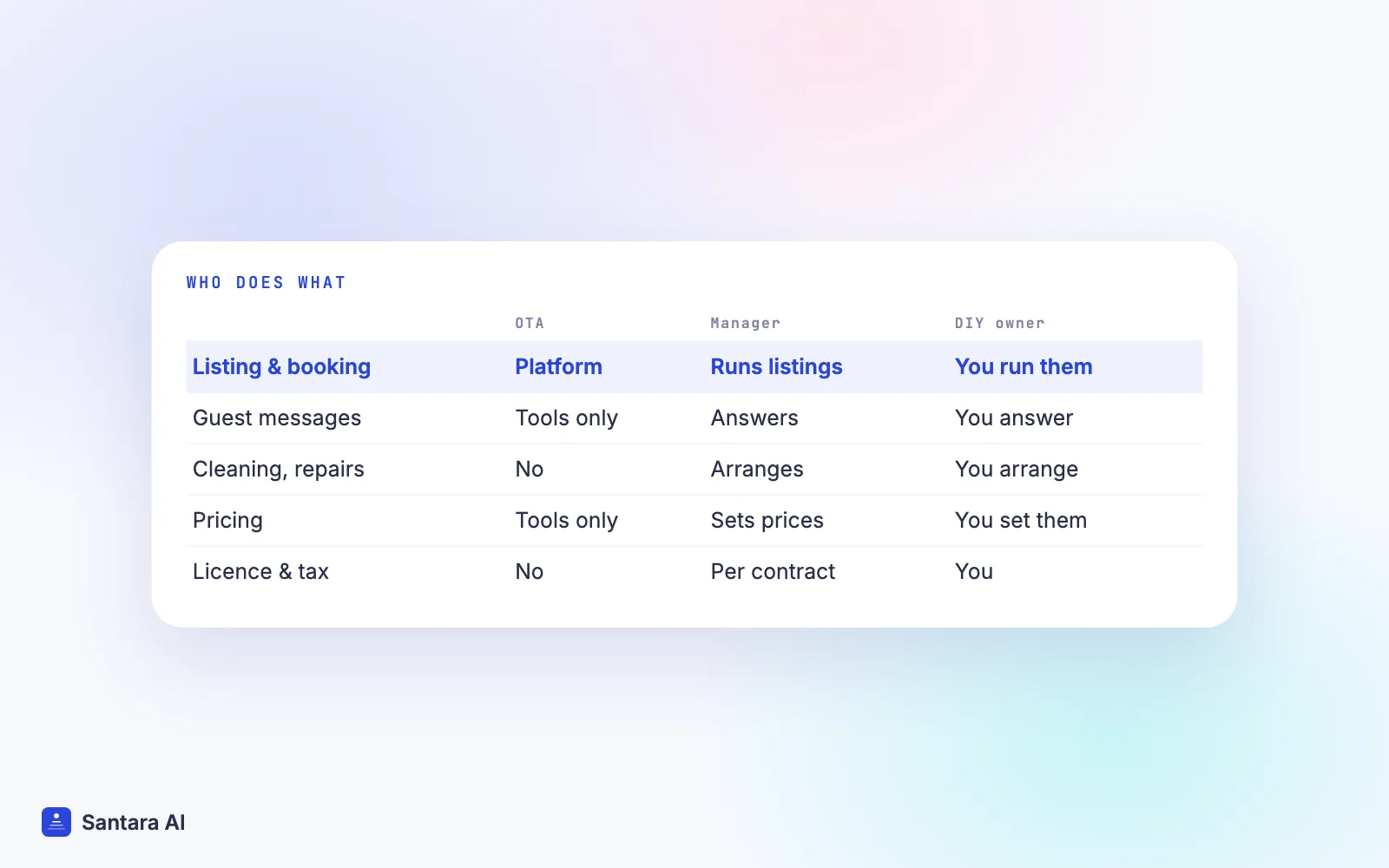
So the platform gives you a listing, search traffic, a booking flow and its own payment rules. Everything that happens between the booking and the review is someone else's job. That someone is either a management company or you.
What a villa management company does
A full-service villa management company acts as the operator. The exact list depends on the contract, but offers usually cover some or all of these:
- Setting up and running the listings on each platform, including photos, descriptions and house rules.
- Pricing and calendar: rates, minimum stays, blocking owner dates.
- Guest messages before and during the stay, check-in and check-out.
- Housekeeping, laundry, pool and garden, and small repairs.
- Paying local suppliers and keeping receipts.
- A monthly owner statement and a transfer of your share.
Some companies also handle licences, guest registration with the authorities and local taxes. Others leave those with you. That single line is where many owner-manager disputes start, so it belongs in writing (more on this in the contract section).
There is also a middle option. Airbnb lets a host add co-hosts with three permission levels: full access, calendar and messaging, or calendar only. Only the listing owner can set up or edit a co-host's payout share. Our Airbnb co-host guide covers this setup in detail.
How management fees are usually structured
Management companies price in a few common ways. We describe them generally because there is no published standard rate.
| Model | How it works | What to ask |
| Percentage of gross revenue | A share of what guests paid | Does "gross" include cleaning fees and taxes? |
| Percentage of net revenue | A share after channel fees, or after fees and expenses | Which costs are deducted before the fee? |
| Fixed monthly fee | A set amount regardless of bookings | When is it reviewed? What happens in a dead month? |
| Fixed plus percentage | A small base plus a share | Are both shown separately on the statement? |
| Extra charges | Set-up, linen, maintenance call-outs, marketing | Is there a written price list? |
The same month can produce very different payouts under each model, which is why the formula must be printed on every statement. Our post on owner statements and management fees works through one villa under three fee models line by line.
Channel commission is a separate cost on top of the management fee. If you want to see what each platform keeps from a booking, read Airbnb vs Booking.com fees for hosts.
The management contract checklist
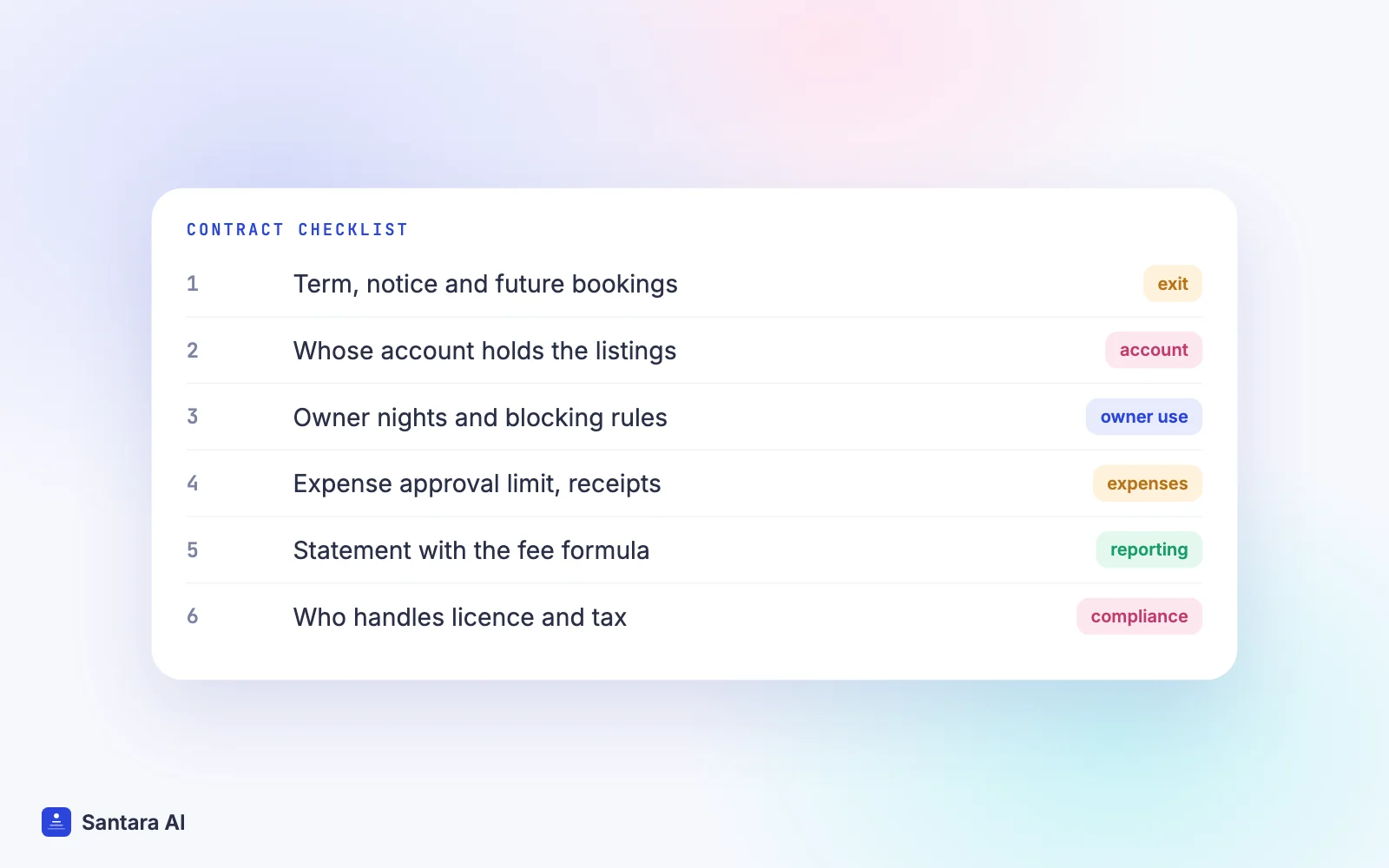
Before you sign with any villa management company, make sure the contract answers each of these questions in plain words.
Step 1
Term and exit
How long is the term, how much notice do you need to give, and what happens to future bookings already on the calendar when you leave? A clear exit clause matters more than a low fee.
Step 2
Whose account holds the listings
If the listings sit on the manager's Airbnb or Booking.com account, the reviews and history usually stay with that account when you part ways. Ask whether listings will be on your account with the manager added as a co-host or team member, or on theirs.
Step 3
Owner use
How many nights can you or your family use the villa, how far ahead must you block them, and are owner stays charged for cleaning?
Step 4
Expenses and approval limits
Which costs are passed through to you, and above what amount must the manager ask before spending? Receipts for every line.
Step 5
Reporting and payout
What the monthly statement shows, which date it arrives, how stays that cross two months are counted, and when your share is transferred.
Step 6
Licences, guest registration and tax
Who holds the business registration, who reports guests to the authorities, and who files and pays tax. Write the name of the responsible party next to each one.
The last point is not a formality. Airbnb's Indonesia host essentials page says all hosts in Indonesia need an NIB before other licences, and that collecting and remitting the regional PBJT tax is the host's responsibility. Airbnb's Vietnam responsible hosting page says hosts must register their business, that hosting income is generally taxable, and that guest information must be reported to local authorities by 11pm (or 8am the next day for late arrivals). Our Bali villa licence guide and Vietnam homestay licence guide list the full steps. A manager can do this work, but the contract has to say so.
How to vet a villa manager
A good pitch is easy to write. These checks are harder to fake.
- Ask for two or three current owner references and call them. Ask how disputes were handled and how fast money arrived.
- Ask for a sample owner statement with real-looking lines: gross by channel, channel fees, each expense, the fee formula, the amount paid. If it is a single total, expect questions every month.
- Check the company is registered. In Vietnam you can search a company by name or tax code on the national business registration portal. In Indonesia, ask to see the company's NIB and check whose NIB is shown on your listings.
- Ask who does the work on site. Their own housekeeping team or subcontractors? Who carries the keys? Our guide to hiring and managing cleaners lists what good housekeeping looks like.
- Ask how they price. Do they review rates weekly? Can they show you the calendar and rates for the next 90 days at any time?
- Read the listings they already run. Recent reviews tell you about cleanliness and communication faster than any brochure.
What doing it yourself really involves
Listing the villa yourself keeps control and removes the management fee, but the work doesn't disappear. It moves to you and your staff.
| Task | How often | Who does it if you DIY |
| Answer guest messages | Every day, including late evenings | You or a trusted staff member |
| Update prices and minimum stays | Weekly, more in peak season | You |
| Keep calendars in step across platforms | Every booking and cancellation | You, or software |
| Turnover cleaning and laundry | Every checkout | Your housekeeping staff |
| Repairs and supplier payments | As needed | You or a caretaker |
| Licences, guest registration, tax | Ongoing, with fixed deadlines | You |
| Monthly accounts | Monthly | You |
Owners who live near the property, already employ a caretaker, and can answer messages quickly often do well with DIY. Owners abroad, with no staff on site, or with several villas, often find the management fee cheaper than their own time. A hybrid also works: you keep the listings and pricing, and a local co-host or caretaker handles check-in and cleaning.
Whichever route you choose, run the numbers first. Our vacation rental profit worksheet shows how to compare a management fee against your own costs.
How Santara AI fits either route
Santara AI replaces both the PMS and the channel manager, so it works for an owner who lists the villa alone and for a manager running villas for owners.
- One calendar across channels. Each room has one calendar. Reservations and cancellations from connected channels such as Airbnb, Booking.com and Agoda update that calendar, and freed dates go back to the other channels.
- One inbox for Airbnb and Booking.com guest messages. AI drafts replies; nothing is sent until you press Send. Agoda messages are not in the inbox.
- Monthly owner statement. Reports record revenue as the net payout and build one statement per property: gross revenue minus channel fees minus expenses. You can add expenses and download a CSV.
- Team roles. You can invite team members with roles to a workspace, so a manager, a caretaker and an owner can work from the same data.
What Santara AI does not do
Santara AI does not calculate a management fee; that line stays in your agreement and your statement. It does not process or hold OTA payouts or charge virtual cards. It does not handle licences, guest registration or tax filing.
FAQ
What is the difference between a villa management company and Airbnb or Booking.com?
Airbnb and Booking.com are marketplaces: they list your villa, take bookings and apply their own payment rules. Their terms say they do not manage the property. A management company is the operator that handles guests, cleaning, repairs, pricing and reporting on your behalf.
How much does a villa management company charge?
There is no published standard. Companies charge a percentage of gross or net revenue, a fixed monthly fee, or a mix, plus possible extra charges. Compare offers by asking each one to calculate the same sample month.
Should I manage my Airbnb myself or hire a manager?
Self-managing suits owners who live nearby, have reliable staff and can answer messages quickly. A manager suits owners abroad or with several properties. A local co-host is a middle option.
What should a villa management contract include?
Term and exit, whose account holds the listings, owner-use nights, expense approval limits, a monthly statement format with the fee formula, payout dates, and who is responsible for licences, guest registration and tax.
Keep reading
- How to list on Airbnb, step by step
- AI co-host vs human co-host
- How to choose villa management software
Your first 3 months are free.
Join For Free