How to get your vacation rental recommended by ChatGPT and AI search
What OpenAI, Google and Microsoft actually say about AI answers: crawler access, consistent facts, reviews, LodgingBusiness schema and llms.txt for vacation rentals.
 Tai Pham
You can't buy or force a ChatGPT recommendation, and no AI assistant publishes a ranking formula for places to stay. What you can do is make your rental easy to find and easy to trust: let the search crawlers read your website, keep the same facts on your website, your OTA listings and any Google profile, earn real reviews, and state the basics (location, beds, price, rules) in plain text. That is also what OpenAI, Google and Microsoft say on their own pages.
More guests now ask an assistant "where should we stay in Canggu with two kids and a pool?" instead of typing keywords into a search box. Nobody can promise vacation rental ChatGPT recommendations, and anyone selling a "secret prompt" or a guaranteed placement is guessing. This guide sticks to what the platforms have published, checked on 2 November 2026, and links each source so you can confirm it.
One line on scope: this post is about AI answers. For classic Google SEO on your own site (one page per property, titles, area guides), read our SEO guide for vacation rental websites.
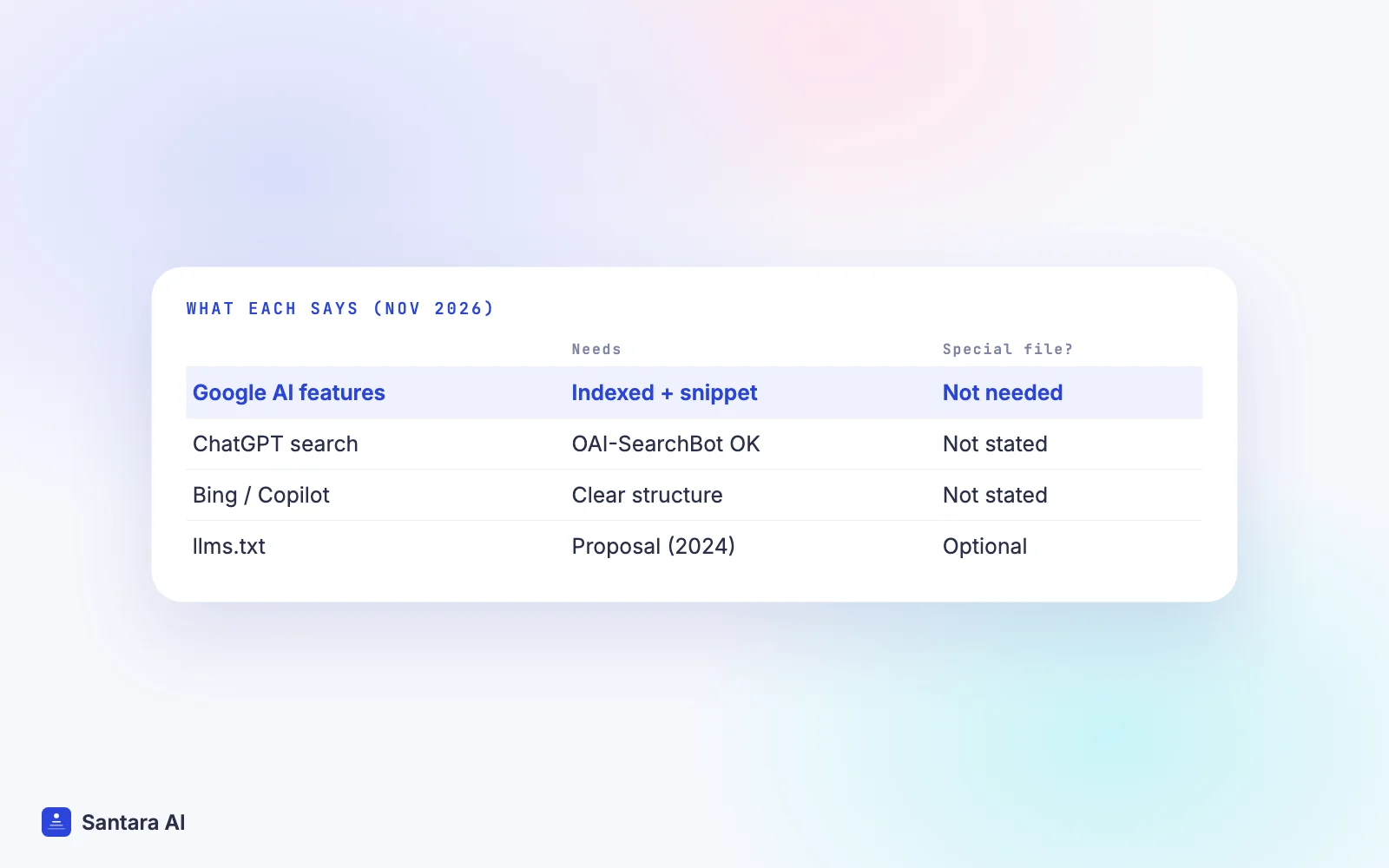
What the platforms actually say (as of November 2026)
| Platform | What it says it needs | Special AI file or markup? |
| Google AI Overviews and AI Mode | The page must be indexed and eligible to show with a snippet | "No additional requirements"; no AI text files or special schema needed (Google) |
| ChatGPT search | Allow OAI-SearchBot to crawl, and let OpenAI's published IP ranges through your host or CDN | Not mentioned; "Placement is not guaranteed" (OpenAI Help) |
| Microsoft Bing / Copilot | Fresh, structured, clear HTML; key facts not hidden in tabs, PDFs or images | Schema in JSON-LD helps label content (Microsoft) |
The pattern is clear. None of them asks for a trick. They ask for pages a crawler can reach and read, with facts stated plainly.
How does ChatGPT find places to stay?
OpenAI's help page explains that ChatGPT search "sometimes partners with other search providers". It rewrites the question into shorter search queries, and it can use an approximate location from the user's IP address, so "good villas near me" may become a query with a city name. For local answers it may also use "trusted third-party providers" for things like nearby business listings. The page links Microsoft's privacy statement for search providers, but it does not publish a list of sources or a ranking formula. It says only that results are ranked "using multiple factors" (Searching the web with ChatGPT).
What OpenAI does state clearly is the crawler rule. Its crawler documentation lists three agents:
- OAI-SearchBot shows websites in ChatGPT search. Sites that block it "will not be shown in ChatGPT search answers", though they can still appear as plain navigation links.
- GPTBot collects content that may be used to train models. Blocking it is a separate choice and does not remove you from search.
- ChatGPT-User visits a page when a user asks ChatGPT to open it. OpenAI says it is not used to decide what appears in search.
OpenAI adds that robots.txt changes take about 24 hours to apply. So the first practical check is simple: open yoursite.com/robots.txt and make sure it does not block OAI-SearchBot (or everything).
How do Google's AI Overviews choose sources?
Google's page on AI features and your website is unusually direct. To be a supporting link in AI Overviews or AI Mode, a page must be indexed and eligible to show a snippet, and "there are no additional technical requirements". Google says you don't need "new machine readable files, AI text files, or markup", and there is "no special schema.org structured data that you need to add".
Its advice for AI features is the normal SEO list: allow crawling, link important pages internally, put important content in text, use good images, keep structured data consistent with what the page shows, and keep your Business Profile information current. AI traffic shows up in Search Console's Performance report under "Web", so you can measure it with the tool you already use.
Is your rental on the places AI assistants read?
An assistant can only repeat what is public. For most rentals, that public footprint is your OTA listings, your direct booking site and, if you qualify, a Google Business Profile.
- OTA listings. Airbnb, Booking.com and Agoda pages are public and often well known to search engines. Keep the description accurate and complete; our guide to how Airbnb search ranking works covers the Airbnb side.
- Google Business Profile. Check eligibility first. Google's eligibility guidelines list "rental or for-sale properties such as vacation homes" as ineligible, and require that a business "make in-person contact with customers during its stated hours". A guesthouse with a staffed reception may qualify; a single villa with a lockbox usually won't. Don't create a profile you'll lose.
- Google Vacation Rentals. Rental listings in Google's travel results come from partners who onboard with Google or work through an approved integration partner, not from markup on your site. One line here; the details are in our Google Vacation Rentals guide.
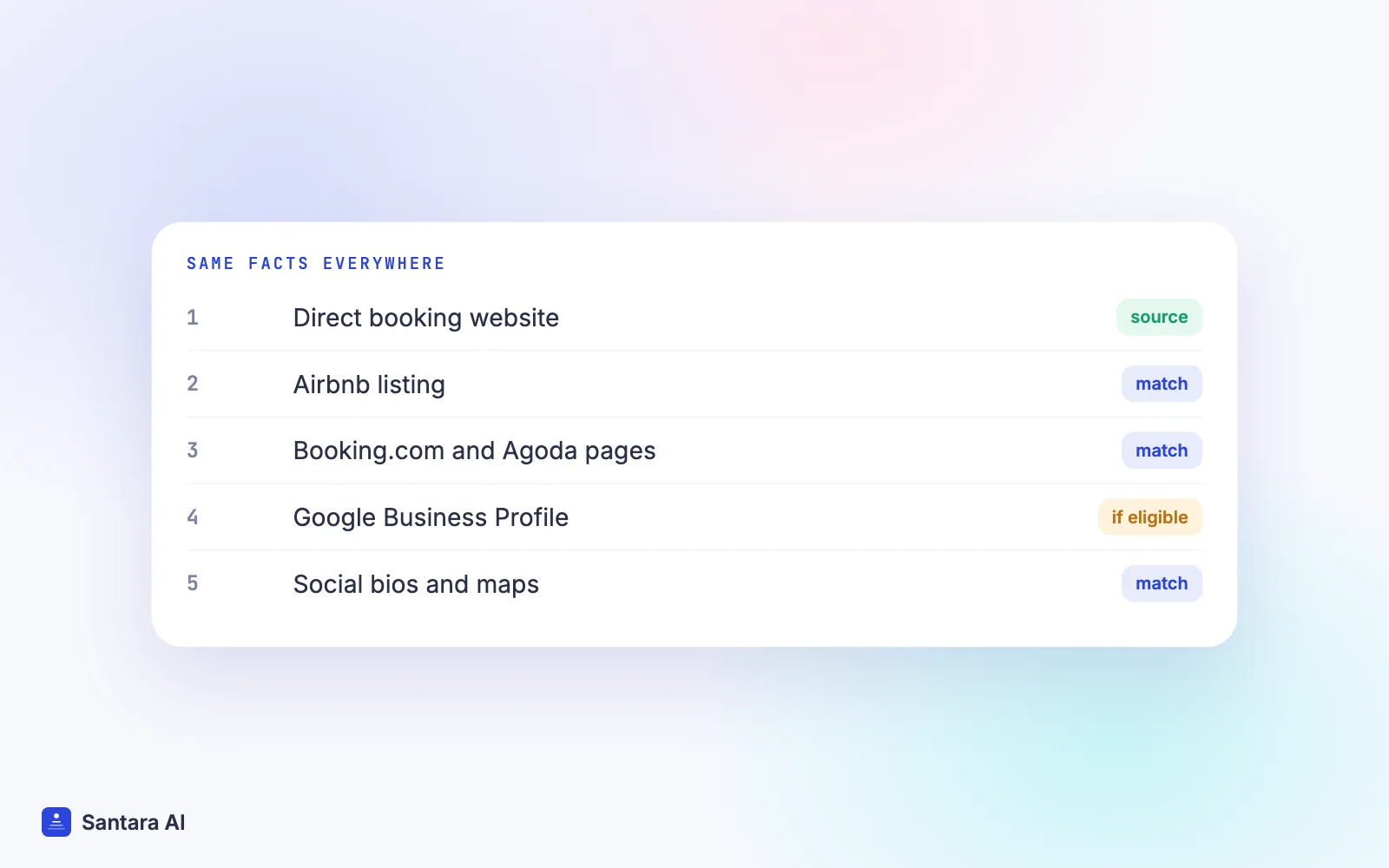
Keep your name, address and facts identical everywhere
When an assistant combines several sources, contradictions hurt you. If your site says "4 bedrooms, sleeps 8", Airbnb says "3 bedrooms" and Booking.com uses an old name, the assistant has to choose, and the guest may not trust any of it.
Step 1
Pick one official name
Use the same property name on your website, every OTA, your Google profile if you have one, and your social bios. Google's Business Profile rules also ask for your "real-world name".
Step 2
Fix the address and area
Write the same address and the same area name (for example "Pererenan, Canggu") everywhere. Add a short "how to get here" paragraph on your site.
Step 3
Match the numbers
Bedrooms, beds, bathrooms, maximum guests, check-in and check-out times. Audit them once a quarter on every channel.
Step 4
State the rules in text
Pets, children, parties, parking, stairs, airport transfer. Microsoft warns that facts hidden in tabs, PDFs or images may be missed, so put them in plain HTML text.
Do reviews matter for AI recommendations?
None of the three platforms publishes reviews as a ranking factor for AI answers, so we won't claim one. What is clear is that reviews are public text about your stay, on pages assistants can read, and they are what a guest checks after an assistant names you. Answer reviews calmly and factually; our guide on how to respond to a bad review has templates. Never copy OTA review scores onto your site as if they were your own: Google's review snippet guidelines say "Don't aggregate reviews or ratings from other websites."
Structured data: LodgingBusiness and VacationRental
Structured data is a label in your page's code that says "this is a place to stay, here is its name, photos and capacity". Schema.org defines VacationRental as "a kind of lodging business that focuses on renting single properties", a subtype of LodgingBusiness.
Two honest caveats. First, Google says no special schema is needed for AI features, so markup is a helpful label, not a ranking switch. Second, Google's own vacation rental structured data feature is "intended for sites that have already connected with a Google Technical Account Manager" and have Hotel Center access. Most independent hosts are not in that program, so adding the markup alone will not produce that rich result. Whatever you mark up must match what the page shows.
What about llms.txt?
llms.txt is a proposal from 2024 for a Markdown file at your site's root that points AI tools to your key pages. It is an emerging convention, not a standard. Google says outright that you don't need "AI text files" for its AI features, and OpenAI's help page doesn't mention llms.txt. It costs little to add one if your site allows it, but don't expect it to change rankings.
A fast direct site with clear facts
If an assistant links to your own site, the page it lands on has to answer the guest's next question and take the booking. That means a fast page, real photos, a clear price, and dates that are actually available. Our direct booking website guide explains how a direct site fits next to the OTAs.
How Santara AI fits in
Santara AI includes a direct booking site in every plan. It sells from the same calendar as your channels, so a direct booking closes the dates on Airbnb, Booking.com and the other connected channels. You can run it on a Santara AI subdomain or connect a domain you own.
Here is what the booking site does for search and AI crawlers, as checked in our code on 2 November 2026:
- robots.txt: a published site allows all crawlers (it does not block OAI-SearchBot, GPTBot or Googlebot) and points them to its sitemap. An unpublished site blocks crawlers.
- Sitemap: lists the home page, every property and room page, and every page or post you publish, leaving out pages you mark noindex.
- Structured data: a LodgingBusiness label for the site (name, description, image, contact email and phone), a VacationRental label on each property and room page (name, description, up to eight photos, bedrooms, maximum guests, city and country, starting price and currency), and article and breadcrumb labels on blog posts.
What it does not do
It does not create an llms.txt file, it is not Google's Technical Account Manager vacation rental feed, and it cannot get you a Google Business Profile or guarantee any AI recommendation. The facts it publishes come from what you enter, so keep them accurate.
FAQ
Can I pay to be recommended by ChatGPT?
OpenAI's help page doesn't describe any paid placement in ChatGPT search results. It says placement is not guaranteed and that sites must allow OAI-SearchBot to be eligible.
Does blocking GPTBot remove my villa from ChatGPT?
No. OpenAI treats GPTBot (model training) and OAI-SearchBot (search) separately. Blocking OAI-SearchBot is what keeps your site out of ChatGPT search answers.
Do I need special schema to appear in Google AI Overviews?
No. Google says there is no special schema.org structured data you need to add. Your page must be indexed and eligible to show a snippet.
Can a vacation rental have a Google Business Profile?
Google lists vacation homes as ineligible. A business that meets customers in person during stated hours, such as a staffed reception or leasing office, can be eligible.
Should I add an llms.txt file?
It's optional. llms.txt is a 2024 proposal, not a standard, and Google says AI text files aren't needed for its AI features.
Keep reading
- Launch a direct booking site in 30 days
- Is booking direct safe? How to earn guest trust
- Direct booking site for international guests
Your first 3 months are free.
Join For Free